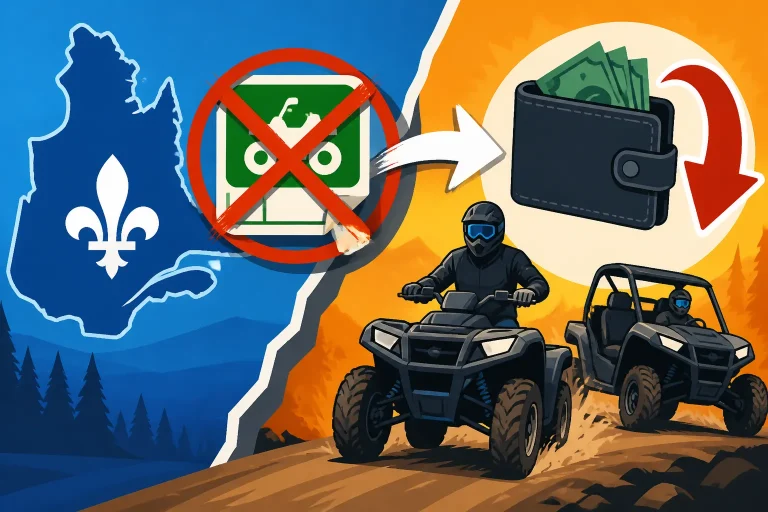
Quebec Ended Reciprocity With Ontario
An Ontario trail permit used to make some Quebec rides simpler. That arrangement has ended, leaving riders unsure whether their existing pass, registration and insurance still cover the trip. The key distinction is that reciprocity concerned trail access, not every legal requirement for a machine. Here’s what changed, what Ontario riders now need, and how to avoid arriving at a Quebec trail with the wrong paperwork.
What Quebec ended with Ontario
Quebec and Ontario no longer have a reciprocal arrangement that lets an Ontario trail pass stand in for a Quebec trail pass on Quebec’s federated ATV network. The change took effect in 2023. If you ride a Quebec federated trail, plan to meet Quebec’s trail-pass requirements even if your machine and Ontario pass are both in good standing at home.
That change is easy to misunderstand because riders use the word “permit” for several different things. A trail pass is not the same as vehicle registration, insurance, a driver’s licence or a safety certificate. Reciprocity between trail systems does not automatically carry over to those other requirements, and the end of trail-pass reciprocity does not, by itself, mean that an Ontario machine must be registered in Quebec simply because it is visiting.
The practical rule is narrower:
- An Ontario trail pass does not replace the Quebec trail pass required for Quebec federated trails.
- A Quebec trail pass does not automatically give you access to Ontario trails. Follow Ontario’s requirements when riding there.
- Registration, insurance, rider qualifications and local access rules remain separate questions.
- A pass does not authorize riding on a closed trail, private property without permission or land where ATV access is otherwise prohibited.
This applies whether you cross the provincial boundary for a weekend, bring a machine for a longer tour or ride only a short part of a Quebec route. The border does not change what kind of trail you are on. If you enter a federated trail in Quebec, you need to follow the rules that apply there.
The change is about trail access, not the ability to travel between provinces. Ontario visitors can still ride in Quebec when they arrange the required pass and meet the other applicable rules. The useful mindset is not “my Ontario documents should carry over,” but “which rules apply to this specific ride, in this province, on this trail?”
For the visitor-specific overview, see Quebec Visitors From Ontario. If you want the short version of the pass requirement itself, Quebec Visitors Must Buy a Quebec Pass is also useful.
What reciprocity used to mean
Before the arrangement ended, a rider’s Ontario trail pass could be recognized for certain Quebec trail riding under the reciprocal system. Riders did not have to treat every cross-border ride as a completely separate trail-pass purchase. That arrangement made travel easier, but it did not mean Ontario and Quebec had one shared trail system or one universal set of rules.
Reciprocity was limited to the agreement between the organizations and trail networks involved. It did not erase provincial requirements for registration, insurance, rider conduct, safety equipment or access to a particular property. It also did not guarantee that every route was open or that every local club had identical conditions.
Once the agreement ended, the old shortcut no longer applied. An Ontario sticker, card or proof of purchase may still show that you have an Ontario pass, but it is not evidence that you have met Quebec’s pass requirement.
What changed for an Ontario rider
For practical planning, assume you need a Quebec pass before using Quebec’s federated trails. Choose the pass type that fits your trip and machine, then check the current purchasing and proof requirements through the official Quebec trail-pass channel before leaving.
Do not wait until you reach a trailhead to sort it out. A pass may involve online ordering, a sticker or other proof, and a specific validity period. The details can change, and a purchase confirmation may not be treated the same as the required proof in every circumstance. Check what must be displayed or carried, and leave enough time to get it ready.
If you plan to ride only private property, a private route or land outside the federated network, the trail-pass question may be different. That does not mean you can assume access. The landowner, operator, municipality or other responsible authority sets the access conditions for that place. A Quebec trail pass is not permission to ride everywhere.
A Quebec trail pass is only one part of the trip
The most reliable way to avoid paperwork confusion is to separate the requirements by purpose. The trail pass deals with access to the federated trail network. Registration identifies the machine for legal use under the applicable vehicle rules. Insurance addresses liability and other coverage under the policy. A driver’s licence and any required training relate to the person operating the machine.
An Ontario rider may have all of those documents at home and still need to confirm that each one is suitable for the Quebec ride. Conversely, buying a Quebec trail pass does not fix a registration, insurance or rider-qualification problem.
| Item | What it generally addresses | What the Ontario rider should check |
|---|---|---|
| Quebec trail pass | Access to Quebec federated trails under the pass rules | Whether the pass type fits the trip and machine, and what proof must be carried or displayed |
| Vehicle registration | The machine’s legal registration status | Whether the Ontario registration and documents are valid for the planned visit |
| Liability insurance | Financial protection for liability covered by the policy | Whether coverage applies to the machine and the intended use in Quebec |
| Driver’s licence | Authorization to operate under applicable rules | Whether the rider meets Quebec’s requirements for the machine and riding location |
| Training or safety certificate | Required qualifications for some riders or situations | Whether age, training and certificate rules apply to this rider |
| Trail or land permission | Permission to use a specific route or property | Whether the trail is open and whether separate permission is needed |
Registration is not a trail pass
Registration is often the first thing people think of when crossing a provincial border. It matters, but it is not what the ended reciprocity agreement was about. A trail pass is for access to a particular trail network; vehicle registration is a separate legal status for the machine.
Do not infer from the end of the pass agreement that an Ontario-registered ATV must automatically be re-registered in Quebec for a visit. Equally, do not infer that an Ontario registration sticker gives you the right to use Quebec trails. Keep the questions separate and confirm the requirements that apply to a visiting machine.
If you have recently moved to Quebec rather than visiting temporarily, that is a different situation. A move can trigger registration and other administrative questions that a short trip does not. The comparison at Quebec Registration Compared to Ontario can help you identify the distinction. For Quebec residents, the registration process itself is covered in How to Register an ATV in Quebec.
Insurance does not travel by assumption
A valid Ontario policy may provide coverage during a Quebec trip, but the answer depends on the actual policy, vehicle and intended use. A trail pass does not create insurance, and the end of reciprocity does not tell you what your insurer will cover.
Before riding, contact your insurer if the policy language or your planned use is unclear. Ask whether the machine is covered while operating on Quebec trails, whether there are limits or exclusions, and what evidence of insurance you should carry. A policy designed for road use, farm use or storage may not respond as you expect on a recreational trail.
Keep proof accessible in the form accepted for the trip. A phone image can be useful as a backup, but do not assume it replaces whatever proof the rules or policy require. More on the practical side is in [Quebec Insurance Proof on the Trail] and Carrying an Insurance Certificate on Every Ride.
Rider rules still apply
A trail pass is not a rider qualification. Age, licence, training, helmet and passenger rules are separate. An Ontario rider should not assume that a rule familiar at home applies unchanged in Quebec, particularly when riding with a young person or carrying a passenger.
Check the rules for each rider and each machine. A side-by-side may have different age or passenger requirements from a quad, and a youth rider may face conditions that do not apply to an adult. If a teen is joining the trip, review Quebec Training Certificates for Teen Riders and the applicable age requirements before planning the route.
Choosing the right Quebec pass for your trip
The right pass depends mainly on how long you plan to ride and how the current Quebec pass system defines its options. Visitors commonly compare an annual pass, a seasonal option and shorter-duration passes. The names, dates, availability and conditions are provider-specific, so check the current official information rather than relying on an old sticker or a friend’s past purchase.
A pass choice should match the trip, not just the number of days you expect to be on the machine. A short visit may still involve several trail days, while a longer stay might make a broader-validity pass more practical. Consider the dates, the number of machines, the route and whether you may return later in the season.
A practical way to compare options
| Trip pattern | What to consider |
|---|---|
| One day on Quebec trails | Check whether a single-day option is available for your planned date and how its validity is defined |
| A short weekend or multi-day visit | Compare the short-term option with the dates you will actually ride, including travel delays |
| Several visits in one season | Compare the broader seasonal or annual option with the expected number of trips |
| A long tour across multiple regions | Confirm the pass is accepted across the federated network and check closures and route conditions separately |
| More than one machine | Confirm whether each machine needs its own pass and how each pass must be displayed |
| Riding with a rental machine | Ask the rental operator which pass arrangements apply; do not assume your own pass is needed or that one is included |
The table is a planning tool, not a substitute for the current pass terms. The provider sets validity dates, eligibility and proof requirements. If your trip straddles a changeover date, or you are riding in a shoulder season, verify the exact dates before buying.
For a broader comparison of longer-validity options, see Quebec Annual Pass vs Summer Pass. If you are planning a brief visit, [Quebec Trail Pass for a Three-Day Trip] and Quebec Trail Pass for One Day address the shorter-trip questions.
Buy for each machine, not just each group
A common planning mistake is to think of a trail pass as a group booking. A group may travel together, but each machine must meet the applicable pass requirements. If two Ontario quads are going, check the rules for both machines rather than assuming one pass or one receipt covers the group.
This matters especially when a family brings several machines, friends combine vehicles in a trailer, or one rider changes machines during the trip. Confirm how the pass is associated with the machine and where it must be placed. If the sticker is damaged, hidden or attached to the wrong vehicle, a valid purchase may be harder to demonstrate during a check.
For a rented machine, ask the operator before buying a pass yourself. Some rental arrangements may include the trail access needed for the rental; others may have different conditions. Get a clear answer about what is included, which machine it applies to and what proof you should carry. Do not assume that a pass on your personally owned quad covers a rental side-by-side as well.
Check the current purchase and proof process
Pass systems can change their online ordering process, display requirements or acceptable proof. Before the trip:
- Confirm the pass options and validity dates through the official Quebec source.
- Check whether the pass is tied to a particular machine or registration.
- Find out whether a sticker, receipt, confirmation or another form of proof is required.
- Note where a sticker must be placed so it can be seen during a patrol.
- Save the purchase confirmation and any related instructions.
- If the pass is delayed or cannot be displayed as directed, contact the pass provider before riding.
A screenshot of a payment confirmation is good travel housekeeping, but it is not wise to assume that it substitutes for the required trail proof. Follow the current instructions rather than relying on what was accepted on a previous trip.
For details about what patrols may ask to see, consult Quebec Trail Pass Proof on the Trail. The buying process is covered separately in How to Buy a Quebec Trail Pass.
Planning a cross-border ride without surprises
A successful Ontario-to-Quebec ride involves more than buying the pass. Plan the route, confirm access and closures, and make sure your paperwork is organized before the trailer is loaded. Many problems happen because a rider assumes that the route is open, a pass is transferable or a document can be found later on a phone with poor signal.
Start with the trail, not the map line
A route shown on an online map is not automatically an open, authorized trail. Quebec’s federated trails are maintained and managed through a network of clubs and may be affected by seasonal closures, weather, maintenance, local restrictions or changes in land access.
Check the current trail status shortly before leaving and again if conditions change during a trip. Use the current trail information for the region, and have a backup route or a place to stop if a segment is closed. A trail pass cannot override a closure or create permission on a route that is not open to the public.
The same caution applies to connecting roads and paths. A GPS route may suggest a short link that is not legal or accessible to an ATV. Confirm that each connection is authorized for your machine. If you plan to leave the federated network for a private trail, camp road or business property, ask who controls access and whether you need permission.
Keep documents organized
Before departure, gather the documents that relate to the machine, rider and trail access. Carry them in a way that keeps them dry and accessible, and make a secure backup where practical. A waterproof document pouch can help protect paper on a wet ride. If you buy one through Amazon or another retailer, check that it closes securely and fits the documents without blocking access when you need them.
A phone can be useful for maps, pass confirmations and emergency contacts, but it is a poor single point of failure. Battery loss, water, impact or weak reception can make a digital copy unavailable when you need it. A power bank bought on Amazon may help on a long day, but it does not replace any required physical document or visible pass.
Likewise, a phone mount from Amazon can make navigation easier if it is secure and suited to your machine, but a mounted phone should not distract the driver. Set the route before moving, stop safely to make changes, and do not rely on a device alone for trail conditions. Keep offline information or a paper backup for remote sections.
At minimum, know where to find:
- Proof of the Quebec trail pass for each machine.
- Registration documents for the machine.
- Insurance information and an insurer contact.
- The rider’s licence and any required certificate.
- Emergency contacts and the planned route.
- Current trail information and a backup plan.
Do not leave original documents loose in a storage box where they can become wet or difficult to retrieve. Use a consistent location for each machine, and tell the other riders where the paperwork is kept.
Allow time at the border and on arrival
A provincial border does not necessarily mean a formal stop for every ATV trip, but the trip still has practical crossing and transport details. If you are trailering, check that the trailer, load and towing setup are ready for the full drive. If you are riding near a border crossing or moving between trail systems, plan the legal route rather than assuming that any roadside connection can be used.
On arrival, take a moment to confirm the pass is properly displayed, the group has the documents it needs and the intended trail remains open. This quick check is much easier in a parking area than after a patrol has stopped the group or a closed route has forced a long detour.
If one rider has not completed the purchase or a sticker has not arrived, do not assume the group can proceed and sort it out later. Contact the provider and follow its instructions. If the requirement is not met, choose a legal alternative until it is.
What to do if you are stopped on a Quebec trail
A patrol check is usually straightforward when the pass and other documents are ready. The important thing is to respond calmly, follow the patrol’s directions and provide the requested proof. Do not argue that an Ontario pass should count because it did in the past; the reciprocal arrangement has ended.
The exact authority and procedure can depend on the trail and the circumstances. A patrol may ask for trail-pass proof and may also check other requirements relevant to the ride. Keep your documents accessible, answer clearly and ask politely if you do not understand what is being requested.
If you have the Ontario pass but no Quebec pass
Having an Ontario pass does not solve the Quebec requirement on a Quebec federated trail. If you realize the problem before riding, stop and arrange the correct Quebec pass before entering the network. If you discover it after entering, do not continue farther on the assumption that the Ontario pass will be accepted. Follow the patrol’s instructions and resolve the issue through the proper channel.
A purchase made after a check may not erase a violation that has already occurred. Do not treat a pass purchase as a way to retroactively legalize trail use. If you receive a ticket or other formal notice, read it carefully, note any response deadline and use the stated process if you intend to challenge it.
If your pass proof is missing or unclear
A pass can be valid yet difficult to verify if it is not displayed as required, the sticker is obscured or the confirmation is inaccessible. Take a clear photo of the pass placement before the trip, but keep the actual required proof in the approved form. If a sticker is lost, damaged or not delivered, contact the provider for the replacement or correction process before riding.
If your phone has no signal, that is not a reason to assume the patrol can accept a document later. Download or save what you need before leaving coverage, and keep any required physical item with the machine. For more on the distinction between proof on a device and proof that must be carried, read Does a Phone Photo Count as Proof on Trail?.
If registration or insurance is questioned
The pass and machine documents are different, so keep them separate and do not assume one answers a question about the other. If a patrol or authority raises a concern about registration or insurance, provide the relevant document and avoid making guesses about what the policy covers. If there is a genuine dispute, record the details and contact the appropriate authority or insurer afterward.
If you are unsure about the requirements before the trip, ask the relevant provider in advance. A trail association can explain pass conditions; the registration authority can clarify vehicle registration; and your insurer can interpret the coverage in your policy. One organization cannot reliably answer for all the others.
Common Ontario-to-Quebec mistakes to avoid
The most common error is continuing to use old information. A rider may have crossed into Quebec under the previous arrangement and assume that the same sticker still works. It does not. A friend’s old advice, an outdated forum post or a pass kept from a previous season is not enough; verify the current requirements for the trip.
Other avoidable mistakes include:
- Treating the trail pass as registration. They serve different purposes.
- Treating registration as trail permission. An Ontario registration does not replace the Quebec pass requirement.
- Assuming insurance is included in the pass. Check the pass terms and your own policy separately.
- Buying one pass for a group. Confirm the requirements for every machine.
- Assuming a pass transfers between machines. Check how it is associated and displayed.
- Relying on an old sticker or receipt. Confirm current validity and proof rules.
- Riding before a pass is properly in place. Resolve missing or delayed proof before entering the trail.
- Assuming all Quebec routes are federated trails. Private property and other routes can have separate access conditions.
- Assuming a pass means the route is open. Check closures and trail status.
- Assuming the rules are identical in both provinces. Review Quebec requirements for riders, passengers, equipment and road crossings.
Visitors sometimes ask whether the loss of reciprocity means Quebec has banned Ontario riders or that every Ontario visitor must get a Quebec vehicle registration. Neither conclusion follows from the pass change alone. Ontario riders can still plan a Quebec trail trip; they need to meet Quebec’s current trail-pass requirement and separately confirm the rules that apply to the machine and rider.
Another frequent question is whether the Ontario pass remains useful at home. It may still serve its purpose under Ontario’s own system, but it is not a Quebec pass. Keep using the pass according to its home-province terms and buy or arrange the appropriate Quebec pass for Quebec trail riding.
A third question is whether a Quebec pass gives an Ontario rider access to every trail in the province. No. A trail pass does not turn private roads, closed corridors or non-federated routes into public ATV trails. Check access for the specific route, and respect signs, gates and landowner restrictions.
A simple pre-ride checklist for Ontario visitors
Use this checklist a few days before the trip, then repeat the key checks at the trailhead. The goal is to avoid trying to interpret rules while standing beside a loaded trailer.
- Identify where you will ride. Confirm whether the route uses Quebec federated trails, private land or another network.
- Check current trail status. Look for closures, maintenance notices, seasonal restrictions and detours.
- Arrange the Quebec pass. Choose the current option that fits the dates and the machines.
- Confirm pass proof. Find out what must be displayed or carried, and make sure every machine is covered.
- Check registration. Carry the machine’s valid registration documents and confirm any visitor-specific requirements.
- Check insurance. Ask the insurer whether the policy covers the planned Quebec trail use and what proof to bring.
- Check every rider. Confirm licence, age, training, helmet and passenger requirements for Quebec.
- Prepare backups. Save route information and confirmations offline, and protect important papers from water.
- Tell the group the plan. Share the route, meeting points, emergency contacts and the location of paperwork.
- Recheck before riding. Make sure the pass is visible, the trail is open and the group has what it needs.
If the trip is only a day or two, paperwork can feel like more effort than the riding itself. It is still worth sorting out before departure. A pass issue can prevent a ride altogether, while a route closure or missing insurance document can turn a simple weekend into a stressful one.
The core takeaway is straightforward: Ontario and Quebec no longer share trail-pass reciprocity. An Ontario pass does not replace the Quebec pass for Quebec federated trails. Treat the pass as one item in a broader checklist, verify the current terms, and keep registration, insurance and rider rules in their own lanes. With those pieces settled, you can focus on the route rather than trying to resolve paperwork at the trailhead.
Disclaimer
This article is for general informational purposes only and does not constitute professional advice. Laws, prices and regulations vary by location and change over time. Consult a qualified professional for guidance on your specific situation.