Passing Safely on a Blind Corner
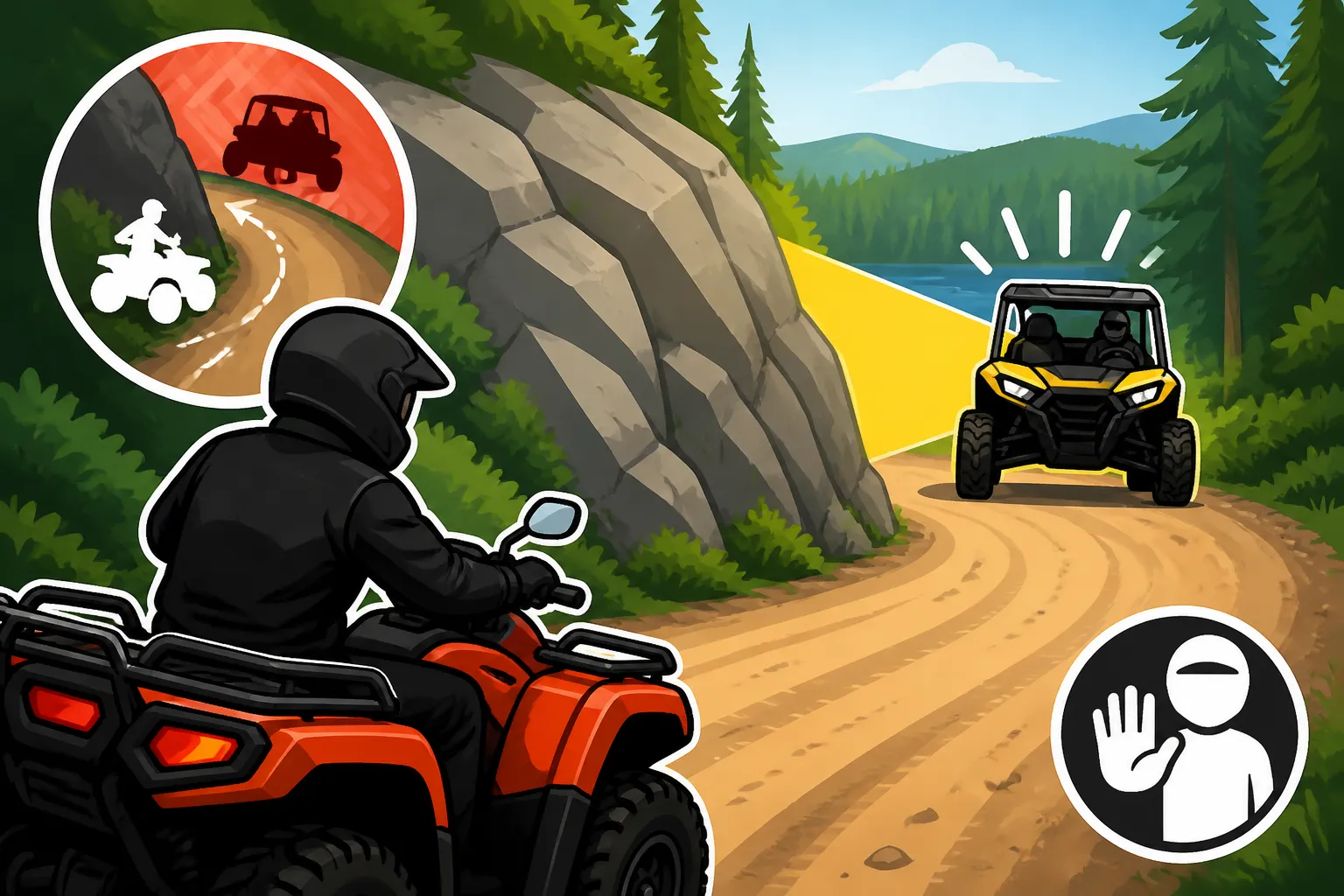
A blind corner on a Quebec ATV or UTV trail can hide another rider, a groomer, a fallen branch, or a sudden change in surface. The safest approach is simple: slow down before you lose sight of the trail, stay in your lane, and never try to pass where you cannot see a clear path ahead. This guide explains how to handle the bend and what to do when riders meet.
Why blind corners are especially risky on Quebec trails
A narrow trail leaves little room for error
Many ATV routes follow forest roads, former rail corridors, and narrow trails where the usable riding surface changes from one stretch to the next. A corner that looks wide from a distance may tighten, dip, or become rutted as you reach it. In a UTV, the machine’s greater width can leave even less room for another vehicle to pass safely.
Visibility can be limited by trees, brush, banks of snow, or the shape of the terrain. On a shared winter corridor, a bend may also conceal snowmobiles or trail-maintenance equipment. You may hear an approaching machine before you see it, but sound alone does not tell you how close it is or which line it will take.
Local trail manners help, but they do not replace careful riding. Before heading out, review Quebec Trail Etiquette Locals Expect and remember that conditions can vary significantly between regions and individual trail sections.
Trail conditions can change the corner
A dry bend can turn slippery after rain. Loose gravel, mud, wet leaves, washboard, or a patch of ice can affect steering and braking just when you need both to be predictable. In spring, thaw conditions can make some trails soft or lead to closures, so check Quebec Trail Conditions Before You Go rather than assuming yesterday’s route is still suitable.
A corner can also become harder to read when dust hangs in the air or snowbanks block your view. If you cannot see what is beyond the bend, treat the space past your sightline as occupied. It might be another rider—or a hazard you would have no time to avoid if you entered quickly.
Passing is different from meeting another rider
A meeting happens when two riders approach each other from opposite directions. Passing happens when one rider tries to move around another travelling in the same direction. Both require room and visibility, but passing asks the rider to use space that may be occupied by oncoming traffic or hidden obstacles.
A blind corner is not a safe place to pass. Even if the rider ahead is moving slowly, you cannot confirm that the trail beyond them is clear. Wait until you reach a straight, open section with enough room, a visible route ahead, and a safe place for the other rider to remain on the trail.
How to approach a blind corner safely
Slow down before your view disappears
Reduce speed while you still have room to brake in a controlled way. Waiting until you are already in the bend can make a sudden stop or sharp steering correction more likely. The right speed depends on the surface, your machine, visibility, and how much room you have to react. If you cannot stop within the visible clear stretch, slow down more.
Keep your hands and feet ready for normal control inputs, and avoid sudden acceleration or hard braking on a loose or slippery surface. With a UTV, account for its width and how it responds to a tight turn; do not assume that a familiar ATV line will suit a larger machine.
Think of the corner as a place to manage uncertainty, not as a challenge to carry speed through. A cautious approach may feel slow when the trail looks empty, but it leaves you more options if someone appears around the bend.
Hold a predictable line and stay on the trail
Where the trail allows, keep to the right side and maintain a steady, visible line. Do not cut across the inside of a corner or swing wide into the space an oncoming rider may need. Avoid riding on the outer edge if it is soft, sloped, washed out, or close to a ditch. The safest line is the one that keeps you in control and within the marked trail.
Stay on the authorized corridor rather than leaving the trail to make room. The shoulder or adjacent land may be unstable, privately owned, or unsuitable for riding. For more on why that matters, see Staying on a Federated Corridor.
If you meet another machine, slow down and make your position clear. If there is enough room to pass safely, each rider should remain on a stable part of the trail and move cautiously. If there is not enough room, stop in a safe place where you are visible and agree on who will move first. Never force the other rider toward a ditch, steep edge, or soft shoulder.
Use lights and signals without relying on them alone
Make sure your machine’s lights are operating as required for your ride, and use them in a way that helps others notice you. A horn or a brief verbal warning may help alert a rider close by, but neither guarantees that someone around a bend has heard you. Do not treat a warning sound as permission to enter a corner quickly.
When riding with a group, use simple, consistent communication. The lead rider should slow before a blind bend and avoid leaving a large gap that encourages someone behind to pass. Riders farther back should be ready to follow the group’s pace rather than trying to catch up by taking risks.
| Situation | Safer choice | Avoid |
|---|---|---|
| You cannot see beyond the bend | Slow before the corner and stay on your side | Accelerating because the visible trail looks clear |
| A rider ahead is moving slowly | Wait for a straight, open section before passing | Passing on the bend or near its exit |
| An oncoming machine appears | Reduce speed, hold a predictable line, and use a safe passing spot | Swerving onto an unstable shoulder |
| Dust, rain, or snow limits visibility | Increase following distance and reduce speed | Following close enough that the other machine’s spray hides the trail |
| You are unsure whether the trail is wide enough | Stop where visible and communicate calmly | Trying to squeeze by and forcing another rider off the trail |
Passing another rider on a trail
Wait for a clear, straight stretch
Before passing, make sure you can see far enough ahead to know the route is open and that there is room for both machines. The trail should be wide and stable enough to complete the pass without pushing the rider ahead off the usable surface. If you see another bend, a crest, a junction, a bridge, or a narrow section ahead, wait.
Do not begin a pass just because the rider in front is going slowly. There may be a reason: they could be navigating a rut, looking for a turn, managing a passenger, or responding to a hazard you have not noticed. Give them room and wait for a safe opportunity.
When it is appropriate to pass, make your intention known in a calm, clear way. Use a signal or brief verbal communication if the situation allows, and do not crowd the other machine. If the rider does not acknowledge you, the trail is too tight, or anything about the pass feels uncertain, stay behind.
Give the other rider time and space
A safe pass is cooperative. The rider being passed should not have to guess where the passing machine will go, and the passing rider should not expect them to brake or move abruptly. Leave enough space for both vehicles to remain stable and for the pass to be completed without sudden manoeuvres.
On a group ride, avoid a chain of riders passing one after another unless everyone can see the full route and has ample room. A single safe pass can become a dangerous one if several machines commit at once, especially when dust or terrain hides the view ahead.
For shared corridors, keep in mind that not every trail user is travelling at the same speed or in the same direction. Sharing a Federated Corridor With Snowmobiles offers useful context for staying alert around other machines, particularly where sightlines are limited.
Choose not to pass when there is doubt
There is no prize for reaching the trailhead first. If the route is narrow, the surface is unstable, or you cannot see what lies ahead, stay behind the rider. A few minutes of waiting is much easier to manage than a collision, a damaged machine, or a rider forced off the trail.
The same caution applies when you are riding near junctions or in unfamiliar areas. A rider who appears to be slowing may be preparing to turn or checking a trail marker. Follow Quebec Trail Signage in French if you need help recognizing common trail instructions, and avoid passing near a turn where the other machine may change direction.
What to do when you meet someone at a blind corner
Slow, stay composed, and avoid a sudden move
If you see an oncoming rider around a bend, reduce speed smoothly and keep your machine stable. Do not swerve blindly toward the edge of the trail; the shoulder may be soft, steep, or hidden by vegetation. The other rider may also be moving over, so an unexpected move can put both of you in the same space.
If there is enough room to pass, proceed slowly and predictably. If there is not, stop in a visible position and communicate. A short pause to decide who has the safer place to move is better than trying to squeeze through while both machines are still moving.
On a tight trail, the rider with the more secure place to wait may be able to hold position while the other carefully passes. Use judgment: machine size, slope, surface, visibility, and the presence of passengers all matter. Neither rider should be pressured into leaving the trail or taking an unstable line.
Keep group rides from turning into a chain of surprises
A lead rider should set a pace that allows everyone to react to corners and hazards. Leave enough following distance that each person can see the trail and brake without running into the machine ahead. If the group stretches out, riders should not compensate by speeding through bends to close the gap.
Before the ride, agree on basic communication: how the group will signal a stop, how riders will handle a split at a junction, and where everyone should wait if the group separates. These small decisions reduce confusion when visibility is poor. Quebec Group Ride Planning can help you think through the details before setting out.
Route planning also matters. Check the club’s information and current trail guidance, especially if you are unfamiliar with the area. A tool such as onX Offroad may help you review a route, but do not treat any app as a substitute for posted signs, local trail updates, or your own judgment. Compare your route plan with Quebec Trail Maps and the iQuad App before you ride, and be prepared to turn around if conditions or access do not match what you expected.
When conditions make the route feel unsafe
If dust, darkness, fog, heavy rain, snow, or trail damage makes it difficult to see and stop safely, slow down and consider turning back. A route that is manageable in clear daylight may be a poor choice when visibility drops. Do not let the effort of reaching a destination persuade you to continue through conditions you cannot handle comfortably.
If you encounter a blocked or damaged section, stop where you are visible and assess the safest option. Avoid making a new route through private land, vegetation, or an unmarked area. Check for posted directions, follow club guidance, and give other riders room to respond. If someone has fallen or a machine is disabled, approach slowly and help only when you can do so without creating another hazard.
The safest blind-corner habit is uncomplicated: reduce speed early, stay predictable, and wait to pass until the trail is clearly open. When the view is limited, patience is part of good trail riding—not a delay to overcome.
Disclaimer
This article is for general informational purposes only and does not constitute professional advice. Laws, prices and regulations vary by location and change over time. Consult a qualified professional for guidance on your specific situation.