Riding Etiquette When You Meet Groomers
Meeting a groomer on a Quebec ATV or UTV trail can feel tense, especially when the machine fills the corridor and visibility is poor. The safest response is to slow down early, give the operator room, and follow any directions from the operator or trail patrol. This guide explains how to approach, pass, and plan around grooming work without putting people or equipment at risk.
Before You Ride on a Trail Where Groomers Work
Confirm the trail is open to your machine
A trail that appears on a map is not automatically open to ATVs or side-by-sides that day. Some corridors are shared with snowmobiles in winter, while others may be closed, restricted, or available only under specific conditions. Check the local club’s latest notices and signs before setting out, and confirm that your machine is allowed on that route.
This matters because a groomer may be working on a trail that is not open to quad traffic. A winter route may also have temporary closures, detours, or changing conditions that a general-purpose map does not show. Quebec Winter Trails Shared With Snowmobiles offers useful background on shared corridors, but always treat current local instructions as the deciding information.
Check the trail pass and access requirements, too. A pass is not permission to ride a closed trail, and it does not override a club’s temporary restriction. If you are unsure whether an ATV or UTV is permitted, ask the trail club or operator before unloading at the trailhead.
Check conditions and grooming notices
Look for grooming updates before you leave and again when you reach the staging area. A corridor can change quickly after fresh snow, thawing, rain, or heavy use. If the trail club reports active grooming, a closure, or a route change, adjust your plan rather than riding ahead to see what is happening.
Use a navigation app such as onX Offroad as a planning aid, not as a substitute for local notices or posted signs. Apps can help you understand the route and keep track of your position, but a map may not reflect a fresh closure or a groomer currently working around a bend. It is worth checking the club’s own updates even if your route looks clear on your phone.
Build a backup plan into the ride. If a groomer is working on a narrow section or the trail is temporarily blocked, you may need to wait, turn around where it is safe, or choose another open route. Quebec Trail Conditions Before You Go is a helpful reminder that checking the trail’s condition is part of planning, not an optional extra.
Prepare for a slower, more cautious ride
Give yourself enough time to ride at a pace that lets you stop safely. On a winter trail, packed snow, ruts, loose material, and limited sightlines can make a machine behave differently than it does on a dry summer route. Leave extra following distance and avoid rushing to catch up with your group.
Before departing, make sure everyone knows what to do if the group meets a groomer. Agree that the first rider will slow down and communicate the situation, while the others follow at a safe distance. A rushed rider who suddenly brakes can create a chain of close calls behind them.
If you use onX Offroad to follow your route, set it up before moving and keep the device secured. Do not stop abruptly in the trail to check a screen. If you need to look at the map, move to a safe place well out of the groomer’s path and make sure the whole group is clear of the corridor.
What to Do When You See a Groomer
Slow down early and make yourself predictable
As soon as you see a groomer, its lights, or signs of active work, reduce speed gradually. Avoid charging toward it and braking hard at the last moment. A steady, predictable approach gives the operator more time to see you and decide how to handle the encounter.
Stay on the travelled portion of the trail unless the operator or a trail official directs you otherwise. Do not assume a snowbank, ditch, shoulder, or soft edge is a safe place to pull over. Those areas can be unstable, hidden by snow, or too narrow for your machine to stop without sliding.
Keep your group together without crowding the groomer. If you are riding with several machines, do not bunch up right behind the lead rider. Each person needs enough space to slow or stop smoothly if the groomer pauses or changes direction.
Give the operator room and wait for a clear signal
A groomer is large, heavy equipment, and the operator may have restricted visibility around the machine. The vehicle can also need room to turn, reverse, or work along the trail. Do not assume the operator has seen you just because you can see the cab.
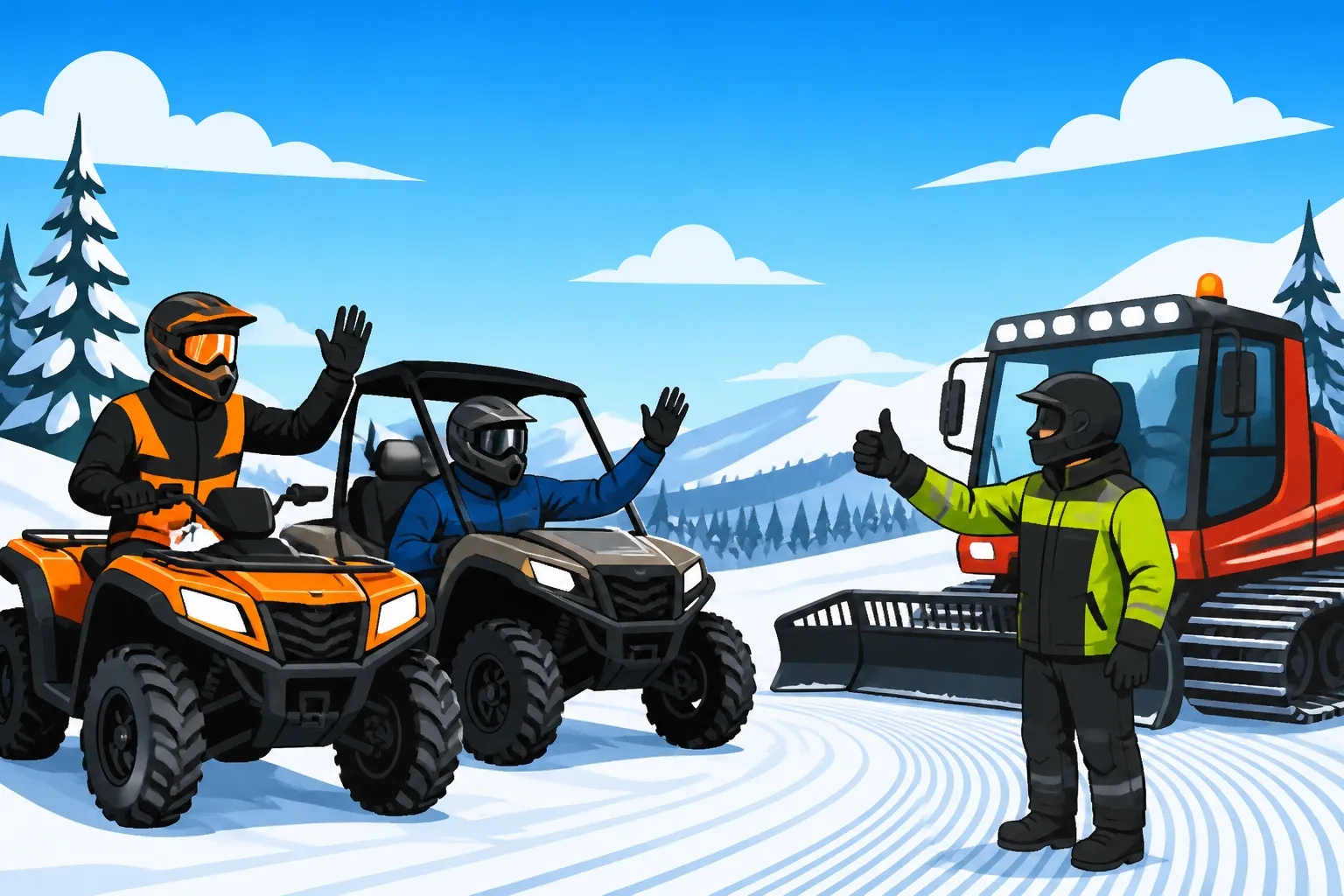
If the groomer is approaching, stop at a safe distance where you are visible and out of its working path. If you meet it from behind, do not ride close to its tracks or try to squeeze past. Wait for the operator to acknowledge you and indicate that it is safe to proceed. If there is no clear signal, stay put and give the operator time to finish the manoeuvre.
Do not wave, shout, or make sudden movements that could be mistaken for a direction. If a trail patroller or operator gives instructions, follow them calmly. Sharing a Federated Corridor With Snowmobiles covers the broader courtesy expected when different trail users share limited space; the same basic principle applies here: make room, communicate clearly, and do not force a pass.
Pass only when it is clearly safe and permitted
Do not pass a groomer simply because there appears to be room beside it. The edge may be soft, the trail may narrow ahead, and attachments or equipment may extend beyond what is obvious from your approach. Passing while the groomer is actively working can also put you in a place the operator does not expect.
Wait until the operator has stopped or clearly indicated that you may pass. Follow the operator’s directions about which side to use and how much room to leave. If the trail is too narrow to pass safely, wait. A short delay is better than risking a collision, damaging equipment, or leaving the groomed corridor.
If you are told to wait, do not pressure the operator by creeping forward or revving. Keep your machine stable, leave room for other trail users, and be patient. Grooming work may involve several passes or adjustments before the operator can safely let traffic through.
Trailside Etiquette During and After Grooming
Do not ride over active work or freshly groomed sections without permission
A newly groomed trail can look like an invitation to ride, but the operator may still be working nearby or may need to make another pass. Riding across an active work area can damage the surface and create an unexpected hazard for the operator and other riders.
If you come upon a freshly groomed section and cannot tell whether it is open, stop well back and look for signs or instructions. Do not use the groomer’s tracks as a shortcut around a closure or barrier. Stay on the marked corridor and follow the club’s direction. Staying on a Federated Corridor explains why respecting the trail alignment matters beyond simple navigation.
When you see signs of active grooming, avoid making your own route around the machine through the brush or over a snowbank. That can damage land, create a new unsafe path, or take you onto property where you do not have permission to ride.
Keep noise and group behaviour under control
A groomer operator needs to concentrate, and a group of machines approaching together can make an already tight encounter more complicated. Keep engines at a controlled level, avoid unnecessary revving, and let one rider communicate with the operator rather than having several people signal at once.
If a member of your group is inexperienced, stay close enough to guide them without crowding them. Explain where to stop and what signal to wait for before you reach the groomer. This is especially helpful for passengers or new riders who may not know how difficult it can be to judge the machine’s path from a distance.
After passing, continue at a considerate speed and leave room for other riders who may still be waiting. Do not race away or throw snow and debris toward the operator. Trail etiquette is not just about avoiding an immediate collision; it also helps keep shared routes usable and welcoming.
Report a hazard without entering the work area
If you notice a damaged sign, blocked corridor, exposed hazard, or unsafe condition, do not ride into the grooming area to investigate. Move to a safe location and contact the trail club or appropriate local contact using the information available to you. Give a clear description of where the issue is, using a trail name, nearby junction, or a location from your navigation app.
onX Offroad may help you identify your position or describe a nearby route feature, but do not treat an app marker as confirmation that a trail is open or safe. Combine your location information with posted signs and local club updates. Quebec Trail Grooming in Winter provides related context for understanding why grooming work and trail conditions can change during the season.
If the trail is blocked and you cannot safely wait or turn around, do not improvise a route through private land or an unmarked area. Contact the club or patrol for direction. It may be frustrating to change plans after travelling to a trailhead, but that is safer than creating a new hazard or trespassing.
A Practical Meet-and-Pass Checklist
Use this quick reference when you encounter grooming work. The right choice depends on the trail layout and the operator’s instructions, so use the table as a prompt—not a replacement for signs or directions.
| Situation | Safer response | Avoid |
|---|---|---|
| You see a groomer ahead | Slow down gradually and approach predictably | Accelerating toward it, then braking sharply |
| The groomer is approaching | Stop at a visible, safe distance and wait | Assuming the operator has seen you |
| You are behind a working groomer | Stay back and wait for a clear signal | Following close to its tracks |
| The trail is too narrow to pass | Wait for the operator’s direction | Squeezing past or using a snowbank as a lane |
| The trail looks freshly groomed | Check signs and confirm it is open before proceeding | Riding into an active work area |
| You need to check your route | Move fully clear of the corridor before stopping | Stopping in the trail to use your phone |
| A group meets a groomer | Keep space between machines and follow one lead rider | Crowding the operator or signalling over one another |
A little patience makes these encounters much less stressful. Slow down early, keep your machine out of the groomer’s working space, and wait for a clear indication before passing. If there is any doubt about access or conditions, check with the local club rather than trying to interpret the situation on the fly. Quebec Trail Etiquette Locals Expect is also useful for the small courtesy habits that make a shared ride smoother for everyone.
Disclaimer
This article is for general informational purposes only and does not constitute professional advice. Laws, prices and regulations vary by location and change over time. Consult a qualified professional for guidance on your specific situation.