Tires for Quebec Clay
Quebec clay can turn a familiar trail into a slick, rutted stretch where your tires spin, the machine drifts, and every muddy dip feels deeper than it looked from the seat. The right ATV or UTV tires can improve grip and control, but the best choice depends on your machine, the route, and how often you ride in wet conditions.
Why Quebec Clay Changes the Tire Equation
Clay can be slick without looking especially deep
Clay is challenging because it can coat the tread and reduce the edges that help a tire bite. On a wet trail, a shallow layer over firm ground may feel unexpectedly slippery. After rain, the same stretch can become soft enough to hold a tire and leave deep ruts. That combination makes it hard to judge traction by appearance alone.
The conditions also change across a single ride. A forest route might alternate between clay, gravel, roots, wet leaves, and firmer packed sections. Trails in regions such as the Laurentians, Lanaudière, or Mauricie can vary from one corridor to the next, so “Quebec clay” is not one uniform surface. Check route conditions before setting out, and treat a recently wet trail differently from a dry one. Quebec Trail Conditions Before You Go
Clay also sticks to tires, fenders, and underbody parts. Once packed into the tread, it can make an otherwise aggressive tire act more like a smooth one. If the machine begins slipping where it usually grips, stop somewhere safe and inspect the tread rather than simply adding throttle. Spinning harder can dig a hole, damage the trail, and leave you with less traction than you started with.
The best tire depends on the whole route
It is tempting to choose the most aggressive mud tire available, especially if a machine spends weekends in soft ground. But a tire designed mainly for deep mud may feel less comfortable or predictable on gravel, hard-packed trails, and rocky sections. Long rides often involve several surfaces, so a tire that works brilliantly in one bog can become tiring on the rest of the route.
Before buying, think through a typical ride: how much of it is wet clay, how often you encounter deep mud, whether you use the machine for work, and how far you travel on firmer trails. A route-planning tool such as onX Offroad can help you review the overall route and nearby access points, but a map cannot tell you precisely how a trail will feel after a particular rainfall. Combine route planning with local trail-condition information and your own experience.
Trail difficulty is another useful part of the picture. A route marked as manageable in dry weather may feel substantially harder after rain, especially if it includes steep approaches or narrow sections where turning around is awkward. Quebec Trail Difficulty Ratings can help you think about the broader demands of a route rather than choosing tires based on mud alone.
Choosing ATV or UTV Tires for Clay
Compare tread patterns with your actual riding
Tire tread is a trade-off between grip, cleaning ability, comfort, and versatility. The table below is a starting point, not a guarantee: tire construction and tread design vary between models, and the same tire can behave differently depending on the machine and ground conditions.
| Tire style | Potential advantage in Quebec conditions | Possible trade-off |
|---|---|---|
| All-terrain tread | A practical choice for routes that mix clay, gravel, and firm trail | May not clear sticky mud as readily as a more open pattern |
| Mud-oriented tread | More open lugs can help shed soft material and find traction in deeper mud | Can feel less settled on hard-packed surfaces and may be more aggressive than mixed routes require |
| Trail or utility tread | Often suits general trail use and work around a property | May struggle in deep, slippery mud compared with a dedicated mud pattern |
| Rock-oriented tread | Can be useful where rocky ground is a regular part of the route | Not necessarily the best match for sticky clay or deep mud |
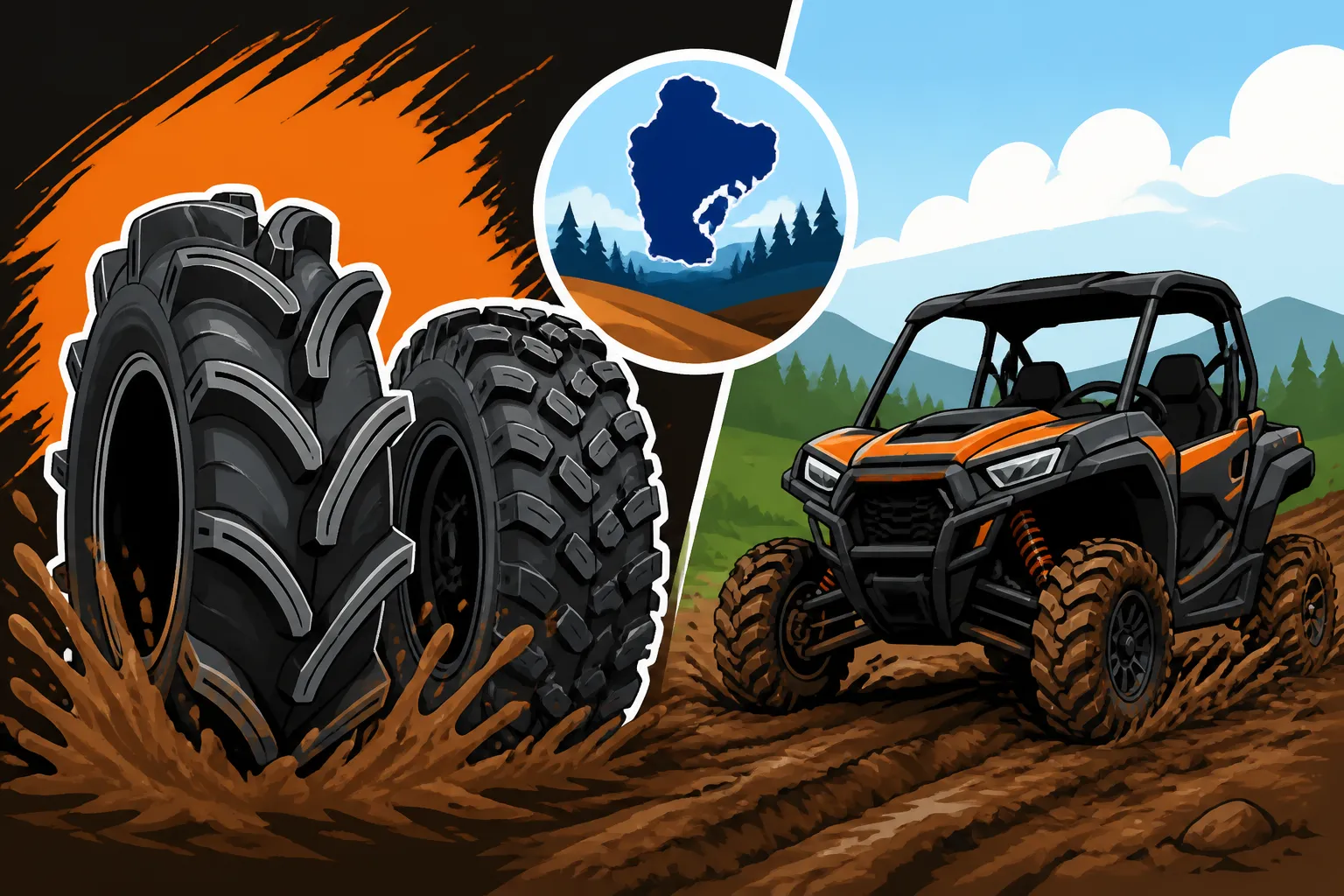
Look closely at the spaces between the lugs, not just how tall the tread appears. Open spacing can give mud somewhere to clear as the tire rotates, while tightly spaced tread may hold onto sticky material in some conditions. But taller, wider-spaced lugs do not automatically make a tire the right choice for every rider. Consider how often your route includes deep mud compared with gravel, exposed roots, and firm trail.
If your usual ride is a mixed circuit, prioritize predictable handling across surfaces. For a route with repeated mud sections, a more open tread may make sense, but consider how it behaves on the long stretches between them. If a trail description leaves you uncertain, check a local club update or ask riders who regularly use that corridor. You can also use onX Offroad to organize route notes and compare planned options, while keeping in mind that actual conditions can change quickly.
Match the tire to the machine and its load
ATVs and UTVs place different demands on tires. A side-by-side is typically heavier than a single-rider quad and may carry passengers, tools, camping gear, or a cargo load. That makes the tire’s load rating, size, and compatibility with the vehicle especially important. Do not assume an ATV tire that looks similar will be suitable for a UTV simply because the dimensions seem close.
Check the vehicle manufacturer’s recommendations and the tire maker’s specifications before changing size or construction. A different size can affect clearance, steering feel, gearing, and the relationship between the tires and drivetrain. On a UTV, also consider how added passengers or cargo change the load on each tire. If you are unsure, a qualified tire shop or dealer can help you confirm fitment for the exact machine and intended use.
For either type of machine, inspect tires for cuts, cracking, damaged sidewalls, missing tread, and embedded debris before heading out. Clay can hide sharp stones or branches, and a tire that has already taken damage is a poor candidate for a long, remote ride. Carry the repair equipment and recovery gear appropriate to your route, and know how to use them before you need them. On a multi-day trip, a little preparation can save a stressful walk back to the trailhead. Packing for a Multi-Day Ride
Getting Better Traction Without Making Things Worse
Set pressure carefully and follow the tire guidance
Tire pressure affects how a tire meets the ground, but lowering pressure is not a universal fix for slippery clay. Pressure that is too low for the machine, tire, or load can increase the chance of damage, tire separation from the rim, or poor handling. The safe starting point is the vehicle and tire manufacturers’ guidance, adjusted only within their recommendations for your specific setup.
Check pressure when tires are cool and use a gauge rather than judging by appearance. If you carry passengers or cargo, account for that load instead of relying on a pressure setting that was chosen for an empty machine. Make changes cautiously, then assess the feel at low speed in a safe place. If handling becomes vague or the tire appears to deform excessively, stop and reassess rather than continuing into difficult terrain.
Pressure adjustments cannot compensate for unsuitable tread, a damaged tire, or conditions beyond the machine’s ability. Nor do they make it wise to ride a trail that is closed or badly damaged. Before a long outing, build tire checks into the same routine as checking fuel, lights, and recovery gear. This is especially worthwhile if your machine has been stored for a while or has not been ridden since the last inspection.
Use smooth inputs and choose a line early
On slick clay, sudden steering, braking, and throttle changes can unsettle a machine. Look ahead, pick a line before reaching the difficult patch, and use steady inputs. If a section is too slippery to cross safely, pause and consider whether there is a suitable alternative route. Do not leave the marked trail to bypass a muddy spot; that can damage vegetation and create new tracks on land where riding may not be permitted.
Ruts can pull a tire in a direction you did not intend, while the edge of a rut may be softer than it looks. Approach slowly enough to keep control and avoid following another rider’s line automatically. Their machine, tire setup, and load may be different from yours. If you are riding in a group, leave space so the rider ahead has room to stop or make a safe adjustment.
When conditions are very wet, turning around may be the responsible choice. Heavy traffic can deepen ruts and break down trail surfaces, creating problems long after one ride ends. Check local notices before departure, and respect temporary closures following heavy rain. Quebec Trail Closures After Heavy Rain offers useful context for why a familiar route may not be suitable on a particular day.
Caring for Tires and Planning Clay-Rich Rides
Clean and inspect after the ride
After riding through clay, remove packed material from the tread, wheel wells, and areas around the suspension. A thick coating can hide a cut, bent component, or lodged object. Cleaning also gives you a chance to notice whether one tire is wearing unevenly or has lost pressure. Use care around seals, electrical parts, and other components where forceful washing could cause damage.
Once the machine is clean, inspect each tire from several angles. Look for cuts in the tread and sidewall, bulges, exposed cords, loose objects, and signs that the tire has been rubbing against part of the machine. Check pressure again after the tires have cooled, particularly if the ride included hard impacts or rough terrain. If you find damage you are unsure about, have it assessed before taking the machine back onto a remote trail.
A useful post-ride routine does not need to be complicated: clean, inspect, record any issue, and repair or replace a tire before the next outing if necessary. More advice on that process is available in Washing a Machine After a Quebec Ride. Keeping tires in good condition is less exciting than choosing a new tread pattern, but it is often what prevents a small problem from becoming a trail-side one.
Plan around changing trail conditions
Start with the route, then decide whether your tire setup suits it. Read local updates, check for closures, and think about recent rain. An app such as onX Offroad can help you review route options and keep a plan organized, but do not treat a digital map as proof that a trail is open or passable. Confirm current access and conditions through the relevant local trail or club information.
For a route with frequent clay, carry a repair kit and recovery equipment suited to your machine and your experience. Tell someone where you plan to ride, especially if you are heading away from well-used corridors. If the route is unfamiliar, pick a conservative option and avoid planning a difficult section late in the day when fatigue can make careful decisions harder.
Finally, remember that tire choice is only one part of responsible trail riding. Stay on authorized routes, give other users room, and avoid spinning tires when traction is poor. If a section is badly damaged or conditions are deteriorating, report the issue through the appropriate local channel rather than making a new bypass. Quebec Trail Etiquette Locals Expect is a helpful companion for planning a ride that is enjoyable without adding unnecessary wear to the trail.
Disclaimer
This article is for general informational purposes only and does not constitute professional advice. Laws, prices and regulations vary by location and change over time. Consult a qualified professional for guidance on your specific situation.