Quebec Trail Closures After Heavy Rain
Heavy rain can turn a familiar Quebec ATV route into a muddy, damaged, or unsafe corridor, and a trail that looked open on your map may have closed since your last ride. This guide explains why clubs restrict access after storms, where to check before leaving, how to ride responsibly around closures, and what to do if conditions change mid-trip.
Why Quebec ATV trails close after heavy rain
Rain can make a trail unsafe even when it looks passable
A trail may appear rideable at the entrance while hiding trouble farther along. Water can wash gravel from a slope, soften a low-lying section, expose roots, or weaken the edge beside a ditch. A culvert that carries water beneath the trail may become blocked or undermined. On a narrow forest route, a shallow washout can leave little room to turn around safely.
The risk is not limited to getting stuck. A machine driven through soft ground can deepen ruts, push soil into a watercourse, or damage the trail surface for everyone who follows. A rut that seems minor on a quad may become a bigger obstacle for a side-by-side, a trail maintenance vehicle, or a rider returning after the ground has softened further.
Conditions can also vary sharply within a short distance. A route near a river or in a low area around the Saguenay, Mauricie, or Laurentians may be saturated while a higher, gravelly section nearby drains more quickly. Even within one circuit, exposed ridges and shaded woods can dry at different rates. A report that says one section is passable does not necessarily describe the whole route.
For riders planning a longer outing, this is why checking [Quebec Trail Conditions Before You Go] matters as much as checking the route itself. Trail status can change after a storm, and conditions at the trailhead may not tell you what is happening several kilometres ahead.
Closures help protect trails, land, and riders
A temporary closure is usually a way to prevent further damage while the ground drains or a club assesses repairs. Trail clubs may need time to inspect a washed-out section, clear fallen branches, replace a sign, or confirm that a bridge or culvert remains usable. Riding around a barrier can turn a small maintenance issue into a longer repair.
There is also a land-access issue. Quebec’s federated trail network crosses different kinds of land, including private property. A landowner may be less willing to continue allowing trail access if repeated riding damages a field edge, drainage area, or forest road. Staying off a closed route helps protect the relationships that make trail access possible. [Quebec Trails That Cross Private Land] offers more context on why respecting those boundaries matters.
A closure can be local rather than regional. One club may close a muddy connector while nearby trails remain open. In another case, several linked sections may be affected because they share a low crossing or access road. Avoid assuming that a trail is open just because the wider region is open, or closed everywhere because one segment has a notice.
Spring thaw closures are another matter. They are associated with seasonal ground conditions and may follow a different schedule from a closure after a storm. For more on that seasonal issue, see [Quebec's Spring Thaw Closure]. Heavy-rain closures can happen at other times of year, whenever local conditions require it.
How to check a trail before you ride
Start with the club or trail operator responsible for that section
Before loading the ATV or UTV, identify which club maintains the route you intend to use. Check that club’s latest trail notices and status information, then look for updates from neighbouring clubs if your route crosses into another area. A circuit may pass through more than one maintenance area, so a single club’s update may not cover the full ride.
Look for the date and wording of the notice. “Closed” is different from “use caution,” and a general weather update is not necessarily a trail-status update. If the notice is unclear, contact the club or operator before setting out rather than interpreting silence as permission. A closure may be posted at a trail entrance, but travelling to the entrance simply to find out can waste time and leave you without a safe alternative.
Check more than once if rain is continuing or the forecast calls for additional showers. A route report from the previous day may no longer reflect conditions after another night of rain. Before departure, check again; if the ride is long, confirm whether there are practical places to turn around or exit if a section closes.
A map app can help you understand where a route goes, but a line shown as a trail does not prove that the trail is open today. onX Offroad can be useful for viewing and organizing route information, especially when planning a ride through unfamiliar terrain, but use the responsible club’s current notice for closures. An app route should never override a posted barrier or a closure instruction.
Plan a route with safe alternatives, not improvised detours
Choose a route that gives your group a clear way to shorten the ride if conditions are worse than expected. That might mean identifying a known trailhead, public stopping point, or return junction before you leave. Make sure every rider understands the plan. If one machine gets stuck or a closure appears ahead, a group that already knows its options is less likely to scatter or start looking for an unofficial way around.
Use a current trail map to understand the official network and junctions. [Quebec Trail Maps and the iQuad App] can help with route planning, but remember that mapping tools and closure notices serve different purposes: maps show where routes are, while clubs communicate whether access is available. You can also use onX Offroad to keep track of your planned route, provided you treat it as a navigation aid rather than confirmation that a trail is open.
Avoid building a backup route that crosses private land or unmarked paths. A detour that seems convenient on a screen may lead onto a logging road, a driveway, a restricted corridor, or land where you do not have permission to ride. If the only alternative requires leaving the authorized network, turn back instead.
| Before the ride | What to check | Why it matters |
|---|---|---|
| Trail status | Current notice from the club responsible for each section | A route can be closed locally even if nearby trails are open |
| Route and exits | Official map, junctions, and a practical turnaround plan | Helps prevent rushed decisions when conditions change |
| Weather | Recent rain and expected additional precipitation | Water and soft ground can worsen after a route report is posted |
| Group readiness | Fuel, communications, recovery gear, and agreed regrouping points | Makes a delay or return trip safer and less chaotic |
For a longer outing, route choice is only part of the preparation. [Quebec Trail Etiquette Locals Expect] is useful reading for understanding why riders need to stay on authorized corridors, respect barriers, and avoid treating a wet trail as an invitation to explore nearby land.
What to do when you encounter a closure or damaged section
Stop before the barrier and follow the posted instruction
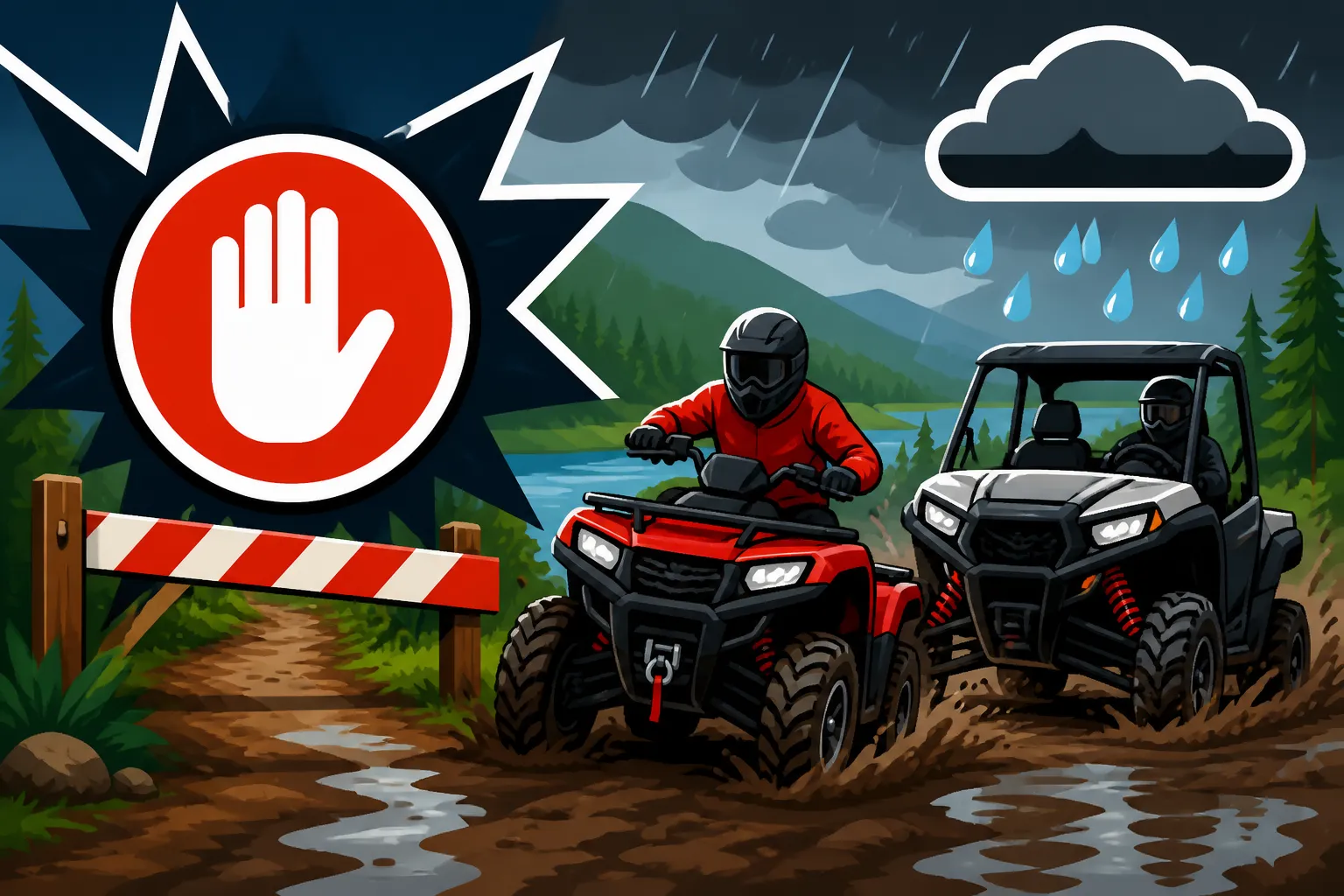
If you reach a closure sign, gate, barricade, or clear instruction from a club representative, stop. Do not move the barrier, squeeze around it, or follow fresh tracks that appear to pass through. Another rider’s tracks are not evidence that the route is open. The closure may have been installed after those tracks were made.
Turn around where it is safe and use the planned route back. If the group is long, communicate the decision clearly and make sure everyone knows which direction to travel. Avoid stopping in a blind corner, at the edge of a washout, or where another group may not see you. If you need to regroup, choose a safe, visible place away from the damaged section.
If the closure leaves you uncertain about how to return, contact the club or local operator when possible. Do not assume you can take a nearby road or forest track. Quebec road access for off-highway vehicles is subject to rules and local permissions; [Quebec ATV Road Rules Under the LVHR] provides related information about where road riding may be allowed. A trail closure does not automatically authorize a road detour.
When conditions change mid-ride, it is tempting to keep going because the group has already travelled a long way. That is often when a cautious turnaround is the better choice. A short, frustrating ride back is usually preferable to getting trapped beyond a washout, damaging the trail, or needing a difficult recovery in unstable ground.
Report damage without making it worse
If you notice erosion, a fallen tree, a flooded crossing, or a damaged sign, report it to the club responsible for the trail. Give a clear location: the trail name or number if known, the nearest junction or landmark, and a description of what you saw. A phone location pin or a carefully chosen map reference can help, but do not enter a hazardous area just to collect better information.
Photos may help explain the problem, as long as you can take them from a safe place without blocking the route. Keep the report factual. For example, say that water is flowing across a low crossing or that the trail edge has collapsed, rather than guessing whether a bridge is structurally sound. Let the club decide what inspection or repair is needed.
Do not attempt an improvised repair unless you are authorized and equipped to do so. Moving branches, digging at a muddy section, or adding material can worsen drainage or create a new hazard. The same applies to riding through a problem to “pack it down.” Repeated passes can widen ruts and make later work more difficult.
Clubs depend on volunteer work and local cooperation. [Quebec Clubs and What They Maintain] explains the role clubs play in looking after trails, while [Quebec Club Volunteer Days] offers a way to learn about supporting that work directly. A useful report, followed by leaving the site undisturbed, can make a real difference.
How to ride responsibly after the rain passes
Treat a reopening as permission to use the route, not a promise of perfect conditions
A trail marked open may still be wet, uneven, or slower than usual. Ease off the throttle where the surface is soft, keep a safe following distance, and avoid sharp turns that can tear up the trail. If your wheels begin to spin, stop rather than repeatedly applying power. Spinning can dig a deeper hole and leave the machine more difficult to recover.
On a side-by-side, remember that its width and weight can make a narrow or soft section harder to manage than it looks from the seat. Stay within the marked corridor and avoid driving onto the shoulder to get around mud. The shoulder may be softer than the main trail, and leaving the corridor can damage vegetation or cross into land without permission.
Ride in a way that leaves the trail usable for the next group. That means not creating a new bypass around a puddle, not cutting across a field edge, and not widening a route to avoid one rough patch. If a section feels unsafe for your machine or experience level, turn back and share the concern with the club.
For broader route preparation, [Quebec Trail Conditions Before You Go] is worth revisiting before each outing, not only after major storms. And if your plan includes a multi-day ride, [Packing for a Multi-Day Ride] can help you prepare for delays, changing weather, and unexpected changes to the route.
Make the decision to cancel early when the conditions are uncertain
A planned ride can be disappointing to postpone, particularly when a group has travelled to a regional trailhead or booked a weekend around the outing. Still, the cost of turning around is usually easier to manage than a damaged machine, a difficult recovery, or a trail made worse by riding when it is too soft. If closure information is missing and the route has received significant rain, take time to confirm access before committing.
Set a simple group rule before leaving: anyone can raise a concern, and a closure or unsafe section means the group turns back together. This avoids pressure on a less experienced rider to continue just because everyone else wants to reach a destination. It also helps prevent a group from splitting up to search for a workaround.
If a route is open but you are unsure about one crossing, choose the conservative option. Do not rely on another machine’s ability to cross it, since tire setup, ground clearance, vehicle weight, and rider experience all differ. A passage that is manageable for one rider may be inappropriate for another.
Responsible riding after heavy rain is not just about avoiding mud. It means checking current information, respecting temporary restrictions, protecting land access, and being willing to change plans. Those habits help preserve Quebec’s trail network for the next ride as well as the one you had planned.
Disclaimer
This article is for general informational purposes only and does not constitute professional advice. Laws, prices and regulations vary by location and change over time. Consult a qualified professional for guidance on your specific situation.