Quebec Rules for Towing a Trailer
There’s nothing quite like the versatility of an ATV or UTV when you’re out in the Quebec wilderness, whether you’re hauling firewood for the camp, bringing out a trophy from hunting season, or simply moving tools around your property. But when it comes to hitching up a trailer, a lot of folks get a little knot in their stomach wondering, "Am I even allowed to do this? What are the rules?" It’s a totally valid concern, because while these machines are workhorses, they’re not pickup trucks, and the regulations in Quebec can be a bit opaque. This guide is here to untangle the confusion and lay out exactly what you need to know about legally and safely towing a trailer with your quad or side-by-side in our beautiful province.
Understanding the Basics of Trailer Towing in Quebec
Let's face it, many of us use our ATVs and UTVs for more than just tearing up trails. They’re invaluable tools for chores, property maintenance, and those cherished hunting and fishing expeditions. Being able to hook up a trailer significantly extends their utility, turning them into mini-tractors for specific tasks. But this added capability also comes with added responsibility, and Quebec, like any other jurisdiction, has rules designed to keep everyone safe.
Why Rules Exist for Off-Highway Vehicle Trailers
It might seem like overkill to have rules for something as simple as a utility trailer behind your quad, especially if you feel like you’re just puttering around your own land or a private camp. However, these rules are rooted in some very practical safety concerns. An ATV or UTV, by its nature, handles very differently than a road-legal vehicle, especially when loaded down and towing. You're dealing with a shorter wheelbase, often less sophisticated braking systems compared to a truck, and a centre of gravity that can be significantly altered by a heavy or improperly loaded trailer.
Imagine trying to stop quickly on a loose gravel trail with a couple hundred pounds of firewood pushing your quad from behind. Or picture navigating a tight turn on an uneven logging road with a poorly balanced trailer swaying behind you. The risks of losing control, jackknifing, or even rolling over are very real. These regulations, even the unspoken common sense ones, are there to mitigate those dangers, protecting not just you, but also anyone else who might be sharing a trail or crossing a road. They ensure that when you expand your machine's capabilities, you do so in a way that prioritizes stability, braking, and general operational safety, acknowledging that an ATV is not a truck. The [Quebec's Off-Highway Vehicle Act and Your Papers] lays out the foundational framework for how these machines are to be operated, and while it doesn't get into microscopic detail on every trailer type, the spirit of safe operation always applies.
Defining What Constitutes a "Trailer" for an ATV/UTV
When we talk about towing, "trailer" can mean a lot of things. For the purposes of ATV and UTV use, it generally refers to any unpowered vehicle designed to be towed by your off-highway machine for carrying cargo. This can range from a small, single-axle utility cart you bought from a big box store, perfect for hauling a couple of bags of soil or tools, to a more substantial, purpose-built hunting trailer, a log hauler, or even a small enclosed cargo trailer for sensitive gear.
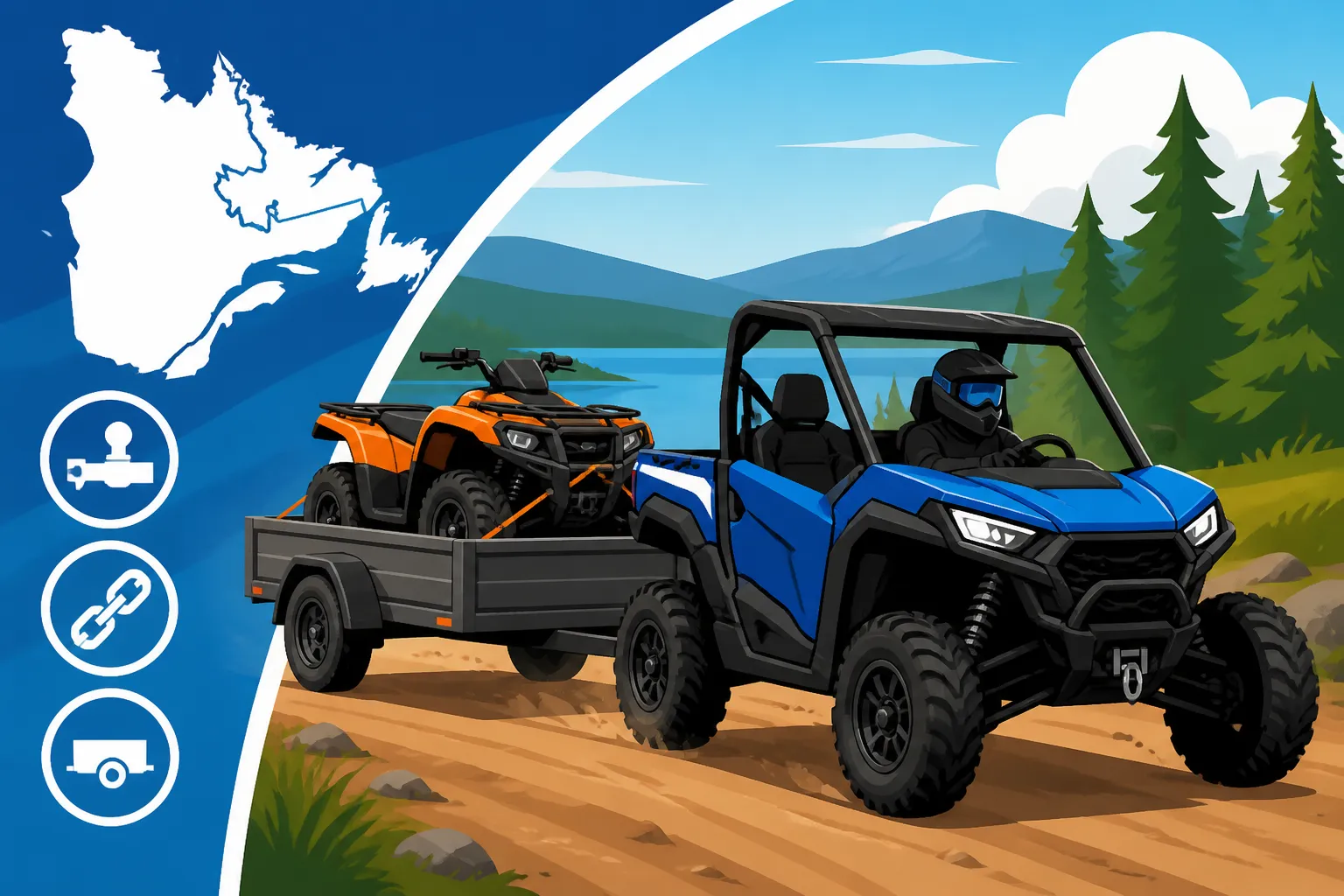
The key distinction usually lies in its design and intended use. Most trailers designed specifically for ATVs and UTVs are relatively compact, have off-road tires, and are built to handle rough terrain. They typically connect via a standard hitch ball and coupler, or sometimes a pintle hitch for heavier-duty applications. Regardless of its size or sophistication, any attachment that carries a load behind your machine, and is not permanently affixed, falls under this "trailer" umbrella. It’s crucial that the coupling mechanism is secure, that safety chains are used (even if not explicitly required for every off-road scenario, it's just good practice), and that the trailer itself is in good repair. A broken hitch or rusted chains are accidents waiting to happen, no matter how short the distance you're travelling.
Legal Requirements for Towing a Trailer with Your Quad or Side-by-Side
Alright, let’s get down to the brass tacks of what the law actually says. This is often where people get tripped up, thinking that if their quad needs a [Quebec ATV Registration With the SAAQ] and [Quebec VHR Plates Explained], then surely their trailer does too. While the SAAQ (Société de l'assurance automobile du Québec) is the primary body overseeing vehicle registration, the rules for ATV/UTV-specific trailers are a bit different than for, say, a boat trailer or a camping trailer designed for highway vehicles.
Registration and Plating for Trailers in Quebec
For the vast majority of trailers specifically designed and exclusively used with ATVs and UTVs for off-highway purposes, SAAQ registration and a license plate are generally NOT required. This is a common point of confusion. These smaller utility trailers, often referred to as "remorques d'utilité" or "chariots," are typically considered auxiliary equipment to your off-highway vehicle rather than separate, registrable vehicles themselves, as long as they stay within reasonable size and weight parameters and are used off the public road network.
However, there's a significant nuance: if a trailer could reasonably be used with a road-going vehicle (like a car or truck) and meets certain size or weight thresholds, even if you intend to only use it with your ATV, it might fall under the SAAQ's general trailer registration rules. These thresholds can relate to gross vehicle weight, width, or length. For instance, a larger utility trailer that you might tow behind a pickup, but also occasionally pull with your UTV on private land, would likely need registration if it exceeds the SAAQ's non-registrable trailer limits.
To simplify for typical ATV/UTV users:
- Small, purpose-built ATV/UTV utility carts: Generally no registration needed. Think of those single-axle poly dump carts, small log trailers, or hunting sleds.
- Larger utility trailers that could be towed by a car/truck: Check SAAQ regulations for general trailer registration. If it exceeds a certain weight (e.g., typically over 900 kg GVWR, but always verify current SAAQ info), it will need a plate, even if you only use it off-road with your ATV. This is less common for true ATV-specific trailers, but it's important to be aware of if you're using a multi-purpose trailer.
The key takeaway here is to assess your trailer. If it's clearly designed for off-road use only, is relatively small, and would never see a highway behind a car, you're usually in the clear regarding registration. If there's any doubt, especially with a larger, more robust trailer, a quick check with the SAAQ's general trailer information is prudent.
Weight and Size Limitations You Need to Be Aware Of
Beyond registration, the most crucial considerations for safe towing are the weight and size of your trailer relative to your ATV or UTV. Unlike heavy-duty trucks with robust towing packages, ATVs and UTVs have specific, often more limited, towing capacities set by the manufacturer. Exceeding these limits is not only dangerous but can also void your warranty and cause significant damage to your machine's drivetrain, brakes, and suspension.
Here's what to keep in mind:
- Manufacturer's Tow Rating: ALWAYS consult your machine's owner's manual for its maximum towing capacity. This figure is critical. It usually includes the weight of the trailer itself plus its cargo (Gross Trailer Weight or GTW). For example, many utility ATVs might have a towing capacity of 500-800 lbs, while larger UTVs could range from 1,200 to over 2,000 lbs.
- Tongue Weight: This is the downward force exerted by the trailer's coupler on the hitch ball of your ATV/UTV. Too little tongue weight can cause the trailer to sway violently ("fishtail"), leading to loss of control. Too much can overload your machine's rear suspension, affecting steering and braking. A good rule of thumb is typically 10-15% of the total trailer weight as tongue weight. You might need to adjust your cargo distribution in the trailer to achieve this balance.
- Braking Capacity: Remember, your ATV or UTV's brakes are designed for the machine's weight, not for an additional heavy trailer. While some larger UTV trailers might have their own braking systems, most ATV utility trailers do not. This means your machine's brakes bear the full load, significantly increasing your stopping distance, especially on declines or slippery surfaces. Always test your braking performance in a safe area before hitting trails with a loaded trailer.
- Trailer Width: While there isn't a hard-and-fast rule in the Quebec Off-Highway Vehicle Act for trailer width behind an ATV/UTV, common sense and trail etiquette prevail. A trailer that's significantly wider than your machine can make navigating narrow trails, gates, or dense brush extremely difficult and potentially damaging. On federated trails, you want to ensure your setup doesn't obstruct the path or damage trail infrastructure.
To give you a general idea, here's a simplified table comparing typical towing capabilities, but remember to always check your specific machine's manual:
| Machine Type | Typical Towing Capacity (lbs) | Notes |
|---|---|---|
| Sport ATV | 0 – 200 | Not designed for towing; minimal or no hitch. |
| Entry-Level Utility ATV | 500 – 800 | Good for light chores, small utility carts. |
| Mid-Range Utility ATV | 800 – 1,200 | Versatile for hunting, firewood, property work. |
| Utility UTV (Side-by-Side) | 1,200 – 2,500+ | Excellent for heavy loads, farming, construction; many have advanced towing features. |
Overloading can not only compromise safety but also put incredible strain on your machine. Parts like axles, bearings, and even the frame can suffer. If you find yourself consistently needing to haul more, it might be time to consider a larger UTV or even a different type of equipment altogether.
Lighting, Reflectors, and Other Essential Equipment
Even if your trailer doesn't need to be registered, visibility is paramount, especially if you're venturing beyond private property or making brief road crossings. The general principle is: if your trailer obscures your machine's lights or significantly increases your overall length, it needs its own.
Here’s what to consider:
- Reflectors: At a minimum, your trailer should have appropriate reflectors on the sides and rear. This is crucial for visibility, particularly if you're out during dawn, dusk, or in low-light conditions. These are inexpensive and easy to install.
- Brake Lights and Turn Signals: If your trailer is wide enough to block the view of your ATV/UTV’s rear lights, or if you simply want an extra layer of safety, adding brake lights and turn signals to the trailer is a smart move. Many ATV/UTV-specific wiring harnesses are available for this purpose. This is especially important if you anticipate any brief [Quebec Municipal Road Access Up to 1 Kilometre] as part of your route.
- Safety Chains: As mentioned before, always use safety chains that cross under the trailer tongue and attach securely to your machine’s frame or hitch receiver. These are your backup if the main hitch connection fails.
- Hitch Pin/Lock: Ensure your hitch pin is secure, preferably with a locking mechanism, to prevent the trailer from disconnecting.
- Flag for Oversized Loads: If you’re hauling something that extends significantly beyond the rear of your trailer (like long logs or lumber), a red or orange flag attached to the furthest point is a critical safety measure, alerting others to the extended length. This is standard practice for any type of vehicle hauling an oversized load.
- Proper Tires: Ensure your trailer tires are in good condition and properly inflated for the load they’re carrying. Off-road specific tires on your trailer will perform better on rough terrain and match the capabilities of your ATV/UTV.
Companies like SuperATV offer a range of utility accessories, including durable hitches, lighting kits, and other components that can help you ensure your towing setup is both safe and compliant. Prioritizing these basic equipment needs isn't just about avoiding fines; it's about preventing accidents and ensuring you and your cargo arrive safely.
Where and How You Can Safely Tow a Trailer in Quebec
Knowing what you can tow is one thing; understanding where you can tow it is another. Quebec offers an incredible network of trails and vast wilderness, but access rules, especially when towing, can vary depending on the type of land and trail you're on.
Trail Riding with a Trailer: FQCQ Network and Beyond
For many ATV and UTV enthusiasts in Quebec, the extensive FQCQ (Fédération Québécoise des Clubs Quads) trail network is the main draw. These federated trails are generally quite accommodating to utility trailers, especially if they are designed for off-road use and don't exceed reasonable dimensions. Clubs understand that members often use their machines for practical purposes like accessing hunting camps, gathering firewood (where permitted), or performing trail maintenance.
Here's what to keep in mind on federated trails:
- General Acceptance: Most FQCQ trails will allow you to tow a utility trailer. There isn't a blanket ban.
- Width Restrictions: Be mindful of the width of your trailer, particularly on narrower sections of trail, through gates, or over bridges. Some older trails, or those in very dense areas, might have practical limits on width that are not explicitly posted but are self-evident. You don't want to get stuck or damage the trail.
- Trail Etiquette: Always practice [Quebec Trail Etiquette Locals Expect]. This means being extra cautious, especially on blind corners or hills, as your turning radius and stopping distance are increased. Yield to other riders, and be prepared to pull over in a safe spot to let faster traffic pass. If your trailer is kicking up a lot of dust, slow down.
- Speed: Never attempt to maintain high speeds while towing a trailer. The increased mass and potential for sway make it extremely dangerous. The [Quebec ATV Speed Limit on Trails] of 50 km/h is a maximum, not a target, and you should always reduce speed significantly when towing.
- Club-Specific Rules: While the FQCQ sets overarching guidelines, individual clubs might have specific local rules or recommendations regarding trailers, especially in sensitive areas or during certain seasons. It’s always a good idea to check with the local club if you're venturing into a new area with a trailer.
Beyond Federated Trails:
On private land (with permission), ZECs (Zones d'exploitation contrôlée), or other non-federated land, the rules are often more relaxed, essentially boiling down to landowner permission and common sense safety. However, the principles of safe towing (weight limits, proper equipment, careful driving) remain absolutely paramount for your own safety and that of others. You'll want to ensure you always have your [Quebec Insurance Proof on the Machine] as well, regardless of where you are riding.
Brief Road Sections and Crossings with a Trailer
This is where things can get a bit trickier, as you're transitioning from the relatively permissive off-road environment to the more regulated public road network. While ATVs and UTVs are not generally allowed on public roads in Quebec, there are specific, limited exceptions for crossing or riding very short distances. These rules, outlined in the Off-Highway Vehicle Act, still apply when you’re towing a trailer.
Key points for road access with a trailer:
- Limited Access: Remember that [Quebec Municipal Road Access Up to 1 Kilometre] is typically only permitted with appropriate signage and under specific conditions. Towing a trailer does not grant you additional road access; it merely means you have to follow those existing rules with an even greater degree of caution.
- Increased Caution: When crossing a road or travelling a short distance on a shoulder, your awareness needs to be heightened. Your machine-and-trailer combination is longer, heavier, and less nimble than your ATV/UTV alone.
- Braking Distance: Your stopping distance will be significantly longer. Anticipate stops much earlier.
- Turning Radius: Your turning radius will be wider. Be very conscious of the trailer's path, ensuring it clears obstacles and doesn't cut corners.
- Visibility: Ensure your trailer's reflectors and lights (if equipped) are clean and visible. If your load is unusually wide, consider adding temporary flags.
- Sightlines: When crossing, pay extra attention to [Quebec Crossing Sightline Distances]. A longer vehicle takes more time to clear an intersection.
- Legality: The legality of your ATV/UTV being on that road section is primary. The trailer is secondary. If your ATV/UTV isn't permitted, your trailer won't make it suddenly legal.
Always treat road sections with extreme respect. Other drivers might not expect to see an ATV/UTV, let alone one towing a trailer, and you are far more vulnerable in a collision.
Safety Practices and Common Pitfalls to Avoid
Towing a trailer significantly changes the dynamics of your ATV or UTV. Here are some essential safety practices and common pitfalls to steer clear of:
- Pre-Ride Inspection: Before every ride with a trailer, do a thorough check.
- Hitch Connection: Ensure the hitch ball and coupler are securely fastened, the hitch pin is in place, and the safety chains are properly crossed and attached.
- Tires: Check trailer tire pressure and condition. Also, check your ATV/UTV tire pressure, as you might need slightly higher pressure in the rear tires to support the tongue weight.
- Lights: Verify all lights (machine and trailer, if applicable) are working.
- Brakes: Test your ATV/UTV brakes for effectiveness, especially with the trailer attached.
- Proper Load Distribution: This is perhaps the most critical safety factor.
- Tongue Weight: As discussed, aim for 10-15% of the total loaded trailer weight on the tongue. Too much, and you overload the rear suspension; too little, and you get dangerous sway.
- Centre of Gravity: Keep heavier items low and centred over the trailer's axle(s). Distribute weight evenly from side to side.
- Secure Cargo: Use straps, ropes, or nets to prevent cargo from shifting. Shifting cargo can drastically alter the trailer's balance and lead to instability.
- Adjust Your Speed: Always reduce your speed significantly when towing. This means going slower than you normally would on trails, and definitely slower than posted limits on roads. Faster speeds amplify any instability and reduce your reaction time.
- Take Wide Turns: The trailer will cut inside your ATV/UTV's turning path. Practice taking wider turns to avoid hitting obstacles with the trailer or driving off the trail.
- Be Mindful of Hills: Going uphill, your machine will work harder, requiring more throttle. Going downhill, the weight of the trailer will push your machine, potentially making it difficult to control speed. Use engine braking (lower gears) on descents to help manage speed and reduce brake fade.
- Avoid Sudden Movements: Smooth acceleration, braking, and steering inputs are key. Jerking the throttle, slamming on the brakes, or sudden steering changes can easily upset the trailer's balance and lead to a loss of control.
- Watch for Obstacles: Pay extra attention to bumps, rocks, and ruts on the trail. A trailer will amplify these impacts, potentially causing cargo to shift or the trailer to bounce uncontrollably.
- Trailer Construction: Invest in a good quality, robust trailer suited for off-road use. Companies like SuperATV offer high-quality, durable hitches and accessories that can enhance your towing experience and machine protection. Avoid flimsy, poorly constructed trailers, even for light loads.
- Understand Your Limits: If you feel uncomfortable or if the load feels too heavy, lighten it or make multiple trips. It's better to be safe than sorry.
Ignoring these practices can lead to anything from minor inconveniences to serious accidents, including costly fines if you're found operating unsafely or in violation of general rules, similar to the context of [Quebec Penalties for Riding Unregistered] or other infractions.
Practical Considerations for Choosing and Using an ATV/UTV Trailer
Now that we’ve covered the legal and safety aspects, let’s talk about the practical side of selecting and maintaining a trailer that genuinely meets your needs for Quebec’s diverse terrain and tasks.
Matching the Trailer to Your Machine and Needs
Choosing the right trailer is just as important as choosing the right ATV or UTV. It needs to complement your machine's capabilities and stand up to the specific demands you'll place on it.
- Material Matters:
- Steel: Very durable and robust, excellent for heavy loads like firewood, rocks, or construction debris. However, steel trailers are heavy themselves, contributing to your overall tow weight, and can rust if not properly maintained.
- Aluminum: Lighter than steel, reducing the load on your machine. Aluminum is corrosion-resistant, making it great for wet environments. It's often more expensive and might not be as heavy-duty as steel.
- Poly (Plastic): Lightweight, rust-proof, and generally less expensive. Ideal for lighter loads like garden waste, leaves, or smaller tools. Poly beds are less durable for sharp or very heavy items.
- Axle Configuration:
- Single Axle: Most common for ATV/UTV utility trailers. Simple, lighter, and easier to maneuver in tight spaces. Best for moderate loads.
- Tandem Axle: (Two axles) Provides greater load capacity and better stability, especially on uneven terrain or at higher speeds (though you should always keep speeds low when towing). Tandem axles distribute the weight more evenly and are less prone to sway. However, they are heavier, more expensive, and harder to turn sharply.
- Tire Types: Look for trailers with knobby, off-road specific tires. These provide better traction on dirt, gravel, mud, and snow compared to highway-style tires. Make sure the tires are adequately rated for the weight you plan to carry.
- Features for Specific Tasks:
- Dump Bed: Incredibly useful for hauling loose materials like gravel, sand, or firewood. A manual or electric dump feature saves a lot of back-breaking effort.
- Removable Sides/Tailgate: Offers versatility. You can configure the trailer as a flatbed for oversized items or use the sides for containing loose cargo.
- Log Bunks: Specialized trailers with cradles designed to secure and transport logs efficiently, minimizing damage and improving stability compared to a flatbed.
- Enclosed Cargo: For tools, hunting gear, or anything needing protection from the elements, a small enclosed trailer can be invaluable, though these are typically heavier.
- Hitch Compatibility: Ensure the trailer's hitch type matches your ATV/UTV's receiver. Most use a standard 2-inch or 1-7/8-inch ball hitch, but some heavy-duty trailers might use a pintle hook.
Consider your primary use. Are you mostly hauling leaves around the yard, or are you planning to extract large game from the backwoods during hunting season? Your answer will guide your trailer choice, and you'll find companies like SuperATV offering components that can help you integrate and optimize your towing setup.
Maintenance Tips for Your ATV/UTV Trailer
Just like your ATV or UTV, your trailer needs regular care and attention to ensure it remains safe and functional. Neglecting maintenance can lead to breakdowns, accidents, and premature wear.
- Wheel Bearings: These are critical, especially for trailers used in wet or muddy conditions. Periodically inspect and grease your wheel bearings. If they feel rough, make noise, or have excessive play, they need to be replaced. Failed bearings can cause a wheel to seize or even come off.
- Tire Pressure and Condition: Check tire pressure before each use, adjusting for the load as needed. Inspect tires for cuts, cracks, or excessive wear. Old, dry-rotted tires are a blowout waiting to happen.
- Rust Prevention: If you have a steel trailer, wash it after use, especially after exposure to mud, salt, or corrosive materials. Touch up any paint chips or scratches to prevent rust. Consider applying a rust-inhibiting spray.
- Electrical Connections (if applicable): If your trailer has lights, regularly check all wiring connections for corrosion or damage. Ensure the plug from your ATV/UTV to the trailer is clean and making good contact.
- Hitch and Coupler: Inspect the hitch ball, coupler, and safety chains for wear, cracks, or bending. Ensure the coupler mechanism locks securely onto the ball.
- Suspension (if applicable): Some heavier-duty trailers have leaf springs or other suspension components. Check these for wear, rust, or damage.
- Fasteners: Over time, bolts and nuts can loosen due to vibrations. Periodically check all fasteners on the trailer frame, bed, and axles, and tighten them as needed.
- Seasonal Storage: When not in use, store your trailer in a dry place, ideally under cover. If storing outdoors, cover it to protect it from UV rays and weather. Consider jacking up the trailer and placing it on blocks to take the weight off the tires and suspension during long storage periods.
A well-maintained trailer is a safe and reliable trailer, ensuring it’s ready for whatever task you throw at it in the Quebec landscape.
Customizing Your Setup for Specific Tasks
One of the joys of owning an ATV or UTV is the ability to customize it to your specific needs, and your trailer setup is no different. With a little ingenuity and the right accessories, you can significantly enhance your towing capability.
- Toolboxes and Storage: Add a secure toolbox to your trailer or ATV rack to carry essential tools, recovery gear, or first-aid supplies. This keeps your main cargo area clear and ensures vital items are always accessible.
- Specialized Racks: For carrying chainsaws, axes, or other long tools, specialized racks can be mounted to the trailer's frame, keeping them secure and preventing them from shifting with the main load.
- Fuel Can Holders: If you're venturing deep into the backcountry, carrying extra fuel is often a necessity. Secure, purpose-built fuel can holders on your trailer prevent spills and ensure you don't run dry.
- Recovery Points: Ensure your trailer has strong, accessible recovery points (like D-rings) in case you get stuck and need to be pulled out.
- Winches: Some heavy-duty log trailers or hunting trailers might incorporate a small hand or electric winch to help load heavy items like game animals or large logs.
- Skid Plates: If your trailer will see particularly rocky or obstacle-rich terrain, consider adding skid plates to protect its underside components.
Companies like SuperATV are at the forefront of providing these kinds of innovative accessories and durable parts. Whether it’s heavy-duty hitches, lighting solutions, or storage options, they often have products designed to integrate seamlessly with your existing setup, allowing you to tailor your ATV/UTV and trailer combination for peak performance and utility, no matter the challenge Quebec throws your way. Customizing allows you to make your off-road rig truly your own, enhancing both its functionality and safety.
Disclaimer
This article is for general informational purposes only and does not constitute professional advice. Laws, prices and regulations vary by location and change over time. Consult a qualified professional for guidance on your specific situation.