Quebec Workers Riding a Kilometre of Road
It can feel like a real headache when you're just trying to get your work done, especially when that work involves moving your ATV or UTV a short distance on a public road in Quebec. You’re not out joyriding; you’re on the job, and you need to know exactly where you stand with the law. This guide will meticulously break down the specific rules and exemptions for workers using their off-highway vehicles on short stretches of public roads, helping you navigate these situations legally and with confidence.
The Essential Distinction: Workers and the Off-Highway Vehicle Act
Quebec's rules around off-highway vehicles (OHVs), or VTTs as we call them here, are primarily designed for recreational use. This means they generally restrict where you can ride these machines, especially on public roads. However, the law recognizes that ATVs and UTVs are often indispensable tools for various industries, from farming and forestry to construction and maintenance. It would be incredibly impractical, if not impossible, for many professionals to do their jobs without the ability to move their machines efficiently, even if it means briefly touching a paved or gravel road. The key is understanding that these allowances are specific to the nature of the activity – it’s about work, not leisure.
When Your ATV Becomes a Work Tool
When your ATV or UTV is used for work, it shifts from being a recreational vehicle to an essential piece of equipment. Think about a farmer needing to cross a municipal road to get from one field to another, a forestry worker accessing different sections of a woodlot, or a utility crew member needing to reach a worksite down a short paved stretch. In these scenarios, the machine isn't just for fun; it's integral to the daily operations and productivity of a business or task. This crucial distinction is what opens the door to specific exemptions under Quebec's Off-Highway Vehicle Act. Without these provisions, many jobs that rely on the agility and terrain-handling capabilities of these machines would face severe logistical hurdles, potentially impacting local economies and essential services. [What Quebec's Off-Highway Vehicle Act Changed for Owners] helps explain the broader context of these regulations.
Beyond Recreation: Specific Exemptions for Professional Use
The Quebec Off-Highway Vehicle Act (LVHR) provides specific carve-outs for individuals using ATVs and UTVs in a professional capacity. These aren't blanket permissions, but rather targeted allowances designed to facilitate work while still prioritizing safety and public order. For instance, the law allows for certain movements on public roads when it's necessary to access a worksite, move between different sections of a property being worked on, or perform duties directly on the road shoulder itself. These exemptions acknowledge that some tasks simply cannot be completed by staying strictly on private land or designated trails. It's about a measured approach: giving workers the flexibility they need without opening the floodgates to unrestricted public road use by all OHV operators. Understanding these specific exemptions is paramount, as misinterpreting them can lead to significant fines and penalties.
Navigating the 1-Kilometre Road Allowance
One of the most common and vital allowances for workers in Quebec is the ability to ride an ATV or UTV on a public road for a distance of up to one kilometre. This isn't a free pass to travel endlessly on municipal roads; it's a very specific provision for short, necessary transitions. Many people get confused by this, thinking it applies to all riders, but for a worker, it’s a lifesaver. This rule is designed for those moments when you absolutely need to use a public thoroughfare to link two segments of your work route, bypass an impassable section, or simply get to the next part of your job site without having to trailer your machine for a mere few hundred metres.
Defining "One Kilometre" for Work Purposes
The "one kilometre" rule is quite literal: it refers to a maximum distance of 1,000 metres you can travel on a public road. This means from the point you enter the road to the point you exit, you cannot exceed that limit. It’s critical to remember that this isn't cumulative throughout the day; it's for a single, continuous stretch of road. So, if you're a farmer moving between two fields separated by a small road, you can use that road, but you must enter and exit within that kilometre. This provision is typically intended for connecting off-road sections of a work site or reaching an immediate destination that is inaccessible by other means. It's not for cruising into the nearest village for lunch, even if that village happens to be less than a kilometre away. [Quebec Municipal Road Access Up to 1 Kilometre] provides further detail on this specific allowance.
Signage, Sightlines, and Safe Passage
Even when you're legally allowed on a public road for work, safety remains the top priority. The law doesn't just grant passage; it imposes conditions. You must still adhere to basic road safety principles, including ensuring adequate sightlines, particularly when entering or crossing a public road. For workers, this often means slowing down, being hyper-aware of other traffic, and using hand signals or turn signals if your machine is equipped. While specific road signage indicating an OHV route might be present for recreational trails, these are generally not in place for temporary worker road transits. Therefore, the onus is heavily on the operator to exercise extreme caution. You are essentially a guest on the public road, and you must act as such, yielding to other vehicles and ensuring you don't impede traffic. Think of it as a temporary, highly cautious crossing, not a normal commute. [Quebec Crossing Sightline Distances] outlines the general rules for crossing.
Machine and Rider Requirements for Work-Related Road Use
Just because you're using your ATV or UTV for work doesn't mean you can slack on the basic legal and safety requirements. In fact, when you're on a public road, even for a short kilometre, you're expected to meet many of the same standards as other vehicles, and certainly all the safety standards for an off-highway vehicle. This includes ensuring your machine is properly equipped for visibility and control, and that you, as the operator, are appropriately licensed and protected. It's about being prepared for a mixed-use environment where you could encounter cars, trucks, and even pedestrians.
Equipping Your ATV for Public Road Sections
When your work machine touches asphalt, it needs to be road-ready. This means having functional headlights and taillights, especially if there's any chance you'll be on the road during dawn, dusk, or nighttime. A working horn is also essential for signalling. Some riders, particularly those whose work frequently involves short road sections, might opt for additional safety features like mirrors, turn signals, and even a windshield for protection from debris and elements. Companies like SuperATV offer a range of accessories that can enhance your machine's safety and utility for these mixed-use scenarios, from durable full windshields that protect against unexpected road grit to heavy-duty LED lighting kits that ensure you're seen by other vehicles. While not all are strictly mandated for a 1-kilometre work transit, these additions can significantly improve your safety margin. [Quebec Lighting Requirements at Night] details the minimums.
Driver Licensing, Age, and Helmet Rules for Workers
Even as a worker, the fundamental rules for operating an ATV or UTV in Quebec still apply. This means you absolutely need a valid driver's licence that allows you to operate an OHV. For most, this will be a Class 5 driver's licence. The minimum age requirements also hold true: generally, 16 for an ATV and 18 for a side-by-side. Furthermore, wearing an approved helmet is non-negotiable whenever you're operating an off-highway vehicle, whether you're on a trail, private land, or a public road, even for that quick kilometre. While the helmet rule has very specific, limited exemptions for trappers and farmers working on their own land at low speeds, these typically do not extend to public road use. Always assume the helmet rule applies when you're on a public thoroughfare. [Quebec Requires a Driver's Licence Since 2021] and [Quebec Helmet and Visor Rules] lay out these requirements clearly.
Proving Your Case: Documentation and Enforcement
It’s one thing to know the rules, it’s another to prove you’re following them when a patrol officer stops you. While you’re performing legitimate work, you still need to be able to demonstrate that your use of the public road falls within the allowed exemptions. This means having your paperwork in order and being able to articulate the purpose of your travel. Getting pulled over when you’re just trying to do your job can be frustrating, but being prepared can make all the difference between a quick chat and a hefty fine.
Carrying the Right Papers on the Job
When you're stopped on a public road while operating your ATV for work, there are a few key documents a patrol officer will want to see. First and foremost, always have your valid driver's licence with you. This is non-negotiable. Secondly, your machine must be registered with the SAAQ, and you need to carry proof of that registration. This usually means the registration certificate, which also serves as proof of your mandatory liability insurance. This insurance is crucial because it covers you in the event of an accident involving another vehicle or property. While not strictly required by law to carry on your person, having some form of documentation that outlines your work duties or the specific location of your job site can be incredibly helpful in explaining your presence on the road. A simple work order, a letter from your employer, or even business cards can help clarify your situation. [Quebec Registration Paperwork Checklist] offers a comprehensive list of what you need.
| Document Type | Purpose | Mandatory for Road Use | Helpful for Work Exemption Proof |
|---|---|---|---|
| Driver's Licence | Proof of legal driving privilege | Yes | Yes |
| SAAQ Registration | Proof of machine registration and ownership | Yes | Yes |
| Insurance Certificate | Proof of mandatory liability coverage ($1M min.) | Yes (part of SAAQ reg.) | Yes |
| Work Order / Letter | Explains reason for road travel (work) | No | Yes |
| Employer ID | Identifies you as a legitimate worker | No | Yes |
What Patrols Look For
When a Sûreté du Québec officer or a local police officer spots an ATV on a public road, their first instinct is to verify compliance with the general rules. They will be checking for your valid driver's licence, proper machine registration, and proof of insurance. Beyond the standard checks, if you claim a "work-related" exemption for being on the road, they will likely inquire about the nature of your work, your destination, and why it's necessary to use that particular stretch of public road. They are looking to differentiate genuine work-related transit from someone simply trying to bypass a trail fee or take a shortcut. Be prepared to explain your situation clearly and calmly. Having corroborating evidence, like the work order or even tools visible on your machine, can lend credibility to your claim. Remember, their job is to enforce the law, and they need to be sure you're operating within the specific allowances. [What a Patrol Can Ask to See] details the scope of their authority.
Distinctions from General Public Road Access
It's absolutely vital to understand that the 1-kilometre rule for workers is a specific exception, not a general right. This is where a lot of confusion arises, and it’s a pain point for many quad owners who see ATVs on the road and assume everyone can do it. The rules for recreational riders accessing roads are much stricter, often requiring a specifically designated and signed route by a municipality after a lengthy consultation process. The worker exemption is not the same thing as a municipality opening a road for general OHV access. Misunderstanding this distinction can quickly lead to tickets, fines, and even machine impoundment.
How Worker Exemptions Differ
The fundamental difference lies in the purpose of the journey. For a worker, the 1-kilometre road transit is a means to an end – specifically, to perform work duties. It's directly tied to a professional activity, whether it's farming, logging, construction, or utility maintenance. For recreational riders, any general access to a public road, even a short crossing, is usually limited to sections explicitly designated by municipal by-laws, requiring specific signage [Quebec Signage for an Authorized Road Stretch]. Without such signage, recreational use of public roads is generally prohibited, save for certain emergency situations or specific, limited crossings. The worker's exemption is about practical necessity for a job, whereas recreational access is about carefully controlled, community-approved routes. [Quebec Rules for a Worker on a Quad] provides the specific context for this.
Avoiding Misinterpretation of the Rules
The biggest trap riders fall into is seeing someone on an ATV or UTV on a public road and assuming the rules have changed for everyone. This simply isn't the case. Just because a utility worker can cross a road for 500 metres to get to a power pole doesn't mean you can use that same road to get to your friend's cottage. Always verify the rules for your specific situation. If you are not actively engaged in work that requires you to be on that road, the 1-kilometre exemption likely does not apply to you. When in doubt, stick to designated trails or private land. The penalties for riding an unregistered or uninsured machine, or for riding on prohibited public roads, can be severe, including significant fines and potential vehicle seizure. Don't risk it by misinterpreting these vital distinctions. [Quebec Fines for Riding a Public Road] details the potential consequences.
Best Practices for Safe and Compliant Work Travel
Even when the law allows you to use a section of public road for work, it's not a cue to relax your vigilance. Operating an ATV or UTV on a paved or gravel road is inherently different from riding on a trail. You're sharing space with faster, heavier vehicles, and the dynamics of your machine change on hard surfaces. Adopting best practices for safe and compliant travel isn't just about avoiding fines; it's about protecting yourself, your equipment, and other road users.
Planning Your Short Road Transits
Before you even turn the key, take a moment to plan your road transit. Even for a short kilometre, consider the time of day: are you hitting peak traffic? Are visibility conditions good? Think about the road itself: is it heavily travelled, or a quiet concession road? Always consider alternative routes if possible, even if slightly longer, that keep you off public roads entirely. If road use is unavoidable, plan your entry and exit points carefully, aiming for locations with clear sightlines and minimal traffic. Communication is key if you're part of a team; let others know your route and estimated time of passage. This proactive planning can significantly reduce risks and ensure you meet your work obligations without incident.
Enhancing Visibility and Protection
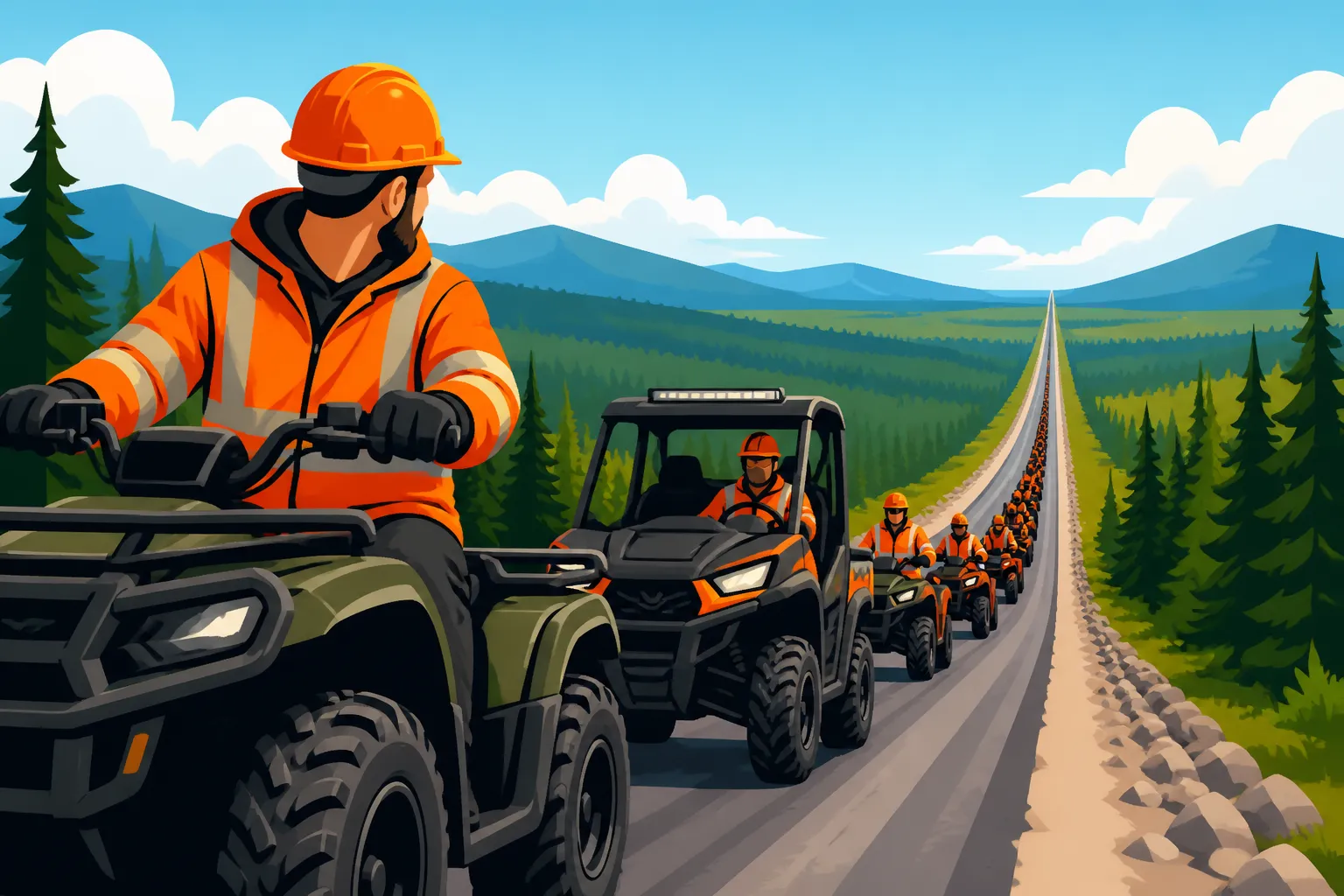
When you're sharing the road with cars and trucks, being seen is paramount. While your machine likely has basic lighting, consider augmenting it. High-visibility clothing for yourself and any passengers is a smart choice. Bright colours, reflective strips – anything that makes you stand out to other drivers, especially in low light conditions or adverse weather. For your machine, if your work requires frequent short road transits, consider adding features that enhance road-readiness. For example, SuperATV offers robust mirrors that improve your rear visibility, essential when merging or turning. They also provide various lighting solutions, from powerful LED light bars for off-road work that can double as enhanced forward lighting on roads, to amber flashing lights for utility vehicles. These accessories aren't just about looking good; they're about practical safety and utility when your ATV or UTV is pulling double duty as a workhorse on and off the asphalt.
Moreover, think about protection for your machine. Even a short stretch of paved road can kick up debris. A strong front bumper or a sturdy set of A-arm guards from a reputable brand like SuperATV can offer peace of mind, protecting critical components from unexpected impacts. Mud flaps can also prevent debris from being thrown at following vehicles. These considerations might seem minor, but they contribute to a safer, more efficient workday when your machine is briefly on public roads.
Disclaimer
This article is for general informational purposes only and does not constitute professional advice. Laws, prices and regulations vary by location and change over time. Consult a qualified professional for guidance on your specific situation.