Quebec Night Riding Fines From $250
It’s easy to get caught up in the thrill of the ride, especially when the sun starts to dip and the trails clear out. But if you’re riding your ATV or UTV in Quebec after hours, you might be in for a rude awakening that comes with a hefty price tag. Many riders are surprised to learn that Quebec has strict regulations on when you can hit the trails, and violating these rules, particularly at night, can lead to significant fines starting from $250. This guide is here to shed light on those crucial rules, the penalties you face, and how to enjoy Quebec's beautiful trail system without running afoul of the law.
The Restricted Riding Hours in Quebec
Quebec isn't like some places where you can ride your off-road machine whenever the spirit moves you. The province operates under a specific framework, laid out in the Loi sur les véhicules hors route (LVHR), which dictates when recreational vehicles like ATVs and UTVs can be operated on federated trails and authorized routes. Ignoring these set hours isn't just a minor infraction; it's a direct violation that carries real consequences.
The Standard Operating Hours
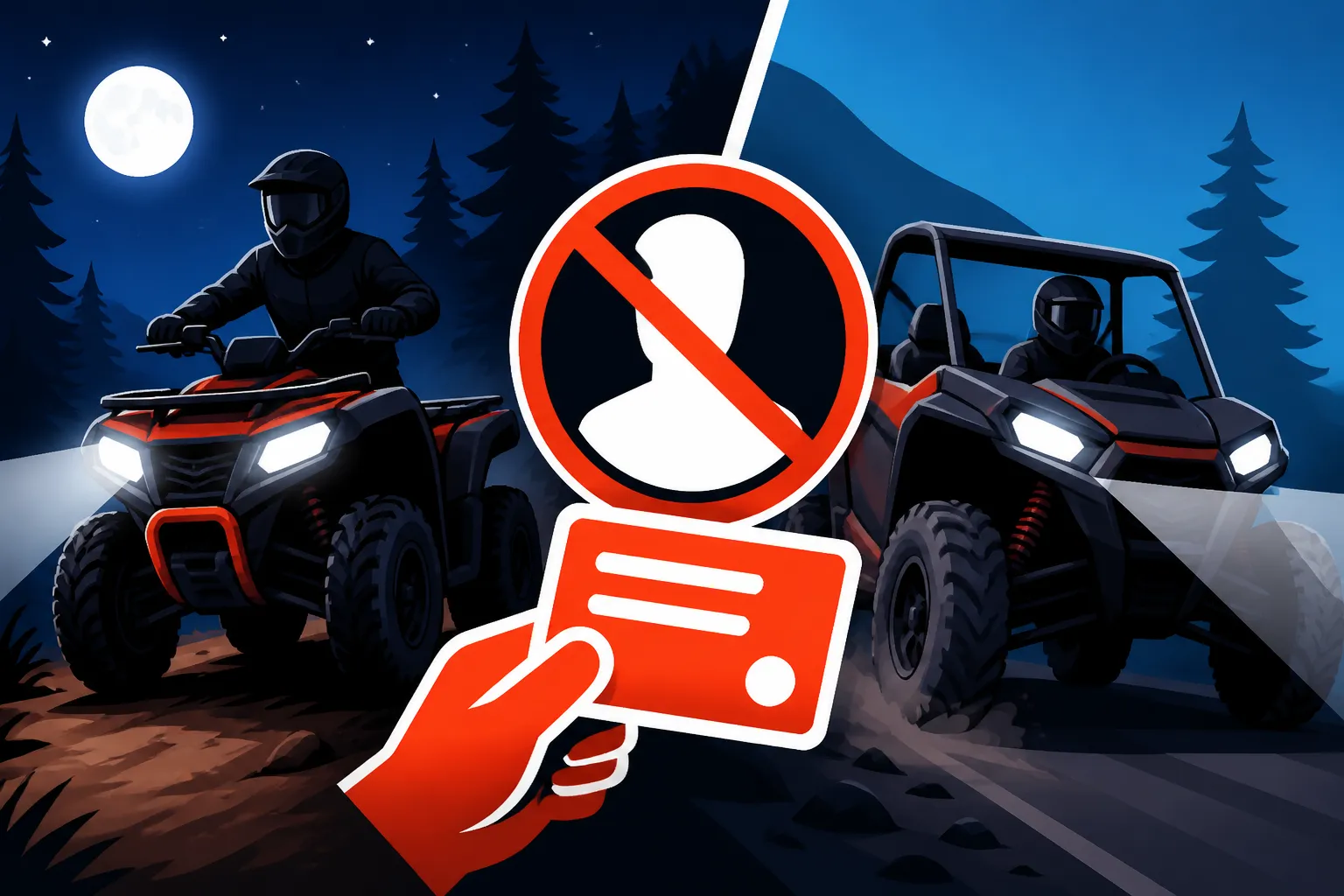
Under Quebec's Off-Highway Vehicle Act, the general rule of thumb for recreational ATV and UTV use is quite clear: you are permitted to ride between 6 a.m. and midnight. This window is firmly in place for a good reason, aiming to balance rider enjoyment with public safety, environmental protection, and the peace of mind for residents living near trails. It means that once the clock strikes midnight, your ride should be over and your machine parked until the morning. Similarly, before 6 a.m., even if the sun is just beginning to rise, you're expected to stay off the trails. This isn't some arbitrary suggestion; it's a legal mandate that trail patrols and police forces actively enforce. Imagine being out there, enjoying the quiet solitude of the forest under a moonlit sky, only to be stopped by a Sûreté du Québec officer or a club patroller who informs you that you're well past your legal curfew. It can certainly put a damper on an otherwise peaceful evening. This specific rule is detailed in [Quebec Riding Hours From 6 a.m. to Midnight].
Why the Restriction Exists
You might wonder why such strict hours are necessary. There are several compelling reasons behind Quebec's night riding restrictions. Primarily, it's about minimizing noise disturbances for communities. Off-road machines, while incredibly fun, can be quite loud, and their operation late at night can disrupt sleep and peace for those living close to trails. Think about a remote cabin or a small village: the sound of engines can carry far in the quiet of the night. Beyond noise, safety is a huge factor. Visibility is significantly reduced for both riders and potential obstacles, wildlife, or other trail users. Accidents are more likely to occur in low light conditions, and rescue efforts can be much more challenging in the dark. Wildlife is also more active at dawn, dusk, and throughout the night, increasing the risk of collisions. Finally, the restrictions help in managing the environmental impact by limiting activity during sensitive periods and making it easier for trail clubs to maintain the network without constant activity.
Municipal Variations to Consider
While the 6 a.m. to midnight rule is the provincial standard, it's crucial to remember that municipalities in Quebec have the authority to enact their own by-laws that can further restrict or, in some rare cases and with specific conditions, extend riding hours on their territory. This means that a trail that is perfectly legal to ride until midnight in one municipality might have an earlier cutoff, say 10 p.m., in another. These local rules are usually in response to specific community concerns, like noise complaints or proximity to residential areas. It’s absolutely vital for riders, especially those venturing into new areas, to check local regulations before planning a ride. Ignorance of a municipal by-law is not a valid defense if you're stopped and ticketed. Always check with the local ATV club or municipal office for the most up-to-date information for the specific area you plan to ride.
Understanding the Fines for Night Riding
When you hear about a "fine from $250," it's not just a warning; it's the starting point. Violating Quebec's night riding rules can quickly become an expensive mistake, and that initial figure can climb significantly depending on various factors. It's not a slap on the wrist; it's a serious financial penalty designed to deter non-compliance.
The Base Fine: Quebec Night Riding Fines From $250
Yes, the initial fine for riding outside the permitted hours starts at $250. This is the minimum amount you can expect to pay if you're caught operating your ATV or UTV between midnight and 6 a.m. on a federated trail or authorized off-road path. This base fine is established under the LVHR and is applied consistently across the province. It's important to understand that this figure is separate from any court costs or administrative fees that might be added to the total. So, while $250 might seem like a substantial hit to your wallet for a few hours of fun, it's often just the beginning of the financial repercussions. This particular aspect of the law is commonly referred to in discussions like [Quebec Night Riding Fines From $250].
Aggravating Factors and Increased Penalties
The $250 minimum fine can escalate rapidly if there are aggravating factors involved. For instance, if you're found to be riding recklessly, at excessive speeds, or causing property damage while riding after hours, the fines will be much higher. Factors like obstructing a trail, disturbing wildlife, or failing to comply with an officer's request can lead to additional and more severe charges. Consider a scenario where you're caught riding after midnight, you're going too fast for the conditions, and your machine's muffler has been modified to be excessively loud. You could easily be facing multiple tickets: one for riding outside the legal hours, another for excessive speed (check out [Quebec Speeding Fines From $90] for more on that), and potentially one for noise violations. Each of these carries its own fine, compounding the cost of a single ill-advised night ride. The cumulative effect of these penalties can quickly turn an evening joyride into a financial nightmare that runs into the hundreds, if not thousands, of dollars.
Additional Consequences Beyond the Fine
Beyond the immediate financial penalty, there can be other, equally frustrating consequences for violating night riding rules. In Quebec, fines for off-road vehicle infractions can also come with demerit points on your driver's license, especially if the infraction is deemed serious or involves reckless behaviour. Accumulating too many demerit points can lead to license suspension, affecting your ability to drive not just your ATV but also your car. In more extreme cases, particularly involving repeat offenses or dangerous behaviour, your off-road vehicle could even be seized by law enforcement. While this is less common for a first-time, simple night riding violation, it's a possibility that underscores the seriousness with which these laws are treated. Furthermore, if your actions lead to an accident or property damage, you could face civil liabilities, which means dealing with insurance claims and potentially personal lawsuits, adding a whole new layer of complexity and expense to your situation. [Quebec Penalties for Riding Unregistered] also gives a good overview of other penalties for various infractions.
Legal Riding Hours: A Deeper Dive
Understanding the exact legal framework for riding hours is key to staying compliant. It's not just about knowing "6 a.m. to midnight"; it's about understanding the nuances and specific situations that might alter or justify riding outside those general parameters.
The 6 a.m. to Midnight Window for Recreational Use
For the vast majority of recreational ATV and UTV riders in Quebec, the 6 a.m. to midnight window is an absolute. This 18-hour period is when you can legally operate your machine on the province's extensive network of federated trails and designated off-road areas. This window is primarily designed for leisure riding, exploring Quebec's breathtaking landscapes, and enjoying the camaraderie of fellow enthusiasts. It's during these hours that trail clubs often have their patrols out, maintaining safety and ensuring compliance with rules. If you're planning a trip, be it a day excursion or a multi-day adventure, make sure your planned stops and starts align with these times. Remember, even if you’re just pulling out of a private driveway onto a permitted trail at 5:50 a.m., you’re technically in violation. Similarly, rolling back into camp at 12:15 a.m. after a long day can land you a ticket. It might feel overly strict, but the law is the law, and enforcement doesn't always have a flexible interpretation.
Exceptions for Specific Scenarios
While the 6 a.m. to midnight rule is broad, Quebec law does recognize specific, legitimate exceptions, primarily for individuals using their off-road vehicles for work purposes. Farmers, trappers, and certain authorized workers might be permitted to operate their machines outside these hours if it's directly related to their professional duties. For instance, a farmer checking fences or moving livestock, or a trapper tending to their trapline, might need to be out before sunrise or after midnight. These are not open invitations for everyone to ride; they are highly specific exemptions for essential activities. Even in these cases, the operator is typically expected to adhere to all other safety regulations, including proper lighting and ensuring their machine is well-maintained and registered. If you fall into one of these categories, it's prudent to carry documentation proving the necessity of your off-hour operation, as patrols will likely question your presence on the trail outside normal hours. Information on general off-highway vehicle rules can be found in [Quebec ATV Road Rules Under the LVHR].
The Role of Local By-Laws in Riding Hours
As mentioned, local municipalities have a significant role in defining where and when ATVs and UTVs can be operated within their jurisdiction. While they generally can't override the provincial 6 a.m. to midnight maximum, they can impose more stringent restrictions. This means a town might have a by-law that closes trails at 10 p.m. or even earlier, especially if the trails run through or near residential areas. Conversely, some municipalities have specific agreements to allow limited road access for ATVs, often for short distances to connect trails or access services, and these routes might have their own set of hours that could diverge slightly from the main trail network. It's not enough to know the provincial law; you truly need to be aware of the local regulations for every area you plan to ride. Consulting the local ATV club's website or official municipal channels before your ride is always the best practice to avoid an unexpected fine.
Enhancing Safety for Permitted Night Riding
Even when riding within the legal hours, hitting the trails when natural light is fading or completely gone presents unique challenges. The Quebec rules prioritize safety, and as a rider, you have a responsibility to go above and beyond just legal compliance to ensure your own well-being and that of others.
Visibility and Lighting Needs
Riding in low light conditions – be it at dusk, dawn, or after dark but before midnight – demands superior visibility. Your machine's factory headlights and taillights are the bare minimum legal requirement. These are vital for you to see what’s ahead and for others to see you. However, for serious night riding, many experienced Quebec riders opt for additional lighting. Auxiliary LED light bars, spot lights, or flood lights can dramatically improve your field of vision, helping you spot trail hazards like fallen trees, deep ruts, or unexpected wildlife much sooner. Brands like SuperATV offer a wide range of robust lighting solutions designed specifically for off-road vehicles, providing brighter, wider beams that can transform your night riding experience. While not legally required beyond the basic factory lights, these enhancements are a game-changer for safety. [Quebec Lighting Requirements at Night] provides further details on mandatory equipment.
Navigating Terrain in the Dark
The familiar trails you ride during the day can become entirely different beasts at night. Shadows can obscure dips and bumps, distances can be harder to judge, and the overall perception of the terrain is diminished. What might be a simple rock garden by day could become a tricky obstacle course after dark. It's crucial to significantly reduce your speed when riding at night, even on known trails. Your reaction time needs to be greater, and your ability to spot and avoid hazards is compromised. Pay extra attention to trail markers, as they can be harder to see. Many experienced riders also prefer to ride with others at night, ensuring that there’s always someone available to assist in case of a breakdown or an accident. The buddy system is not just for moral support; it’s a critical safety measure when venturing out after sundown.
Preparing for Emergencies at Night
An emergency on the trail is always a concern, but at night, it can escalate quickly. A simple breakdown that might be an annoyance during the day can become a dangerous situation when temperatures drop and visibility is nil. Always carry essential emergency gear: a well-stocked first-aid kit, a flashlight or headlamp with extra batteries, a fully charged cell phone (though coverage can be spotty in remote areas), a satellite messenger or GPS device, and enough warm clothing to stave off hypothermia if you're stranded. Knowing basic machine repair, like how to fix a flat tire or replace a belt, is also invaluable. If possible, inform someone of your planned route and estimated return time. Being prepared for any eventuality, especially when the sun isn't providing its helpful light, is a hallmark of a responsible Quebec rider.
Equipment Requirements and Legal Obligations
Beyond the time restrictions, Quebec law mandates specific equipment for all off-highway vehicles, especially when riding during periods of reduced light. These aren't just suggestions; they are legal necessities that patrols check for.
Headlights and Tail Lights Standards
Every ATV and UTV operated in Quebec must be equipped with at least one headlight and one taillight. These lights must be in good working order and emit a white or amber light to the front and a red light to the rear. The law specifies that these lights must be turned on during periods of reduced visibility, which includes riding after dark, at dawn, or in conditions like heavy fog or snowfall. It's not enough to have them; they must be functional and illuminated. A burnt-out bulb or a broken lens can lead to a fine. Before every ride, especially if you anticipate being out after dark (within the legal hours, of course!), give your lighting system a quick check. Ensure your lights are clean and free of mud or snow, as even a thin layer can significantly diminish their effectiveness.
Reflective Gear for Riders
While not always explicitly outlined as a standalone "fine" for night riding, wearing reflective gear significantly enhances your visibility to others, whether they are other riders, pedestrians, or even search and rescue teams in an emergency. Many quality riding jackets and helmets come with integrated reflective elements. If yours doesn't, consider adding reflective tape to your helmet, jacket, or even your machine. This passive form of lighting can make a huge difference in how quickly you are spotted by an approaching vehicle or trail patrol, especially on corners or crests where direct light might not immediately illuminate you. It's a simple, inexpensive safety measure that aligns with the spirit of Quebec's emphasis on rider safety.
Auxiliary Lighting and Accessories
Many riders in Quebec recognize that factory lighting, while legal, isn't always sufficient for optimal night vision or safety. This is where auxiliary lighting comes in. Aftermarket LED light bars, like those offered by SuperATV, can cast a much wider and brighter beam, illuminating not just the path directly ahead but also the surrounding terrain, which is invaluable for spotting wildlife or potential hazards hidden in shadows. Some riders also install side-facing or rear-facing auxiliary lights for increased situational awareness. Beyond lighting, other accessories contribute to safer night riding, such as robust skid plates for unexpected impacts in low light, or a quality winch for self-recovery if you get stuck in a tricky, dark spot. Investing in good quality, durable accessories is not just about performance; it's a vital part of preparing your machine for the specific demands of riding in the reduced light of a Quebec evening.
Enforcement, Penalties, and Contesting a Fine
Knowing the rules is one thing; understanding how they're enforced and what to do if you receive a ticket is another. Quebec has a robust system for monitoring off-highway vehicle use, and the consequences for non-compliance are clear.
Who Conducts Checks on the Trails
In Quebec, enforcement of off-highway vehicle laws, including night riding restrictions, falls primarily to two groups: the Sûreté du Québec (SQ), the provincial police force, and authorized trail patrols from federated ATV clubs. The SQ has full policing powers and can issue fines, inspect machines, and take enforcement actions. Club patrols, on the other hand, are often volunteers from the Fédération Québécoise des Clubs Quads (FQCQ) who have been granted specific authority to enforce certain aspects of the LVHR. They can check for valid trail passes, proper registration, and adherence to operating hours. While a club patroller might not have the same power as an SQ officer, they can certainly issue citations and summon an SQ officer if there are more serious violations or non-compliance. It's important to respect both types of authorities on the trail. [What a Patrol Can Ask to See] details the documents they might request.
The Process of Receiving a Ticket
If you are stopped by an SQ officer or a club patroller for riding outside the permitted hours, the process typically involves identification verification, an explanation of the alleged infraction, and the issuance of a statement of offense (a ticket). They will ask for your driver's license, your machine's registration (which also includes your mandatory liability insurance from the SAAQ), and your FQCQ trail pass. If you're caught riding after midnight, the officer will explain that you are in violation of the LVHR. They will record the details of your machine, the time, location, and the specific offense. The ticket will clearly state the fine amount, the due date, and instructions on how to pay or contest the fine. Remember, even if you disagree with the ticket, it's best to remain polite and cooperative during the stop. Arguing with an officer on the trail is unlikely to get the ticket dismissed and could potentially lead to further charges.
Contesting a Fine for Night Riding
If you believe you were unjustly ticketed for night riding, you have the right to contest the fine. The instructions for doing so will be printed on the back of your statement of offense. Generally, this involves notifying the court within a specified timeframe (often 30 days) of your intention to plead not guilty. You will then be given a court date to present your case before a judge. When contesting a fine, it's crucial to have solid evidence or a legitimate legal defense. Simply stating that you "didn't know" the rules is rarely an acceptable defense in court. You might argue, for example, that you were operating within a specific municipal exception, or that you were performing a work-related duty that is exempt. Be prepared to provide documentation and clear arguments to support your claim. While the process can be lengthy and require legal assistance, it's an option for those who genuinely believe their ticket was issued in error.
Quebec ATV Night Riding Rules and Penalties Summary
To give you a quick overview of the key points regarding night riding in Quebec, here’s a handy table:
| Aspect | Description | Important Considerations |
|---|---|---|
| Legal Riding Hours | Generally, 6 a.m. to midnight. This 18-hour window is strictly enforced for recreational ATV/UTV use on federated trails and authorized routes. | Riding outside these hours is a violation. Always check local municipal by-laws, as they can impose earlier closing times. |
| Base Fine | Starts at $250. This is the minimum penalty for operating an off-highway vehicle between midnight and 6 a.m. | This figure does not include additional court costs or administrative fees. |
| Aggravating Factors | Reckless riding, excessive speed, noise violations (e.g., modified exhaust), property damage, failure to comply with an officer. | Each additional infraction carries its own fine, significantly increasing the total penalty. May result in demerit points or even vehicle seizure in severe or repeat cases. |
| Exceptions | Limited exceptions exist for specific work-related duties (e.g., farmers, trappers). These are highly specific and require justification. | Riders claiming an exception should carry documentation proving the necessity of their off-hour operation. |
| Mandatory Equipment | At least one functional headlight (white/amber) and one taillight (red) must be on during reduced visibility. | Ensure all lights are clean and working before any ride, especially if you anticipate low light. Consider auxiliary lighting (like from SuperATV) for enhanced safety. |
| Enforcement | Sûreté du Québec (provincial police) and authorized FQCQ trail patrols. | Both authorities can issue citations. Cooperate respectfully during a stop. |
| Contesting a Fine | You have the right to contest a fine by notifying the court within the specified timeframe. Requires a valid legal defense and supporting evidence. | "I didn't know the rules" is generally not a valid defense. Seek legal advice if needed. |
Riding your ATV or UTV in Quebec offers an incredible way to experience the province's natural beauty. However, doing so responsibly means understanding and adhering to the rules, especially those governing operating hours. While the thought of a fine starting from $250 for night riding is certainly a deterrent, the ultimate goal of these regulations is to ensure the safety of all trail users, protect the environment, and maintain peace for communities. By respecting the 6 a.m. to midnight window, equipping your machine properly, and being aware of local nuances, you can ensure your Quebec quad adventures are memorable for all the right reasons, not for an unexpected ticket. Remember to consult resources like [Quebec SAAQ Forms for a Private Sale] if you're ever getting a new machine, or [Quebec ATV Registration Costs Explained] to understand the ongoing commitments of ownership.
Disclaimer
This article is for general informational purposes only and does not constitute professional advice. Laws, prices and regulations vary by location and change over time. Consult a qualified professional for guidance on your specific situation.