Quebec Registration for a Snowmobile Compared
For anyone who enjoys exploring Quebec's vast natural playground, whether it's tearing up a summer trail on a quad or gliding through a snow-covered forest on a snowmobile, you've likely noticed that while the machines are different, the essential process of getting them registered feels remarkably similar. This often leaves owners wondering: how truly alike are the rules for registering a snowmobile versus an ATV in Quebec, and where do the critical differences lie that could trip you up? This comprehensive guide will walk you through the nuances of registering both your snowmobile and your ATV, highlighting the common ground and the distinct requirements for each, so you can hit the trails confidently and legally.
Why Quebec's Off-Road Registration System Feels Familiar
One of the first things off-road enthusiasts discover in Quebec is the central role played by the Société de l'assurance automobile du Québec (SAAQ). It’s not just for your car or motorcycle; the SAAQ is also the primary body responsible for registering all off-highway vehicles, which includes both your ATV (or VTT as it's often called here) and your snowmobile. This unified approach, while sometimes leading to confusion about specific regulations, actually streamlines many of the core administrative tasks for owners. You're dealing with the same government agency, often using similar forms and following comparable procedures.
The SAAQ: One Stop for Two Types of Machines
It might seem unusual to have the same authority handling everything from passenger cars to snowmobiles, but in Quebec, it's a deliberate choice aimed at consolidating vehicle safety and insurance under one roof. When you visit an SAAQ service counter, whether you're bringing in papers for a newly purchased quad or renewing your snowmobile registration, you’ll encounter the same general system. The clerks are trained across a broad spectrum of vehicle types, which can be a relief if you own multiple machines. This consistency means that if you've registered an ATV before, the concept of registering a snowmobile won't feel entirely alien, and vice-versa. It's about providing a clear, single point of contact for all things related to vehicle ownership, registration, and the mandatory liability insurance that comes with it. This also makes it easier for the SAAQ to manage revenue for road safety initiatives, even if your quad or sled rarely touches pavement. You can learn more about [What the SAAQ Actually Does for Quad Owners] in another one of our posts.
The Philosophy Behind Quebec's Unified Approach
At its heart, Quebec’s system is designed to ensure public safety and accountability across all vehicle types that operate within its borders, whether on public roads or designated trails. For off-highway vehicles like ATVs and snowmobiles, this means mandatory registration ensures that every machine has a clear owner, is part of a traceable system, and carries the required liability insurance. The SAAQ acts as both the registrar and insurer, automatically bundling a minimum level of liability coverage with your annual registration fee. This is a crucial aspect for both quads and snowmobiles, as it protects riders and the public from the financial fallout of an accident. While the specific rules of operation differ greatly between a summer quad and a winter sled, the foundational requirement for identification and insurance is the same. It's a pragmatic approach to managing a diverse fleet of vehicles that all contribute to Quebec's vibrant outdoor recreation scene. This is why [Quebec's SAAQ Is Registrar and Insurer] for these machines.
Key Differences in Paperwork and Proof of Ownership
While the SAAQ is your main point of contact for both types of machines, the specific documentation you need, especially when buying from a private seller or importing, can have subtle but important differences. Understanding these nuances upfront can save you a lot of grief and extra trips to the service counter.
Required Documents for First-Time Registration
When you walk into an SAAQ office to register either an ATV or a snowmobile for the first time, you'll need to present proof of ownership. For a new machine purchased from a dealer, this typically means the bill of sale from the dealership, often pre-filled with the necessary SAAQ details. If you bought privately, you'll need a bill of sale signed by both parties, clearly stating the sale price, date, and machine details, along with the seller's registration certificate. It’s critical that these documents are clear and complete. For an ATV, the proof of ownership establishes that you are the rightful owner of a VHR (Véhicule Hors Route) class machine. For a snowmobile, it establishes ownership of a specific model that falls under the province's snowmobile regulations. While the type of document (bill of sale) is the same, the specific details pertaining to snowmobile vs. ATV models, engine sizes, and classifications might be slightly different on the SAAQ’s internal systems, so ensure all details are accurate on your paperwork. Services like LawDepot can be invaluable for drafting robust bills of sale for private transactions, ensuring all necessary fields are covered. If you need help, check out [Quebec Registration Paperwork Checklist] for more details.
Transferring Ownership: What Differs, What's the Same
The process of transferring ownership for a privately sold ATV or snowmobile is largely identical. Both the buyer and the seller must appear at an SAAQ service outlet, or the buyer can go alone with the seller's signed registration certificate and a bill of sale. The seller's registration acts as a key document for both machine types, confirming their legal right to sell and helping the SAAQ verify the transaction. The primary difference often lies in the specific forms or internal classification codes used by the SAAQ, but from the owner's perspective, the steps are parallel. You'll declare the sale price, pay the applicable sales tax (for either machine!), and the new registration certificate will be issued in your name. This ensures a clean transfer of legal responsibility and insurance coverage. It's also important to remember that if the machine has a lien against it, such as from a financing company, that lien needs to be addressed before the SAAQ will finalize the transfer. For private sales, having a standardized bill of sale template, perhaps from a resource like LawDepot, can make the process smoother and prevent disputes. [Quebec SAAQ Forms for a Private Sale] are essentially the same for either machine, but it’s always wise to verify.
Dealing with Missing or Incomplete Papers
This is where things can get a bit more challenging, regardless of whether it's an ATV or a snowmobile. If you've acquired a machine without a proper bill of sale or the previous owner's registration certificate, you're in for some extra steps. The SAAQ is strict about proving ownership to prevent theft and fraud. For both types of machines, you might need to provide additional evidence like sworn affidavits, previous registration documents, or even a police report if the machine was recovered after being stolen. The lack of a clear paper trail can delay your registration significantly. In some cases, for very old machines or those with a truly murky history, you might be asked to provide more unique forms of proof. This is a common frustration for folks trying to register a vintage sled or an older quad that has changed hands many times informally. The SAAQ's goal is to be absolutely certain you are the rightful owner before they issue a new registration and plate. Having documentation, even if it's just a simple handwritten agreement, can be helpful, but formal proof is always preferred.
Navigating the Annual Renewal Process for Both Machines
Once your ATV or snowmobile is initially registered, you enter the annual renewal cycle. This is another area where the SAAQ strives for consistency, making the renewal process very similar for both types of off-road vehicles. While the specific renewal dates might be staggered by machine type or even by region, the steps you take to keep your registration current are largely the same.
Receiving Your Renewal Notice
Just like with your car, the SAAQ sends out renewal notices well in advance of your registration expiry for both ATVs and snowmobiles. These notices typically arrive in the mail, but many owners now opt for digital notifications. The notice will clearly state your renewal date, the amount due, and provide instructions on how to complete the renewal. For a quad, this usually covers the VHR plate, while for a snowmobile, it's for its specific snowmobile plate. It's crucial to pay attention to these notices, as riding with an expired registration is a serious offense that can lead to fines and even seizure of your machine. Keep your contact information with the SAAQ up to date so you don't miss these important reminders. Missing your [Quebec Registration Renewal Notices] can lead to unpleasant surprises later.
Online vs. In-Person Renewal Nuances
For the vast majority of owners, renewing their ATV or snowmobile registration can be done conveniently online through the SAAQ's website. This is often the quickest and easiest method, allowing you to pay your fees and update your information from the comfort of your home. You'll need your renewal notice and payment method. However, if there are any changes to your information (like an address change), if you've recently transferred ownership and need to pay taxes, or if you're dealing with a special circumstance, you might still need to visit an SAAQ service counter in person. For example, some people prefer in-person renewals just for the peace of mind of speaking with a representative, or if they have questions about [Quebec ATV Registration Costs Explained]. The option to renew online is a major convenience for both ATV and snowmobile owners, reflecting the SAAQ’s move towards digital services.
What Happens If You Miss the Deadline
Missing your registration renewal deadline for either an ATV or a snowmobile can lead to immediate consequences. The moment your registration expires, your machine is no longer legally registered to operate on federated trails or approved road sections, and your mandatory liability insurance lapses. If you're caught riding an unregistered machine by a trail patrol or police officer, you could face significant fines. In some cases, your machine might even be impounded. The SAAQ doesn't typically offer a grace period, so it’s essential to renew on time. If you do miss the deadline, you’ll need to go through the renewal process as soon as possible, and you might have to pay a small penalty in addition to the regular registration fees. The good news is that the process for reactivating an expired registration is the same for both quads and snowmobiles: pay your dues, and you're back in business.
Understanding the Unique Operating Rules That Stem from Registration
While the registration process has many similarities, the implications of that registration for how and where you can ride your ATV versus your snowmobile diverge significantly. This is where the legal framework for each machine type truly separates.
Plates and Their Placement
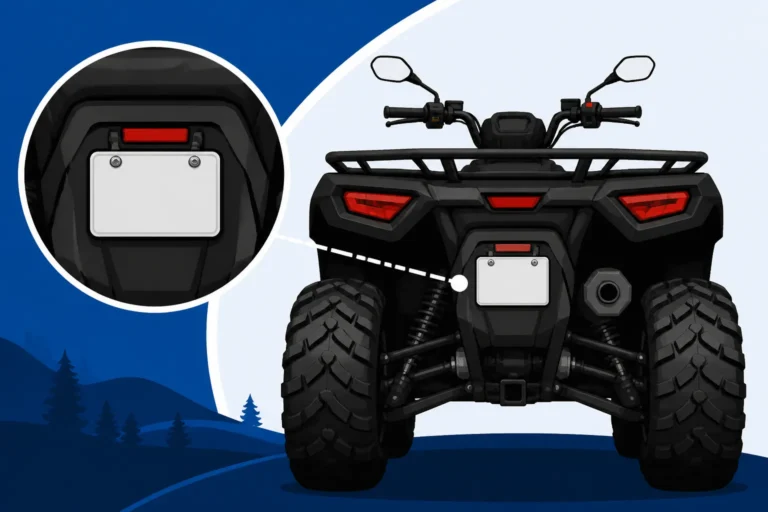
Both ATVs and snowmobiles require a valid registration plate issued by the SAAQ. However, the plates themselves are distinctly different in appearance and are mounted in different locations due to the design and usage of each machine. ATV plates are typically called VHR plates, short for "Véhicule Hors Route" (off-road vehicle), and are designed to be relatively small and sturdy, usually mounted on the rear fender where they are visible but less prone to damage from trail riding. You can see [Why a VHR Plate Fits on a Fender] in another one of our articles. Snowmobile plates, on the other hand, are designed for the specific body shape of a snowmobile, often rectangular and mounted on the tunnel or rear, again, in a highly visible location. The differences in plate design and placement are purely functional, reflecting the practicalities of mounting them securely and visibly on two very different types of vehicles.
Insurance: A Shared Mandatory Minimum
A critical similarity that stems directly from SAAQ registration is the mandatory liability insurance. For both ATVs and snowmobiles registered in Quebec, the SAAQ provides basic third-party liability coverage as part of your annual registration fee. This coverage protects you against damages you might cause to another person or their property if you're deemed at fault in an accident. Previously, the minimum was $500,000, but this has increased. You can read more about [Why a Million Became the Floor]. This is a fundamental safety net that ensures all registered off-road vehicle operators are covered. While the SAAQ provides this basic coverage, many owners choose to purchase additional private insurance for their ATVs or snowmobiles to cover damage to their own machine, theft, or higher liability limits. This supplementary insurance is separate from the SAAQ registration, but the base coverage is a shared and non-negotiable part of owning either a registered quad or a sled in Quebec.
Where Your Registered Machine Can Legally Go
This is arguably the most significant area where registered ATVs and snowmobiles differ. While both are off-highway vehicles, their designated operating environments are distinct, dictated by Quebec's off-highway vehicle laws.
- ATVs (Quads): A registered ATV is primarily intended for use on Quebec's vast network of federated ATV trails, which are maintained by clubs under the FQCQ (Fédération Québécoise des Clubs Quads). There are strict rules about road access for ATVs; generally, they can only use public roads for short distances (up to 1 kilometre) to connect trails, access services like gas, or cross roads at designated points, and only if specifically authorized by municipal by-law and marked with appropriate signage. Riding a registered ATV on a major highway or unauthorized public road can lead to significant fines. The [Quebec ATV Road Rules Under the LVHR] are quite strict.
- Snowmobiles: A registered snowmobile operates almost exclusively on designated snowmobile trails, which are maintained by clubs under the FCMQ (Fédération des Clubs de Motoneigistes du Québec). Like ATVs, snowmobiles have very limited access to public roads, primarily for crossing or connecting trails, and this is typically in specific, marked areas during the winter season. They are not designed or permitted for general road use. The distinct seasonal nature of snowmobiling also means that their operational rules, trail closures (e.g., spring thaw), and trail pass requirements are tailored to winter conditions.
In essence, while the SAAQ is the gateway for registration for both, the type of machine dictates where that registration grants you legal passage. Both require trail passes to use the federated networks, but these passes are specific to the machine type (an FQCQ pass for ATVs, an FCMQ pass for snowmobiles).
Here’s a quick overview of the key comparison points for registering your ATV versus your Snowmobile in Quebec:
| Feature | Quebec ATV (VTT) Registration | Quebec Snowmobile Registration |
|---|---|---|
| Administering Body | SAAQ (Société de l'assurance automobile du Québec) | SAAQ (Société de l'assurance automobile du Québec) |
| Primary Documents | Bill of sale, proof of identity, previous registration (if applicable) | Bill of sale, proof of identity, previous registration (if applicable) |
| Proof of Ownership | Bill of sale is crucial, especially for private sales. LawDepot templates are useful. | Bill of sale is crucial, especially for private sales. LawDepot templates are useful. |
| Mandatory Insurance | SAAQ-provided third-party liability (minimum $1 Million) included with registration. | SAAQ-provided third-party liability (minimum $1 Million) included with registration. |
| Registration Plate | VHR plate (Véhicule Hors Route), typically smaller and mounted on rear fender. | Snowmobile plate, typically rectangular, mounted on rear/tunnel. |
| Annual Renewal | Annual renewal notice from SAAQ; online or in-person options. | Annual renewal notice from SAAQ; online or in-person options. |
| Operational Season | Primarily spring, summer, fall (year-round on some trails) | Primarily winter (December-April) |
| Trail Network Access | FQCQ (Fédération Québécoise des Clubs Quads) federated trails, requires FQCQ trail pass. | FCMQ (Fédération des Clubs de Motoneigistes du Québec) federated trails, requires FCMQ trail pass. |
| Public Road Access | Very limited; typically 1km connections, specific crossings, only where signed and authorized. | Very limited; specific crossings, trail connections, only where signed and authorized. |
Understanding these similarities and differences ensures you’re not caught off guard, allowing you to enjoy Quebec’s magnificent landscapes, whether on four wheels or two skis.
Disclaimer
This article is for general informational purposes only and does not constitute professional advice. Laws, prices and regulations vary by location and change over time. Consult a qualified professional for guidance on your specific situation.