Quebec’s VHR Vehicle Class
It's no secret that navigating the world of off-road vehicles in Quebec can feel like a maze, especially with all the specific terminology and regulations. Many of us just want to hit the trails, but first, we need to understand the foundational concept of the "VHR vehicle class" – what it is, why it matters, and how it impacts everything from registration to riding rules. This guide is here to untangle that, helping you understand this crucial classification so you can get your machine properly squared away and enjoy Quebec's incredible trail network with peace of mind.
What Exactly Is a VHR Vehicle Class?
When you talk about ATVs, quads, or side-by-sides in Quebec, you'll often hear the term "VHR." It's more than just a casual description; it's a specific legal classification that governs how these machines are treated under provincial law. Understanding what this class encompasses is the very first step to being a responsible off-road vehicle owner here.
Defining VHR: Véhicule Hors Route
VHR stands for véhicule hors route, which literally translates to "off-road vehicle." In Quebec, this term is used by the Société de l'assurance automobile du Québec (SAAQ) to categorize a broad range of machines primarily designed for use off paved roads. This includes the classic four-wheeled ATVs (often called VTTs, for véhicule tout-terrain), as well as the increasingly popular side-by-sides. It’s a legal definition that comes with a host of specific requirements for registration, insurance, and operation. Unlike a car or a motorcycle, which are designed for public roads, VHRs have their own distinct regulatory framework, reflecting their unique use cases and potential risks.
The classification is important because it dictates everything from the type of license plate you receive – a distinct "VHR" plate – to the mandatory liability insurance you must carry. Without being properly classified and registered as a VHR, your machine cannot legally be operated on federated trails or even for short distances on authorized public roads in Quebec. It’s the foundational piece of the puzzle for any off-road enthusiast in the province.
Historical Context of the Classification
The formal classification and regulation of VHRs in Quebec aren't new, but they have certainly evolved over time, especially with the passage of the Act respecting off-highway vehicles (often referred to as the LVHR for Loi sur les véhicules hors route). This piece of legislation codified many of the rules that off-roaders live by today. Before such comprehensive acts, regulations were perhaps more piecemeal, leading to varying interpretations and safety standards. The LVHR, particularly with its major updates and revisions, aimed to standardize the expectations for all VHR owners and operators across the province.
This evolution has meant clearer rules regarding age limits, helmet requirements, permissible operating hours, and even where you can and cannot ride. For instance, the 2021 changes introduced significant updates, making it even more crucial for owners to understand their obligations. These legal shifts have progressively tightened up the framework, reflecting a greater emphasis on rider safety, environmental protection, and ensuring harmonious coexistence with other land users. The VHR classification is the legal vessel through which these regulations are applied, providing a clear legal identity for your off-road machine within Quebec's legislative landscape. For more on how things have changed, take a look at [What Quebec's Off-Highway Vehicle Act Changed for Owners].
Why Does Quebec Have a Special VHR Class?
You might wonder why Quebec needs a distinct classification like VHR when other provinces might just lump these machines under general "off-road" categories. The truth is, it's all about comprehensive regulation, safety, and ensuring that the unique characteristics and uses of these vehicles are properly addressed. It’s not just red tape; it's a system designed to protect riders, the public, and the environment.
The SAAQ's Central Role in VHR Regulation
One of the most defining aspects of Quebec's VHR system is the central role played by the SAAQ. Unlike many other jurisdictions where vehicle registration and insurance might be handled by separate entities, the SAAQ acts as both the registrar and the mandatory insurer for all off-road vehicles. This integrated approach simplifies the process for owners – you get your plate and your basic liability insurance all at once when you register your VHR with the SAAQ. This one-stop-shop model ensures that every legally registered VHR on Quebec trails automatically carries the minimum required liability coverage, which is a massive safety net for everyone involved in case of an accident.
This system means that when you go to register your new (or new-to-you) quad, you're not just getting a plate; you're also fulfilling your legal obligation for basic insurance. It streamlines compliance and ensures a higher rate of insured machines on the trails, which ultimately benefits the entire riding community. To understand this unique setup better, you might find [Why the SAAQ Registers and Insures Your Quad] a helpful read.
Ensuring Safety, Liability, and Trail Sustainability
The VHR classification, coupled with the SAAQ's oversight, is fundamentally about safety, liability, and the long-term sustainability of off-road riding in Quebec. Off-road vehicles, by their very nature, carry different risks than passenger cars. They operate on varied terrain, often at higher speeds in remote areas, and can be involved in accidents that have significant consequences. The VHR framework addresses this by:
- Mandatory Liability Insurance: As mentioned, every registered VHR must carry liability insurance through the SAAQ. This ensures that if you're involved in an accident and are deemed at fault, there's coverage for damages to third parties. The current minimum liability coverage is substantial, offering robust protection. In fact, [The $1 Million Liability Floor Every Owner Carries] is a key component of this.
- Regulatory Framework: The VHR classification allows the province to set specific rules for operation, such as age restrictions, helmet laws, and speed limits, which are tailored to the realities of off-road riding. These rules are crucial for mitigating risks and promoting responsible behavior.
- Funding Trail Infrastructure: The fees collected for VHR registration and trail passes contribute directly to the maintenance and expansion of Quebec's extensive federated trail network. Without this classification and the associated financial contributions, the incredible 25,000+ kilometres of trails we enjoy wouldn't exist or be maintained to current standards. It's a system where everyone contributes to the common good of the riding community.
Common Types of Machines in the VHR Class
When we talk about VHRs, we're really talking about a diverse group of machines, each with its own characteristics and uses. While the core VHR classification applies to all, understanding the nuances between them is important, especially when it comes to specific riding rules or registration details.
ATVs (Quads or VTTs)
The classic ATV, often called a quad or VTT (véhicule tout-terrain), is perhaps the most iconic VHR. These four-wheeled machines are designed for a single rider or, in some cases, a driver and a passenger if factory-equipped with a passenger seat and footrests. They are incredibly versatile, capable of handling everything from tight forest trails to muddy fields, making them popular for recreation, hunting, and light utility work. ATVs are generally smaller and more agile than side-by-sides, which can be an advantage on narrower trails.
Registration for an ATV falls squarely under the VHR class, requiring a specific plate from the SAAQ and adherence to all VHR regulations regarding age, licensing, and equipment. The purchase and ownership of an ATV in Quebec will always funnel through the VHR system, ensuring that the machine is recognized, insured, and ready for the trails.
Side-by-Sides (SxS or UTVs)
Side-by-sides, also known as SxSs or UTVs (Utility Task Vehicles), have seen a massive surge in popularity. These machines resemble miniature cars, with steering wheels, foot pedals, and bucket seats, allowing passengers to sit side-by-side with the driver. They typically come in two-seater and four-seater configurations and often boast more cargo capacity and a smoother ride than traditional ATVs, making them ideal for longer excursions, family rides, or heavier utility tasks.
While they offer a different riding experience, side-by-sides are unequivocally VHRs in Quebec. They too require a VHR plate from the SAAQ and are subject to all the same underlying VHR laws, though some specific rules might apply, such as a higher minimum age for drivers compared to ATVs. For instance, [Quebec Requires 18 for a Side-by-Side] while ATV riders can be younger with proper certification. The process for [Registering a Side-by-Side in Quebec] is largely the same as for an ATV, though you'll always want to confirm factory-installed passenger capacity for multi-person machines.
Other VHR Machine Types
While ATVs and side-by-sides dominate the VHR landscape, the classification can sometimes extend to other specialized off-road vehicles. This might include certain types of tracked vehicles designed for snow or rough terrain, or perhaps very specific utility machines that operate off-road. However, the vast majority of personal recreational off-road vehicles you'll encounter and want to register will be either an ATV or a side-by-side. Machines like dirt bikes, for example, have their own distinct classification and rules, separate from the VHR category, and are not registered or operated under the same framework as quads and side-by-sides. If you're unsure if a specific machine falls into the VHR class, the SAAQ is always the best resource for clarification, as incorrect classification could lead to significant issues.
Registration and Titling for Your VHR Machine
So, you've got your VHR machine, and you're ready to explore. The next crucial step is getting it properly registered and titled with the SAAQ. This isn't just a formality; it's a legal requirement that unlocks your ability to ride on Quebec's federated trails and ensures you're covered by mandatory liability insurance.
Initial Registration Steps at the SAAQ
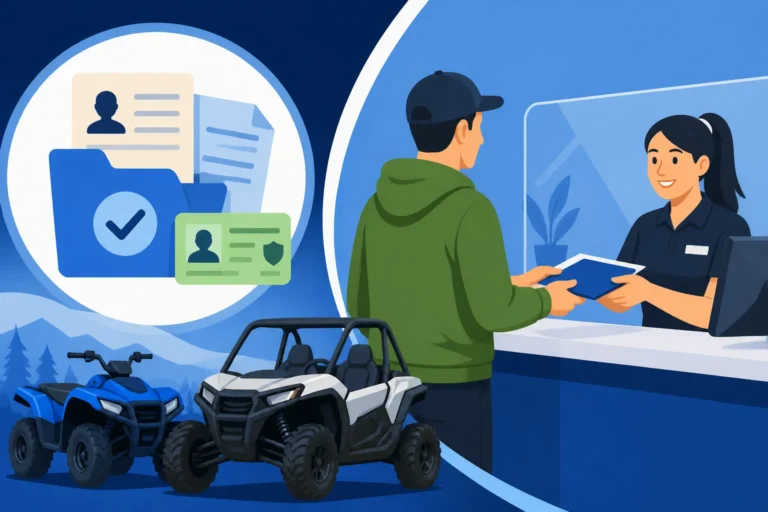
The process to register your VHR in Quebec, whether it's a brand-new ATV from a dealer or a used side-by-side from a private seller, generally starts at a SAAQ service counter. You can't just send in a form; you typically need to visit in person to finalize the registration and receive your VHR plate.
Here’s a general rundown of what you’ll need:
- Proof of Identity: A valid driver's license or other government-issued ID.
- Proof of Ownership: This is critical. For a new machine, you'll have a new vehicle information statement (NVIS) or a similar document from the dealer. For a used machine, you'll need a properly executed bill of sale.
- Machine Information: Details like the vehicle identification number (VIN) and engine size.
- Payment: For the registration fees and the mandatory SAAQ liability insurance.
The SAAQ agent will verify your documents, process the registration, and issue you the distinctive VHR plate. This plate must then be affixed to your machine in a visible location. For a comprehensive guide on this, refer to [How to Register an ATV in Quebec]. It's a straightforward process if you come prepared, but missing documents can cause frustrating delays.
The Importance of Proof of Ownership and Sales Documents
This cannot be stressed enough: maintaining clear and proper proof of ownership is paramount when dealing with VHRs in Quebec. Whether you're buying or selling, these documents are your legal lifeline.
- For New Purchases: When you buy from a dealer, they typically handle a lot of the initial paperwork and provide you with all the necessary documents for the SAAQ. They'll give you a receipt and a statement of new vehicle information that proves you are the first registered owner.
- For Private Sales: This is where many people run into issues if they're not careful. When buying a used VHR from a private individual, you absolutely need a clear, legible, and properly filled out bill of sale. This document should include:
- The date of sale.
- The full names and addresses of both the buyer and the seller.
- A detailed description of the VHR, including make, model, year, and VIN.
- The agreed-upon sale price.
- Signatures of both parties.
Without a robust bill of sale, the SAAQ may refuse to register the machine in your name, leaving you with a VHR you can't legally ride. Resources like LawDepot can be incredibly helpful for finding reliable bill of sale templates that meet Quebec's requirements, ensuring all necessary fields are covered. It might seem like overkill, but trust me, having proper paperwork upfront saves you headaches down the line. Check out [Quebec Registration and Proof of Ownership] for more details on this. It's especially crucial for [Paperwork Two Individuals Sign on a Private Sale].
Annual Renewal of Your VHR Registration
Unlike some vehicle registrations that might last for multiple years, VHR registration in Quebec requires annual renewal. This ensures that the SAAQ's records are up-to-date and that your mandatory liability insurance coverage remains active. You'll typically receive a renewal notice in the mail from the SAAQ a few weeks before your registration expires.
The renewal process is generally simpler than the initial registration. You can often renew online, at an authorized agent, or sometimes even through your bank, depending on your notice. It's crucial not to let your registration lapse, as riding with an expired VHR plate can lead to fines and, more importantly, leaves you uninsured for mandatory liability coverage. Keep an eye on your mailbox for that renewal notice! For everything you need to know about keeping your registration current, read [Quebec ATV Registration Renewal Each Year].
Operating Your VHR Vehicle in Quebec: Rules and Responsibilities
Once your VHR is registered and plated, you're almost ready to hit the trails. But owning a VHR in Quebec comes with a set of operational rules and responsibilities that are just as important as the registration itself. These rules are designed to keep you safe, protect others, and preserve the privilege of off-road riding in the province.
Trail Passes and Federated Network Access
Quebec boasts an incredible network of federated ATV trails, maintained by hundreds of local clubs under the umbrella of the Fédération Québécoise des Clubs de Quad (FQCQ). To access these trails, you absolutely must purchase an annual trail pass. This pass is separate from your SAAQ registration and is vital for funding the maintenance, signage, and grooming of these trails.
The FQCQ pass covers the entire federated network across Quebec, meaning a single pass gives you access to thousands of kilometres of trails, from the Laurentians to the Gaspésie. You can typically purchase these passes online through the FQCQ website. There are different types of passes available, including annual, summer, and short-term options. For example, [Quebec's Annual FQCQ Trail Pass] is a popular choice for dedicated riders.
It's important to remember that riding on a federated trail without a valid pass is a serious offense that can result in significant fines. Trail patrols are out there, ensuring compliance. Also, be aware of specific trail closures, such as during the spring thaw, regardless of whether you have a pass. Knowing your trail system, perhaps using the iQuad app, and having your pass on display are key to a smooth ride. Find out more at [Quebec ATV Trails: The FQCQ Network].
Here's a quick comparison of key requirements for VHR operation:
| Requirement | ATVs (Quads) | Side-by-Sides (SxS/UTVs) |
|---|---|---|
| Minimum Age | 16 years (with FQCQ training certificate) | 18 years (no training certificate requirement specific to age) |
| Driver's Licence | Required (Class 5 or equivalent) | Required (Class 5 or equivalent) |
| Helmet | Mandatory (approved, securely fastened) | Mandatory (approved, securely fastened) |
| VHR Plate | Mandatory (SAAQ issued) | Mandatory (SAAQ issued) |
| Liability Insurance | Mandatory (through SAAQ registration) | Mandatory (through SAAQ registration) |
| Trail Pass | Mandatory for federated trails (FQCQ issued) | Mandatory for federated trails (FQCQ issued) |
| Passengers | Only if factory-designed with passenger seat/footrests | Only if factory-designed with passenger seating and seatbelts |
Driver's Licence, Age, and Helmet Requirements
Safety is paramount, and Quebec has strict rules regarding who can operate a VHR and what safety gear they must wear:
- Driver's Licence: To operate any VHR on a federated trail or authorized public road, you must hold a valid driver's licence (typically a Class 5, like for a passenger car). You can't just operate it with a learner's permit or without any licence at all. [Do You Need a Licence for an ATV in Quebec?] clarifies this common question.
- Age Requirements:
- For ATVs: You must be at least 16 years old. If you're 16 or 17, you also need to hold a valid FQCQ training certificate. This certificate proves you've received specific instruction in safe ATV operation.
- For Side-by-Sides: The minimum age to drive a side-by-side is 18 years old. No training certificate is required for this age group, but safety courses are always recommended.
- These age rules have changed over time, so always check the most current regulations. For a full breakdown, see [Quebec ATV Age Requirements].
- Helmet and Visor: An approved helmet, securely fastened, is mandatory for all VHR operators and passengers. This isn't just a suggestion; it's the law. Many helmets also require a visor or goggles to protect your eyes. [Quebec ATV Helmet Rules] details these requirements, ensuring you're compliant and safe.
Road Access and Municipal Regulations
One of the biggest areas of confusion for VHR owners is road access. Generally, VHRs are not permitted on public roads in Quebec. However, there are specific, limited exceptions:
- Crossing Roads: You can cross a public road at a right angle, after coming to a complete stop and yielding to traffic.
- Short Stretches for Access: You may use certain public roads for very short distances (up to one kilometre) to access a trail or reach a service, but only if the municipality has explicitly authorized and properly signed that specific stretch of road for VHR use.
- Designated Paths: Some municipalities have by-laws that permit VHRs on certain roads or shoulders, but these are exceptions, not the norm, and must be clearly indicated by signage.
It's crucial to understand that relying on general assumptions about road access can lead to fines. Always look for official signage. Never assume a road is open to VHRs without explicit authorization. Respecting these rules is vital for maintaining positive relationships with local communities and law enforcement. [Can You Ride an ATV on the Road in Quebec?] provides a more in-depth look at these rules.
The Benefits and Challenges of the VHR Classification
Like any comprehensive regulatory system, Quebec's VHR classification brings with it both significant benefits for the off-road community and certain administrative challenges for individual owners. It's a balance designed to foster safe and sustainable riding.
Enhanced Safety and Insurance Protection
One of the most profound benefits of the VHR classification is the layer of safety and financial protection it provides. The mandatory SAAQ liability insurance, which is intrinsically linked to your VHR registration, ensures that every rider carries a substantial safety net. If you're involved in an accident and are found responsible for damage or injury to a third party, that mandatory coverage is there. This is a huge relief, especially considering the potential costs associated with accidents involving vehicles.
Moreover, the regulatory framework enforced through the VHR class – including age limits, licensing, and helmet rules – contributes significantly to accident prevention. These regulations, while sometimes feeling restrictive, are born from safety statistics and the desire to make off-road riding as safe as possible for everyone. It means that when you hit the trails, you can have a higher degree of confidence that other riders are also operating under a baseline of safety and responsibility.
Funding and Maintaining the Trail Network
Without the VHR classification and the associated registration fees and trail pass system, Quebec's unparalleled federated trail network simply wouldn't exist in its current form. The funds generated through these mechanisms are directly reinvested into the trails. This means:
- Maintenance: Clearing brush, repairing washouts, maintaining bridges and culverts, and ensuring clear signage.
- Grooming: In winter, many shared trails are groomed, providing a smoother and safer riding experience.
- Expansion: New trails can be developed, connecting communities and expanding riding opportunities.
Every time you pay your registration or buy a trail pass, you're directly contributing to the infrastructure that makes Quebec a world-class destination for off-road enthusiasts. This collective contribution is essential for preserving access to private lands through club agreements and maintaining the overall quality of the riding experience.
Navigating the Administrative and Regulatory Landscape
While the benefits are clear, there's no denying that the VHR classification also presents some administrative hurdles and a need for ongoing awareness. New owners, especially those moving to Quebec or buying their first machine, can sometimes feel overwhelmed by the specific requirements.
- Paperwork and Renewals: Keeping track of registration documents, bills of sale (where LawDepot can assist with templates), and annual renewal dates requires attention. Missing a renewal can mean riding uninsured or incurring fines.
- Evolving Rules: Regulations, particularly around age limits, training, and road access, can change. What was permissible last year might have been updated. Staying informed through the SAAQ and FQCQ websites is crucial.
- Cost: Beyond the initial purchase, there are ongoing costs for registration, mandatory insurance, and trail passes. Budgeting for these ensures you can enjoy your VHR legally and responsibly.
It's a small price to pay, however, for the privilege of accessing such an extensive and well-maintained trail system, knowing that safety and liability are prioritized. Ultimately, understanding and respecting the VHR vehicle class and its associated rules is fundamental to a rewarding and hassle-free off-road experience in Quebec.
Disclaimer
This article is for general informational purposes only and does not constitute professional advice. Laws, prices and regulations vary by location and change over time. Consult a qualified professional for guidance on your specific situation.