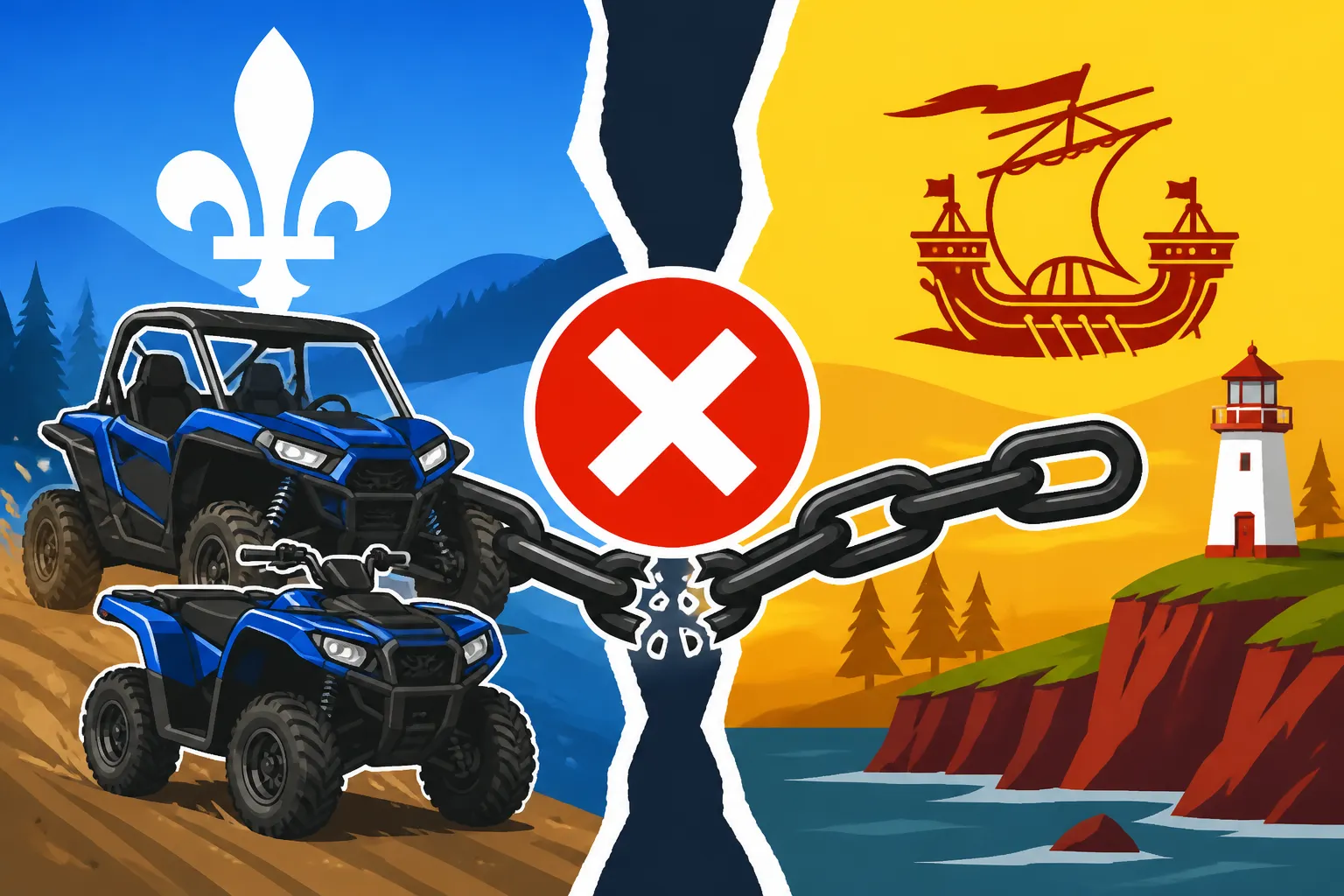
New Brunswick Ended Its Own Reciprocity Agreement
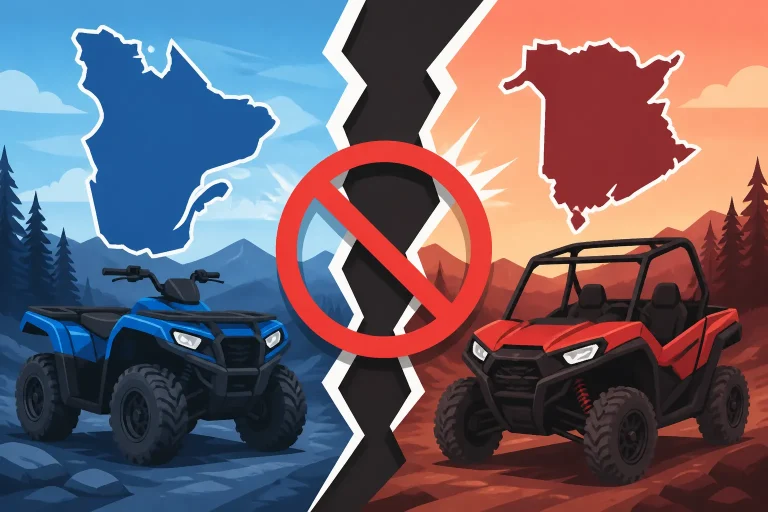
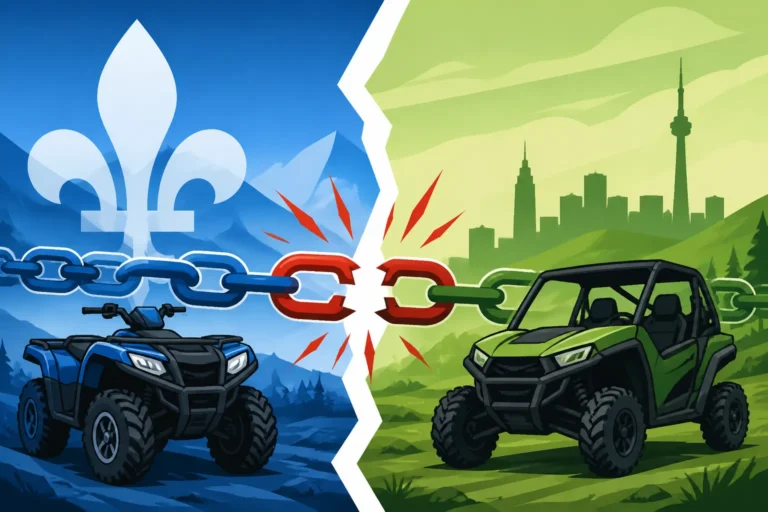
A Quebec or New Brunswick trail pass may look like it should work across the provincial border, but reciprocity between the two systems has ended. The practical result is that riders should plan for separate trail authorization on each side. Here’s what that means for your pass, registration, insurance and route planning.
What the end of reciprocity means
Reciprocity was an arrangement under which a pass issued in one province could be recognized on participating trails in the other. With that arrangement ended, you should not assume that a Quebec trail pass gives you access to New Brunswick trails, or that a New Brunswick pass covers you in Quebec.
The key distinction is between permission to ride on a trail network and the legal status of your machine. A trail pass is not the same thing as vehicle registration, insurance, a driver’s licence or a training certificate. Each item can have its own rules, and a pass from one province does not replace the requirements that apply in the other.
| Item | What it generally covers | Does a pass from the other province replace it? |
|---|---|---|
| Trail pass | Access to participating, authorized trails | Do not assume so; plan to meet each province’s current trail-access requirements |
| Vehicle registration | Registration or identification of the machine | No |
| Liability insurance | Financial protection required for riding under applicable rules | No |
| Driver’s licence or training certificate | Rider eligibility where required | No |
| Local trail and land rules | Where and when riding is allowed | No |
The end of reciprocity is most relevant when your route crosses the provincial boundary or when you trailer your ATV or side-by-side to ride in the other province. If you stay entirely within one province, the change may not affect your pass for that ride. If your route crosses the border, however, treat each province’s trail system as a separate destination unless the relevant organization confirms otherwise.
This is about organized trail access, not a blanket ban on visitors. Riders can still travel between Quebec and New Brunswick, but they need to follow the requirements that apply where they ride. A vehicle registered in Quebec does not automatically qualify for trail access in New Brunswick, and a New Brunswick registration does not itself authorize use of Quebec’s federated trails.
For Quebec riders, the separate roles of the pass and registration are worth keeping clear. Quebec Registration and Club Membership explains how those can relate without being the same thing. You can also review Quebec Registration and Trail Pass Together for the practical difference between having a registered machine and having trail access.
What to arrange before riding in either province
Before you leave, identify where the ride will take place and which organization controls or administers access to those trails. A route that begins near the border may remain in one province, cross into the other, or use a mix of trails and roads. The map alone may not make the pass requirements obvious, so check the route and access conditions rather than relying on a general idea that passes are interchangeable.
Use this checklist for a cross-border ride:
- Confirm the route’s provincial boundaries. Check whether the planned trail actually crosses into the other province. A trailhead, lodging stop or fuel stop near the border does not necessarily mean the ride enters the other trail network.
- Ask what pass is valid on each section. Confirm the current requirement with the trail-pass seller, club or organization responsible for the route. If the trip uses trails in both provinces, ask whether you need separate passes for each.
- Check whether the pass dates match your trip. Pass types and validity periods can differ. Do not assume that a pass bought for one season, day or province covers the same period or activity elsewhere.
- Verify the machine’s registration and insurance documents. Carry the documents required for the machine and the places where you will ride. A trail pass does not serve as proof of either.
- Check rider requirements. Age, licence, training, helmet and passenger rules can vary by jurisdiction and by the type of machine. Check the rules for the province where the riding happens.
- Save confirmation of what you bought. Keep the pass confirmation and any required documents accessible during the ride. A purchase receipt may help explain a transaction, but it does not make an unrecognized pass valid on a trail.
Quebec visitors should separately confirm their machine’s registration and insurance status. Quebec’s Liability Insurance Rule covers the insurance issue, while Quebec ATV Registration for Newcomers is useful if the rider or machine has recently moved to Quebec. A visitor riding temporarily should not assume that a local trail pass fixes a registration or insurance problem.
The same separation matters for a Quebec rider visiting New Brunswick. Find out what New Brunswick requires for the machine, rider and trails before departing. If the trip includes private land, a trail operated by a private outfitter, or an organized event, ask the landowner or operator about its own permission and pass rules. A provincial trail pass does not necessarily grant access to every private route.
Rules and pass arrangements can change, so confirm them close to the trip rather than relying on an old sticker, a friend’s recollection or a previous season’s plan. The official pass seller or trail organization is the best place to settle a question about current recognition. For Quebec, Quebec Visitors From New Brunswick can help frame the visitor question; the equivalent check should be made with the relevant New Brunswick organization before riding there.
How to plan a trip that crosses the border
A simple way to avoid an expensive misunderstanding is to divide the ride into sections. Note which province each section is in, then confirm the applicable pass and operating rules for that section. If a planned connection depends on access through another province, verify that access before booking lodging or towing to the trailhead.
For example, a rider might spend one day on trails in Quebec, trailer to New Brunswick for another ride, then return to Quebec. That is not necessarily one continuous pass arrangement. Think of it as two separate trail days: check access for the Quebec day and then check it again for the New Brunswick day. If the route itself crosses the border while riding, confirm the required authorization for both sides before setting out.
When comparing passes, ask specific questions rather than simply asking whether your pass is “good there.” Useful questions include:
- Is this exact pass recognized on the trails I plan to use?
- Does recognition apply to this pass type and these dates?
- Does it cover the machine, or does every machine need its own authorization?
- Are there additional requirements for a visitor or an out-of-province machine?
- Does the route include trails managed by a club, landowner or outfitter with separate conditions?
- What proof should I carry, and will a digital confirmation be accepted?
The answers may depend on the type of pass, where it was purchased, the route and current arrangements. Get the answer from the organization responsible for the trails you intend to ride, and keep a record of it. If an operator says a separate pass is required, do not rely on a social-media post or an older receipt to override that instruction.
Also distinguish a trail pass from road access. A pass for an organized trail network does not automatically let you ride on public roads, shoulders or municipal routes. Those permissions depend on applicable laws, signage and local rules. Quebec’s road-access restrictions are covered in Quebec ATV Road Rules Under the LVHR. Check the rules on the New Brunswick side independently; do not transfer Quebec road rules to another province.
If you are renting rather than bringing your own machine, ask the rental operator which province’s trails are included and whether the rental arrangement includes the required pass. Do not assume that a rental package valid in one province covers riding across the border. The rental company may restrict where the machine can go, and its agreement may impose conditions beyond the general trail-pass rules.
Common assumptions that cause problems
The most common mistake is treating a provincial trail pass as a kind of all-purpose permit. It is not. A pass can provide access to a specific network under specific conditions, but it does not automatically satisfy every requirement for the machine or rider.
Another mistake is assuming that because reciprocity existed in the past, it still applies to a current trip. A previous season’s pass, a familiar trail sticker or a long-standing habit is not enough to establish current eligibility. Check the current arrangement before you go, especially if the route crosses the border.
Riders also sometimes confuse registration recognition with trail-pass reciprocity. A machine’s registration may identify it for use under the rules that apply to that vehicle, but registration does not substitute for a trail pass. Likewise, carrying insurance does not grant trail access, and buying a pass does not make an uninsured or improperly documented machine compliant. Quebec Registration and Proof of Ownership and Carrying an Insurance Certificate on Every Ride address two separate parts of the paperwork picture.
Finally, do not assume that a route is open simply because it appears on a map. Trail access can be affected by closures, local permissions and seasonal conditions. A pass cannot override a closure or grant permission on land where access is not authorized. Confirm the route status shortly before riding, then follow signs and directions from the trail organization.
The safest planning rule is straightforward: treat Quebec and New Brunswick as separate trail-pass jurisdictions, verify current access for each province you will ride in, and carry the documents required for the machine and rider. That approach may mean more preparation, but it is far better than reaching a trail entrance with a pass that is not accepted.
Disclaimer
This article is for general informational purposes only and does not constitute professional advice. Laws, prices and regulations vary by location and change over time. Consult a qualified professional for guidance on your specific situation.