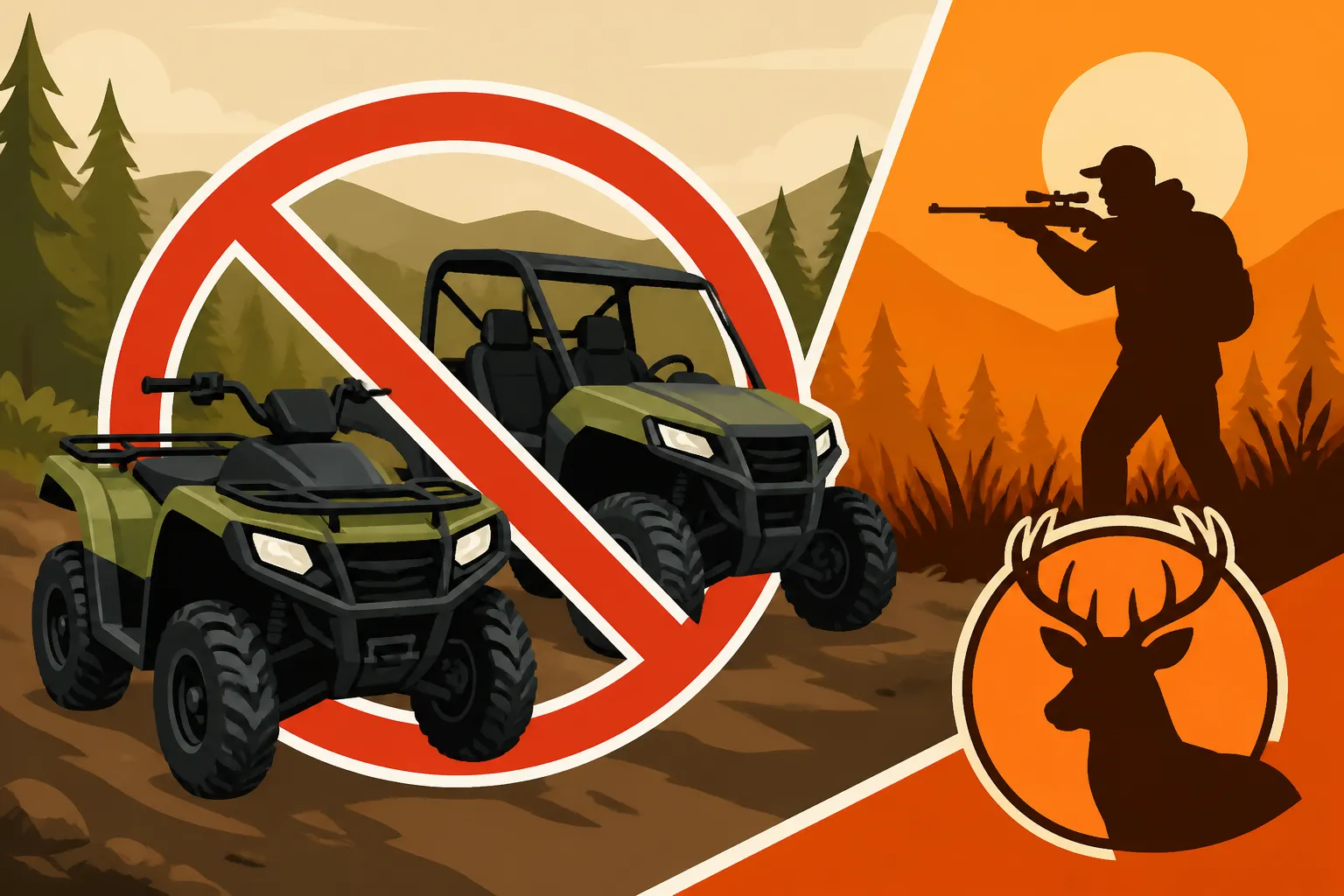
Quebec Trails Closed for Hunting Season
A planned Quebec ATV ride can unravel when a trail is closed for hunting season, especially if the closure appears after you’ve mapped your route or driven to a trailhead. The key is to check the specific corridor, club notices, and local land-access rules before leaving. This guide explains why closures happen, how to verify them, and how to adjust your ride responsibly.
Why Quebec ATV trails close during hunting season
Hunting seasons and trail access do not follow one province-wide calendar
Hunting dates and conditions vary by species, hunting zone, and season. ATV trail access can also depend on the local club, landowner agreements, municipal rules, and the conditions of a particular route. That means there is no single date when every Quebec trail closes—or a reliable assumption that every trail stays open throughout hunting season.
A route in the Laurentians may be affected differently from one in Mauricie, the Outaouais, Saguenay, or Gaspésie. Even within one region, a club may close only a short section that crosses a hunting area, while nearby trails remain open. A closure notice may apply to a corridor, a trailhead, a connector, or a larger area, so read its scope carefully.
This is why a map that looked correct when you planned your ride can still lead you astray on the day. Treat hunting-season access as a local, changeable condition, not a fixed feature of the province’s trail network. Before you go, check [Quebec Hunting Season Trail Rules] and the notices from the club responsible for the section you want to ride.
A closure can protect access as well as safety
Many ATV trails rely on permission to cross private property or on arrangements with the organizations responsible for managing a route. During hunting season, landowners may limit access to avoid conflicts with hunting activity, protect people using the land for another purpose, or reduce disturbance in sensitive areas. A trail closure can therefore be about preserving the relationship that keeps the route available beyond hunting season.
A rider may see an empty trail and assume that a quick pass-through is harmless. But a posted closure still matters, even if no hunters are visible and the trail looks unchanged. Going around a barrier or following an unofficial detour can create problems for landowners, riders, and the club that maintains the route.
The safest response is to follow the closure as posted and ask the responsible club if the notice is unclear. Don’t assume that a trail pass, club membership, or a route shown on a map overrides a temporary restriction. For wider context on the network and its land access, see [Quebec Trails That Cross Private Land] and [Staying on a Federated Corridor].
How to check whether a trail is open
Check local club and trail network notices first
Start with the club or organization responsible for the trail. Look for recent closure notices, trail-condition updates, maps, and announcements that identify the affected section. If a notice is vague—for example, it names a sector but doesn’t clearly show where the closure begins—contact the club before you ride rather than trying to interpret it from a distance.
Check again close to departure. A route that was open when you planned the trip may have changed after a landowner request, weather event, maintenance issue, or seasonal restriction. When you’re travelling from another region, this second check is especially useful: it can save you a long drive to a trailhead that no longer provides access to the route you expected.
The [Quebec Trail Conditions Before You Go] page is a useful topic to review when building a pre-ride routine. You can also use [Quebec Clubs and What They Maintain] to understand why checking with the local club matters. When you contact a club, ask about the exact trail or connector, the dates or conditions covered by the notice, and whether there is an approved alternate route.
Use maps as planning tools, not permission to ride
Digital maps can help you see where trails run and how an alternate route might connect. Tools such as onX Offroad can be useful for organizing a route and keeping track of your planned ride, but a mapped line should not be treated as proof that a trail is open or that you have permission to use it. Temporary closures and local restrictions may not be reflected in the map you’re viewing.
A practical approach is to compare your navigation map with the current information from the club or other responsible authority. If the map shows a route through an area covered by a closure notice, follow the notice. Don’t use an alternate track, property boundary, or access road unless you’ve confirmed it is open to ATV traffic and you’re allowed to use it.
Download or save the information you need before you leave, especially if your route passes through areas where mobile coverage may be limited. Keep the closure information available offline too. A map is there to help you navigate an approved ride; it cannot replace checking current access or respecting signs, gates, and barriers.
Planning a safer ride during hunting season
Build a route with a clear backup plan
Before you load the machines, identify the trail sections you intend to ride and the points where you can safely turn around or choose an approved alternate. A backup plan shouldn’t mean improvising a shortcut across private land. It means knowing what you’ll do if a closure blocks your original route, such as returning to the trailhead or using a different, confirmed-open section.
For a group ride, share the planned route and the closure information with everyone in advance. This helps avoid the common situation where one rider follows the marked route while another tries to navigate around a barrier. Agree that the group will stop, regroup, and reassess if the trail is closed or conditions differ from what you expected.
If you’re travelling to a new area, check nearby services and trailheads before you go, but don’t assume a parking area or access road is available just because it appears on a map. [Quebec Trailheads With Parking] can help you think through staging, while [Quebec Trail Maps and the iQuad App] covers map planning. Confirm the details with the relevant club before treating any route as a go.
Ride with visibility and awareness
Hunting-season riding calls for extra awareness, even on an open trail. Reduce distractions, keep a pace that gives you time to respond, and watch for signs of other land users, vehicles, wildlife, gates, and trail changes. If you encounter hunters or people working on the land, give them space and avoid unnecessary noise or stops in a sensitive area.
Wear suitable high-visibility gear where appropriate, but don’t treat bright clothing as permission to enter a closed area or as a replacement for local rules. Keep lights and required equipment in working order, and make sure your group knows how to communicate if someone needs to stop. If you see a new sign or barrier, don’t assume it was left there by mistake.
Respectful conduct helps keep ATV access welcome. Stay on the authorized route, keep speeds controlled near homes and other land users, and leave gates as you find them when access is permitted. For more on shared-trail behaviour, see [Quebec Trail Etiquette Locals Expect] and [Quebec Equipment Checks by Patrols].
What to do when a closure affects your ride
Stop and confirm the restriction instead of riding around it
When you reach a closure sign, gate, or barrier, stop before it and read the notice. Check whether it identifies a particular trail section, a time period, or a wider area. If you can’t tell what it covers, don’t continue through the restricted route while you try to figure it out.
Use the contact details on the notice, or reach the club or organization responsible for the route. If you can’t get an answer, choose the conservative option: turn back or use only an alternate trail that has been confirmed open and authorized for ATV use. An unofficial detour can cross land where riding is not allowed and may put your group in a less predictable situation.
Avoid moving signs, opening a closed gate, or following tracks around a barrier. Those actions can undermine access agreements and create safety concerns for everyone using the area. If the sign appears damaged or a closure seems inconsistent with another notice, report what you observed rather than deciding for yourself that the trail is open.
Communicate changes to the whole group
A route change is easier to manage when every rider hears the same information. Stop in a safe place, explain what the closure notice says, and agree on whether the group will return to the trailhead or proceed on a verified alternate. Don’t let riders split up to explore separate tracks unless the route is known to be open and the group has a clear plan.
If someone is leading with a GPS or a navigation app, make sure the rest of the group understands that the device shows a route, not necessarily current access status. Riders should keep enough distance to stop safely and avoid bunching up near barriers or blind corners. If the group includes newer riders, explain the plan in simple terms before moving again.
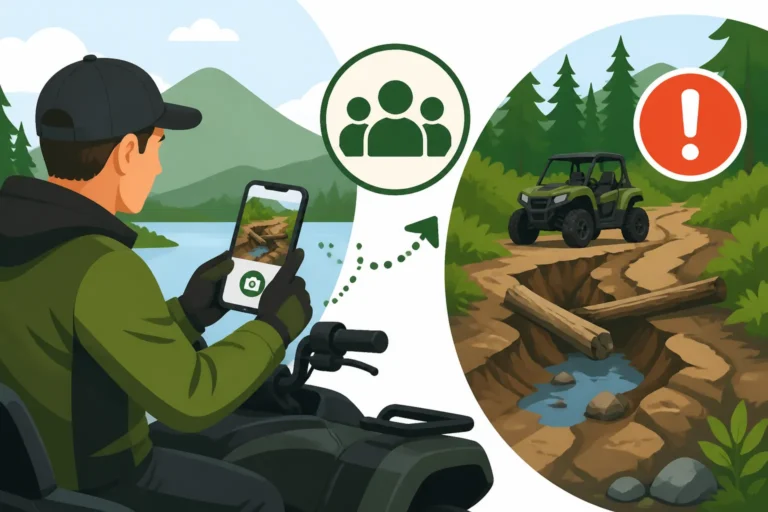
After the ride, consider sharing a factual report with the relevant club if a notice was difficult to locate or a trail condition needs attention. Stick to what you observed—such as the location of a sign or a blocked section—rather than guessing why the closure was put in place. The club can decide whether an update is needed.
A practical pre-ride checklist for hunting season
Confirm access, equipment, and communication
A short checklist can prevent a frustrating trip from becoming a bigger problem. Before departure, verify the trail status with the responsible club, check the exact route for closures, and make sure any alternate is authorized. Review [Quebec Thaw Closures in Early May] as a reminder that seasonal access restrictions can apply for reasons beyond hunting; trail access can change with conditions throughout the year.
Tell someone outside the riding group where you plan to go and when you expect to return. Carry the paperwork and safety equipment required for your ride, and check that each machine is ready for the conditions. If you’ll be in a remote area, plan for limited cell service and make sure your group knows how to respond if a machine breaks down or the route becomes impassable.
Finally, set a clear rule: signs and official closure notices take priority over a planned track. That simple agreement helps keep a group from making a rushed decision when the trail ahead is blocked.
| Before you ride | What to confirm |
|---|---|
| Trail status | Check recent notices from the responsible club or trail organization |
| Route scope | Confirm whether closures affect a trail, connector, trailhead, or wider area |
| Alternate plan | Use only routes confirmed open and authorized for ATV traffic |
| Navigation | Treat map apps, including onX Offroad, as planning aids rather than proof of access |
| Group communication | Make sure every rider knows the route and what to do if a closure appears |
| On-trail behaviour | Respect signs, barriers, landowners, hunters, and other trail users |
Keep a flexible mindset
It’s disappointing to reorganize a ride after you’ve made plans, particularly when everyone has taken time off or travelled a long distance. Still, a closure is part of riding responsibly in a landscape shared with landowners, hunters, clubs, and other outdoor users. A flexible route plan gives you a better chance of enjoying the day without putting access agreements at risk.
If your intended trail is closed, a confirmed-open route in another area may work—but only after checking its access and condition too. Avoid rushing into an unfamiliar route just to salvage the original plan. A shorter ride on an open corridor is usually a better choice than an uncertain detour.
For future trips, save the club contacts and trail-status pages you rely on, and note which sections tend to require extra seasonal checks. You’ll spend less time scrambling at the trailhead and more time making a sound decision before the machines are unloaded.
Disclaimer
This article is for general informational purposes only and does not constitute professional advice. Laws, prices and regulations vary by location and change over time. Consult a qualified professional for guidance on your specific situation.