Why a Quebec Landowner Withdraws Permission
A trail that has been open for years can suddenly be blocked when a landowner withdraws permission. For ATV and UTV riders, that can disrupt a familiar route, a weekend plan, or a whole club network. This guide explains why access changes, what to do when it happens, and how to ride in Quebec without making a difficult situation worse.
Why a Quebec landowner may withdraw trail permission
Permission can be conditional and temporary
A route that crosses private land is not automatically open to riders just because it appears on a map or has been used for a long time. Access may depend on an agreement with the landowner, a club arrangement, or permission for a particular purpose or period. If those conditions change, the route may close.
That can come as a surprise when the trail looks established: there may be a groomed surface, signs, or tire tracks from other machines. But those visible clues do not tell you whether permission is still in place. A trail can also be authorized for one corridor while nearby land remains off-limits. When you are unsure, check with the local club or land manager before riding.
This matters across Quebec, whether you are following a familiar route in Lanaudière, exploring the Laurentians, or planning a ride in Charlevoix. A marked trail is useful for navigation, but the status of access can change. For background on how trail access works, see Quebec Trails That Cross Private Land and Quebec Private Land Permission.
Land use, safety, and neighbour concerns can change
A landowner may need to use a field, woods, or access road for forestry, farming, construction, or another activity. A trail that worked around those operations last season may conflict with them now. Sometimes the change is temporary, such as during a harvest or repair project; sometimes it means the route needs to be moved.
Safety and property concerns can also build over time. Riders may have left gates open, travelled outside the marked corridor, damaged a wet section, or disturbed livestock or wildlife. Even one incident can affect how an owner views the entire trail. Noise, dust, traffic near a home, or concerns about riders stopping on private property can contribute to a decision to close access.
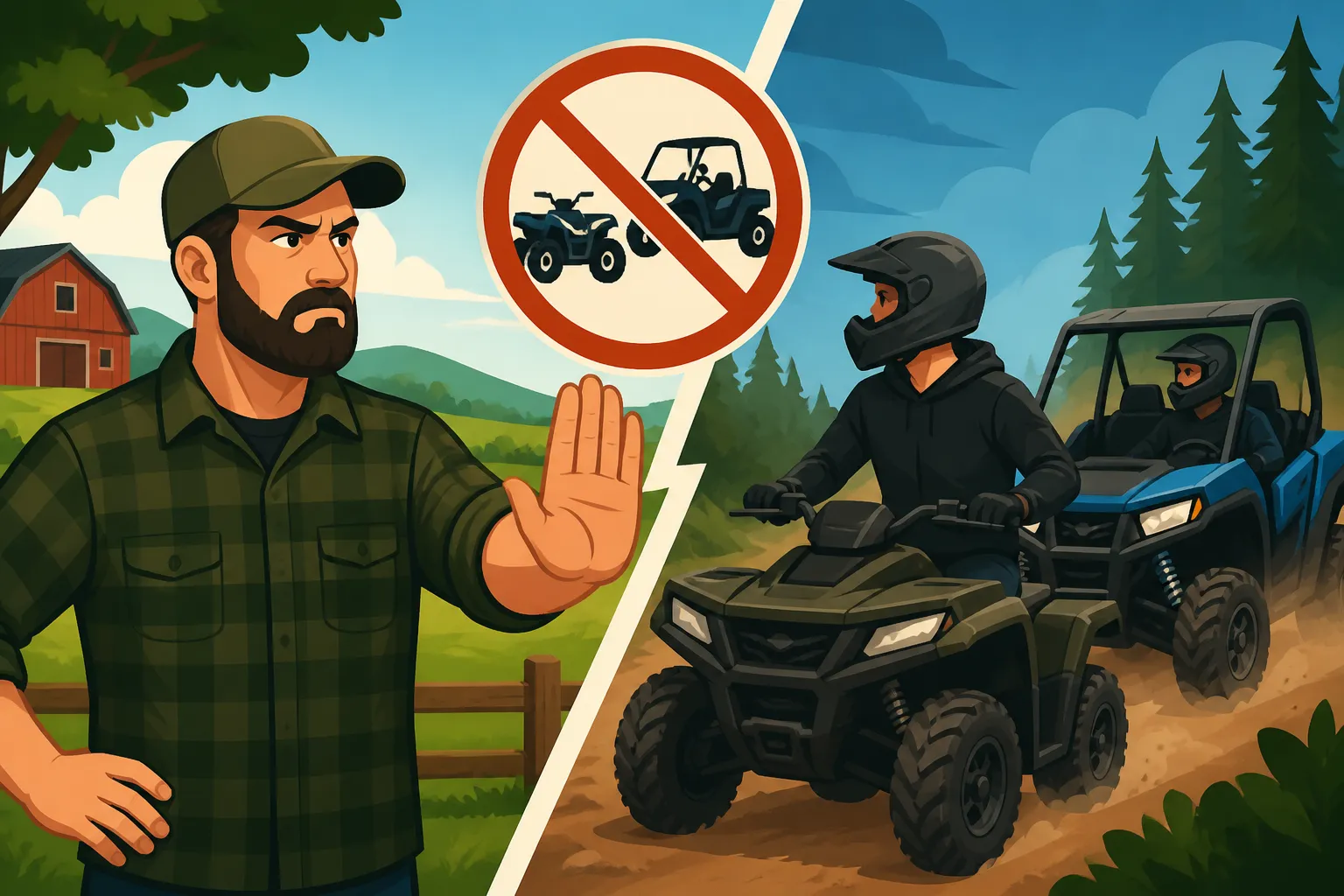
It is easy to assume that a landowner is objecting to ATV or UTV riding in general. Often, though, the issue is more specific: how riders are using that particular property, or what the owner needs the land for. Understanding that distinction can help a club or local contact look for a practical alternative, if the owner is willing to discuss one.
A closure may reflect a wider trail issue
A single landowner’s decision can affect more than one short stretch. If a route depends on several connected parcels, losing access across one parcel may break the connection between trail sections. Riders can then encounter a dead end or be tempted to improvise a detour. That is when a local closure can become a wider safety and access problem.
Federated trails rely on route planning, signage, maintenance, and cooperation with the people whose land the trail crosses. A club may need to reroute the corridor, update signs, or temporarily close a section while it works on access. Check Quebec Clubs and What They Maintain for more on the role clubs play, and review Quebec Trail Conditions Before You Go before heading out.
A route shown in an older screenshot, saved GPS file, or printed map may not reflect a recent change. If you use onX Offroad or another mapping app, treat it as a planning aid rather than proof that you have permission to cross a parcel. Check current trail information with the relevant club, and follow posted closure signs even if your device still displays the route.
What to do when access is withdrawn
Stop before entering and confirm the closure
If you reach a locked gate, a clear closure sign, or a trail blocked by the landowner, do not go around it. Turning onto a field edge, forestry road, driveway, or adjacent property to avoid the obstruction can create a second access problem. It may also put you in an unfamiliar place without a safe, authorized route back.
Pause somewhere safe and check your route. Look for a marked detour or an official update from the club responsible for that trail. If there is no clear alternative, turn around using a safe, permitted route rather than pushing ahead. A map app such as onX Offroad may help you orient yourself, but it cannot establish that a route is open or that you may use nearby land.
If you are part of a group, tell everyone to stop and regroup before anyone rides ahead. A machine disappearing around a bend can leave the rest of the group uncertain about whether the trail is open. Clear communication matters, especially if riders are carrying limited fuel or are unfamiliar with the area.
Contact the right local organization
For a club trail, the local ATV club or trail organization is usually a sensible first contact. It may know whether the closure is temporary, whether an official detour exists, and whether signs or route information need updating. Give a useful location: the trail name or number if known, the nearest intersection, a nearby landmark, and the direction you were travelling.
Keep the conversation neutral. Ask whether the section is closed and what route is currently authorized. Avoid confronting the landowner or assuming that the club can immediately restore access. Clubs often have to respect the owner’s decision and may need time to find another route or work through an access issue.
If the route is not part of a managed trail network, do not assume that a nearby club can grant permission on the owner’s behalf. Ask the landowner directly only if you can do so respectfully and without trespassing. For club-managed corridors, Staying on a Federated Corridor explains why remaining on the marked route matters.
Avoid unofficial detours and online route assumptions
A line on a phone screen can look like a road, but it may be a private driveway, a logging track, a seasonal access road, or a route that is no longer authorized. Apps and downloaded GPS tracks are helpful for orientation; they are not a substitute for current local access information. This is true whether you use onX Offroad, another mapping tool, or a track shared by a friend.
Do not post an unverified bypass as a “new route” or encourage others to use it. A detour across private land can turn one closure into repeated unauthorized traffic, making future access discussions harder. If you share ride updates, make it clear when a section is closed and point riders toward an official update rather than a guessed alternative.
| What you encounter | Safer response | Avoid |
|---|---|---|
| Closure sign or locked gate | Stop and check for an official detour | Riding around the barrier |
| Trail missing from a current club update | Contact the local club before riding | Assuming an old GPS track is current |
| No authorized route forward | Turn back safely | Cutting across nearby property |
| Unclear permission on private land | Ask the owner or responsible organization | Treating a map line as permission |
How riders can help protect access
Stay on the marked route and respect property
When a trail crosses private land, small choices can have a real effect. Stay within the corridor, slow down near homes and farm activity, and do not stop in a driveway or work area. Close a gate only if the posted instruction or trail practice tells you to do so; otherwise, leave it as you found it. If you see a damaged sign or gate, report it to the club rather than attempting a repair that could create confusion.
Keep noise and speed in check, especially where a route passes close to homes, cottages, or livestock. A quiet, orderly group is easier for a landowner to live alongside than a stream of riders spreading out, revving engines, or stopping wherever there is space. The basic principle is simple: use only the route that is open and authorized, and leave the property as you found it.
Trail etiquette also includes being considerate of other users and trail workers. Slow down when visibility is limited, follow posted signs, and give maintenance crews room to work. Quebec Trail Etiquette Locals Expect offers additional guidance for sharing corridors responsibly.
Ride with current information and a realistic backup plan
Before leaving home, check the trail status with the local club or the source responsible for that route. A saved track can be useful, but it should not be the only thing guiding your day. Download or note the official information you need while you still have a reliable connection, and identify a safe way to shorten the ride if a section is closed.
An onX Offroad route view, paper map, or GPS unit can help you understand where you are, but none of these tells you on its own that the landowner’s permission is current. Plan enough time and fuel to turn back if needed. For a group ride, agree in advance that nobody will continue beyond a closure or split off to search for an unofficial way around.
This preparation is especially useful on longer regional rides, where a short blocked segment can force a substantial backtrack. Check nearby fuel and services as part of your plan, but do not make an uncertain private road your emergency exit. If you are organizing a ride, share the closure-checking responsibility with another rider so that route information is not based on a single person’s outdated screenshot.
Support clubs without pressuring landowners
When a landowner withdraws permission, riders may feel that the decision is unfair, especially if they have used the route for years. Still, a respectful response is more likely to preserve the possibility of future discussion than an argument, a public call-out, or continued riding on the closed section. The owner may have reasons that are private, practical, or temporary.
If a local club is working on a reroute, follow its updates and use the new marked corridor once it is officially open. You can also help by reporting damage, attending volunteer days, or sharing accurate trail information with other riders. Those actions support the people who maintain routes and communicate with landowners.
A club cannot guarantee that a private corridor will stay open forever. Access depends on cooperation, and that cooperation can be affected by how riders behave as well as by changes in land use. Treat a closure as a boundary to respect, not a challenge to overcome, and help keep the rest of the network usable for the riding community.
Disclaimer
This article is for general informational purposes only and does not constitute professional advice. Laws, prices and regulations vary by location and change over time. Consult a qualified professional for guidance on your specific situation.