Quebec Moose Encounters While Riding
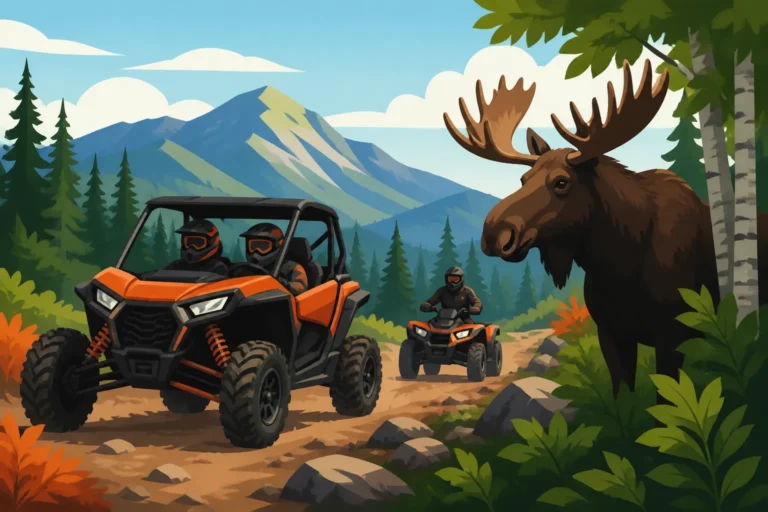
A moose stepping onto a Quebec ATV trail can turn a relaxed ride into a tense few minutes, especially when trees and brush leave little room to maneuver. The safest response is to slow down, give the animal space, and avoid trying to pass or photograph it up close. This guide explains how to prepare for an encounter, what to do in the moment, and how to ride more thoughtfully in moose country.
Why moose encounters happen on Quebec trails
Where and when riders are more likely to see moose
Moose live across much of Quebec, including forested regions such as Charlevoix, the Laurentians, Mauricie, Abitibi, and the Côte-Nord. They may appear on a trail, near a wetland, at a salt lick, or along a clearing where they can feed. A familiar route can still bring a surprise: vegetation can block your view until you are close, and a moose may be standing quietly beside the trail rather than moving across it.
Encounters can happen in any season. In spring and summer, cows may be especially protective of calves, which can be difficult to spot in thick brush. During the fall rut, bull moose may be more focused on other moose and less predictable around people. In winter, snow can make travel more tiring for the animal, while shared corridors and reduced visibility can put riders in its path. None of these patterns makes an encounter certain, but they are good reasons to stay alert year-round.
Riders planning a regional route can check trail status and closures before leaving, then treat wildlife sightings as a reason to change plans rather than press on. Guides to [Quebec Wildlife on the Trail] and [Quebec Trail Conditions Before You Go] can help you think through the broader conditions that may affect a ride.
Why an ATV does not make the encounter safe
An ATV or side-by-side can feel like a protective barrier, but it is not a dependable shield from a large, fast-moving animal. A moose may be startled by the noise or proximity of a machine, and a confined trail may leave both the rider and the animal with few easy escape routes. Even a calm-looking moose can react suddenly if it feels cornered or is protecting a calf.
The machine itself can add to the problem. Revving the engine, moving closer for a better view, or trying to squeeze past can make an animal feel pressured. A rider may also be tempted to accelerate away, but a narrow, uneven trail is a poor place for a hurried maneuver. Your best advantage is usually distance, patience, and a clear route away from the animal.
Remember that a trail is not a wildlife viewing area. If the moose is blocking the corridor, waiting or turning around is safer than treating the animal as an obstacle to get around. For a broader sense of courteous trail behaviour, see [Quebec Trail Etiquette Locals Expect].
What to do when you see a moose
Slow down, stop, and assess the scene
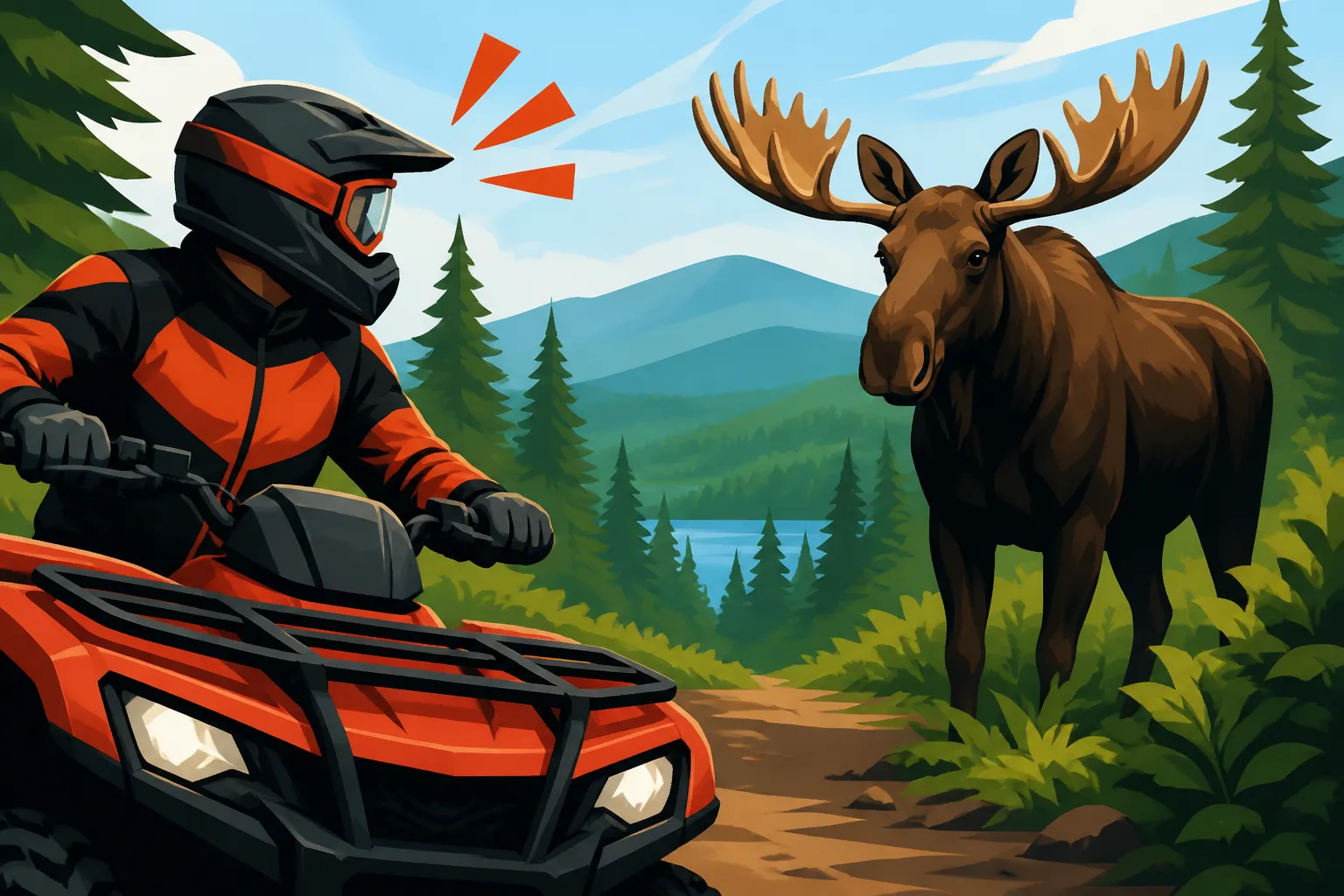
As soon as you see a moose, ease off the throttle and stop at a safe distance. Avoid sudden movements, repeated horn use, shouting, or revving the engine. Keep the animal in sight without advancing toward it, and look carefully for a calf or a second moose nearby. A cow with a calf may be more defensive than the first animal’s calm posture suggests.
If you are riding in a group, signal the riders behind you to stop as well. Keep the group together, but do not crowd the trail. Riders who arrive one by one can unintentionally surround the animal or make it feel that its route away is closing. Speak quietly and agree on whether you can safely wait for the moose to move away or should retreat.
Do not approach for a photo, feed the animal, or try to make it leave. If you have a phone or camera, use it only from a safe distance and do not let the desire for a picture draw you closer. An animal that is looking in your direction may simply be assessing the situation; that is not an invitation to move nearer.
Give the moose an open escape route
If there is room to do so, back away slowly along the route you came from. Keep a generous distance and avoid blocking the direction in which the moose could leave. Do not try to pass between a cow and calf, between the animal and dense cover, or through a narrow gap that forces it to move toward you. If you cannot retreat safely, wait in a place that gives the moose time and space to move on its own.
Watch for changes in the animal’s behaviour, but do not depend on a single warning sign. A moose may appear tense, lower its head, raise the hair along its back, or move its ears back. It may also charge with little warning. The safest choice is to create more distance at the first sign that the animal is uncomfortable, rather than waiting to see how far it will go.
If a moose approaches, put a substantial barrier between you and the animal if one is immediately available, such as a large tree. Avoid trying to outrun it on the ATV or in the brush. If you are knocked down, protect your head and remain still until the animal has moved away; then leave the area carefully. These situations are frightening, and there is no maneuver that guarantees a safe outcome, so distance and prevention matter most.
If the moose is standing on the trail
A moose occupying the trail does not mean you should edge past it. Stop well back and give it time to move. If it stays put, or if the trail is too narrow for a safe retreat, turn around when you can do so without moving toward the animal. A longer route is a better trade than forcing a close pass.
On a remote ride, tell your group what you saw and note the location so you can avoid returning to the same spot unexpectedly. If the animal appears injured, trapped, or in immediate danger, contact the appropriate local wildlife authority or emergency service when it is safe to do so. Do not attempt to rescue or herd it yourself.
| Situation | Safer response | Avoid |
|---|---|---|
| Moose is visible ahead | Stop at a distance and watch for calves or other animals | Approaching for a closer look |
| Moose is on the trail | Wait, retreat, or turn around when safe | Squeezing past or driving toward it |
| Moose appears tense | Increase distance and leave an escape route | Revving, honking repeatedly, or crowding it |
| Group riders are approaching | Signal everyone to stop and regroup calmly | Letting riders arrive one at a time |
| Animal seems injured or trapped | Report it from a safe location | Trying to handle or move it |
Prepare for wildlife before you ride
Plan your route and keep a backup option
Before leaving, review the route, trail access, and conditions. A current map can help you understand where the trail goes and identify places to turn back, but no map can predict where wildlife will be. Use route tools such as onX Offroad as part of your planning, alongside local trail information and signs. Check the tool’s map availability and settings before relying on it in an area with limited cell service.
For longer rides, save or carry the information you need to navigate without a dependable connection. Let someone know where you plan to ride and when you expect to return. A flexible plan matters: if a moose blocks a corridor, you should be able to stop, retreat, and choose another route instead of feeling pressured to continue. [Quebec Trail Maps and the iQuad App] and [Planning a Route on the Interactive Map] are useful starting points for route preparation.
If you are riding with a group, agree beforehand that any rider can call a stop for wildlife. Make sure everyone knows not to pass the person who has spotted an animal. On a busy trail, one rider’s quick stop can become a chain of abrupt braking if the group is following too closely. Leaving room between machines helps prevent that second problem.
Carry practical essentials for a delayed ride
An unexpected wildlife stop can add time to a trip, particularly on a remote route where turning around is slow. Bring enough water, suitable clothing, a charged phone, and the basic equipment your route requires. A first-aid kit and a way to contact help are sensible precautions, but do not approach a moose in order to use them or to assist someone else.
Know your group’s meeting plan if riders become separated. A simple agreement—stop at the last safe turnout, do not continue alone, and communicate before changing routes—can prevent a stressful encounter from becoming a navigation problem. For more detailed preparation, see [First Aid on a Remote Circuit] and [Packing for a Multi-Day Ride].
You can also use onX Offroad or another mapping option to review where you can safely turn around before starting a less familiar section. The important part is not the brand of map; it is knowing your route well enough to avoid making a rushed decision while an animal is nearby. Save the map information you need before entering areas where your phone may not have service.
Ride with a wildlife-aware pace
Speed affects how much time you have to notice an animal and respond smoothly. Ride at a pace that fits the trail’s visibility and surface, especially around blind corners, wet areas, and dense vegetation. Scan beyond the immediate track, and expect an animal to be standing beside the trail or emerging from cover. A slower pace cannot prevent every encounter, but it can give you more time to stop without skidding or startling the animal.
Keep your group’s noise and movement controlled when wildlife is near. Do not chase an animal for a better view, and do not leave the marked corridor to get around it. Staying on the route also reduces the chance of damaging vegetation or entering land where riding is not permitted. The guidance in [Staying on a Federated Corridor] and [Quebec Trails That Cross Private Land] is relevant when a tempting detour appears to offer an easy way around a blocked trail.
After the encounter
Leave the area carefully and share useful information
Once the moose has moved away, give it time and space before continuing. Look for other animals nearby and make sure the route ahead is clear. Start moving calmly rather than accelerating suddenly. If you still see the moose close to the trail, keep your distance or choose another route.
If your group turns around, confirm that everyone is accounted for before leaving the area. A rider who stopped farther back may not have seen the moose move. Use your usual group communication plan, and avoid splitting up to investigate where the animal went.
If a moose is injured, trapped, or creating an immediate hazard, report the location when you are safely away. Give a clear description of the trail or nearby landmark and what you observed. Do not post an exact location in a way that encourages other riders to approach the animal for photos.
Make the next ride safer without treating sightings as a guarantee
A moose sighting is a reminder to stay alert, not proof that the route is unsafe every time you ride it. Wildlife moves, and conditions change. On the next trip, check local trail notices, ride at a sensible pace, and keep a plan for turning back. If you saw a cow and calf or an animal behaving defensively, be especially cautious about returning to the same area soon.
For longer trips through remote country, review your route and backup options again rather than assuming the trail will be passable because it was clear before. onX Offroad may help you review your planned route, but pair any mapping tool with current local trail information and sound judgment on the ground. The safest decision is often the least dramatic one: stop, give the moose room, and accept a delay or detour.
Disclaimer
This article is for general informational purposes only and does not constitute professional advice. Laws, prices and regulations vary by location and change over time. Consult a qualified professional for guidance on your specific situation.