Quebec Restaurants Along a Trail
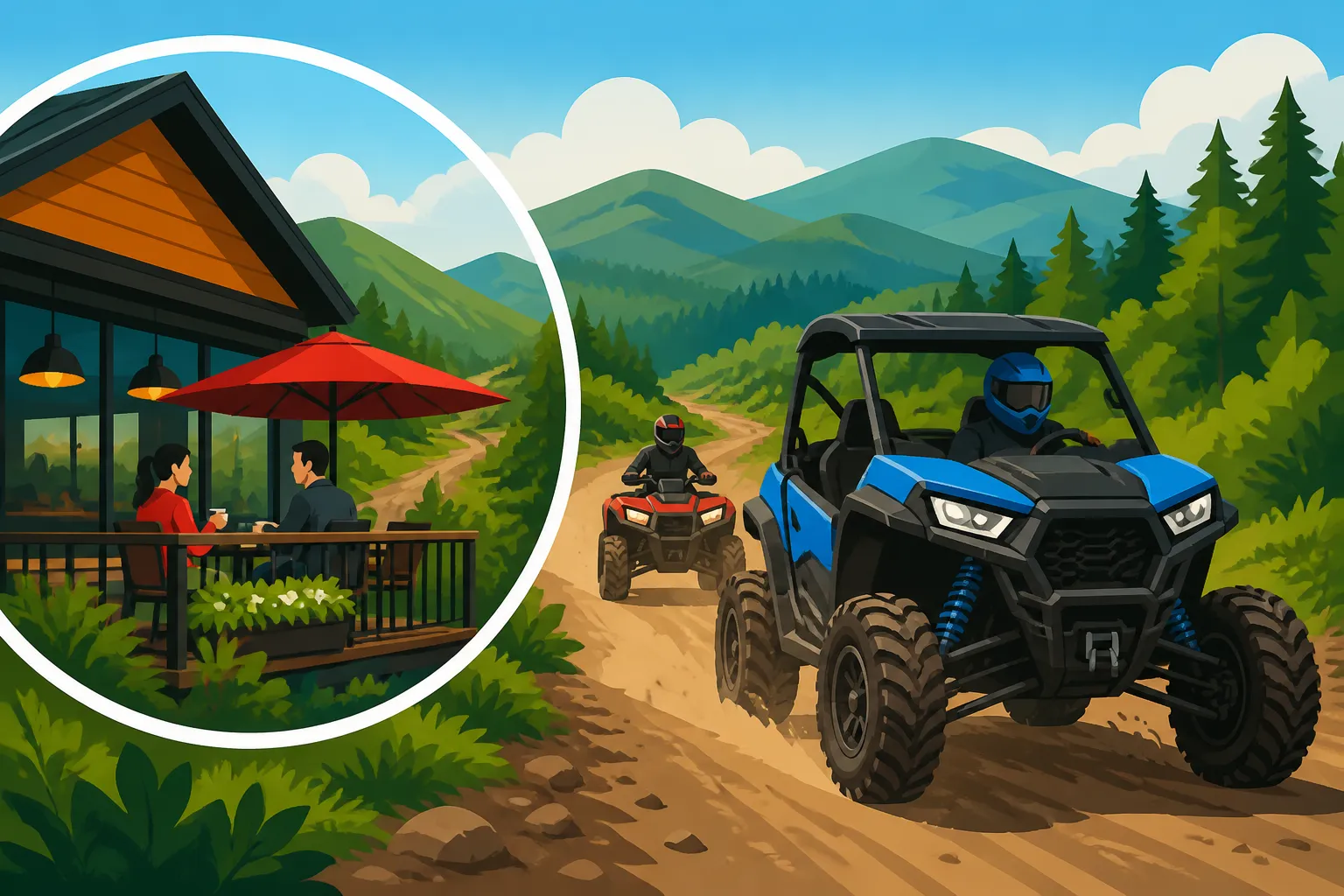
A restaurant stop can be the easiest part of a Quebec ATV ride to underestimate: the trail may pass near a village, but that does not mean you can legally ride to the door or park beside the patio. This guide explains how to plan meals around authorized routes, choose practical stops, confirm access, and keep your group moving safely.
Plan restaurant stops around the trail, not just the map
Check whether the route actually reaches the village
A restaurant that looks close to a trail on a phone screen may still be difficult or impossible to reach by ATV. The route could run on the other side of a river, stop before town, or connect to roads where quad access is restricted. Measure the ride by the authorized trail network and its access points—not by the shortest line between your trail and a restaurant.
Before the ride, check a current trail map and local conditions. The [Quebec Trail Maps and the iQuad App] can help you understand how to follow the marked network, while local club updates can clarify closures or detours. A navigation app such as onX Offroad can be useful for organizing waypoints or keeping a wider route picture, but don’t treat an app’s line as permission to ride a road, private property, or an unmarked connection.
This matters especially on longer outings near places such as Baie-Saint-Paul, La Malbaie, Saint-Michel-des-Saints, or Mont-Laurier. A town may have plenty of places to eat, but the route you are riding may not provide a lawful connection to the centre. Confirm the last authorized trail segment and where your group can safely leave the machines before building lunch plans around a particular address.
Treat road access and restaurant access as separate questions
A restaurant’s proximity to a trail does not automatically make the route to it legal. In Quebec, road access for off-highway vehicles depends on the rules that apply to that road, including signage and local requirements. Don’t assume that a short ride along a shoulder, through a parking lot, or down a village street is allowed simply because it seems convenient. Review [Quebec ATV Road Rules Under the LVHR] and check local signage and bylaws for the area you plan to ride.
There are two separate things to confirm: whether your machine can legally reach the location, and whether the business allows ATV parking. A restaurant may welcome riders but have no suitable space for machines or trailers. Conversely, a large parking lot does not mean the route into it is an authorized ATV connection. Call ahead and ask where riders should approach and park.
If there is no clearly authorized route to the restaurant, choose another stop, arrange a separate vehicle, or plan to eat at a permitted location along the ride. Don’t turn a meal break into an improvised road ride. For broader planning, [Staying on a Federated Corridor] is a useful reminder that a marked route is more than a suggestion: leaving it can create safety, permission, and land-access problems.
Choose a stopping point that suits your group
For a quick meal, a village stop with straightforward parking may be more practical than a remote restaurant that requires a complicated approach. For a longer break, look for a place where your group can sit comfortably, use washrooms, and check the next part of the route without feeling rushed. If you’re riding with children, new riders, or anyone who tires easily, a convenient stop can be worth more than a scenic detour.
Think about the group’s pace as well as the mileage. A group of experienced riders may be comfortable with a longer stretch between meals, while a mixed group may need a planned break before anyone is hungry, cold, or impatient. The [Quebec Group Ride Planning] guide can help you think through pacing, regrouping, and communication before setting off.
| Stop type | Works well when | Confirm before riding |
|---|---|---|
| Village restaurant | You want a full meal and services nearby | Legal access route, machine parking, and business hours |
| Café or snack stop | The group needs a shorter break | Whether the stop is open and whether there is room for machines |
| Picnic area or packed lunch | You want flexibility or are far from a village | Whether stopping is permitted and whether facilities are available |
| Outfitter or lodge stop | You are using the location as a ride base | Access rules, parking arrangements, and whether outside riders are welcome |
Find the right kind of meal stop for your route
Use villages as practical checkpoints
Towns can make useful checkpoints because they give riders a chance to eat, use facilities, refuel if an appropriate station is accessible, and check the group’s condition. Along routes in the Charlevoix region, for example, Baie-Saint-Paul and La Malbaie are recognizable planning points. In the Laurentians, Mont-Laurier can serve as a reference point when organizing a broader outing. These names are starting points for research, not a promise that a particular trail leads directly into town.
Check the route map and local trail information first, then look for businesses that are genuinely reachable from the authorized network. The [Quebec Trails With Fuel Stops] guide can help you think about combining food and fuel planning, but a fuel stop and a restaurant stop are not necessarily at the same place—or connected by an ATV-permitted road.
If your group is travelling through a quieter area, don’t count on finding an open restaurant at the exact time you arrive. Plan a backup, particularly outside peak tourist periods or during shoulder seasons. A packed snack or lunch can prevent a minor closure or delay from turning into a stressful search for food when everyone is already tired.
Decide between a sit-down meal and food you carry
A sit-down meal gives the group a proper rest, but it can take longer than expected. Riders need to park, remove riding gear, settle in, eat, and get organized again. If your group has a tight schedule, that extra time can affect your return before dark or your ability to reach the next planned stop.
Carrying some food gives you flexibility when the route is remote, a restaurant is busy, or weather changes your plan. Choose food that travels well and won’t become a mess in a warm storage compartment. Water matters too: riding in dust, wind, or warm weather can make a short stretch feel more tiring than expected. If you plan to eat outdoors, check that stopping is allowed and leave the place clean.
A sensible approach is often to plan one main meal stop and carry a small backup snack. That way, a delayed restaurant visit does not leave riders hungry, and the group can still adjust if trail conditions slow progress. For longer outings, [Packing for a Multi-Day Ride] offers ideas for thinking ahead about food and supplies without relying on a perfect schedule.
Make a backup plan before you leave
A restaurant can be unexpectedly closed, full, or unsuitable for a large group. Before setting out, identify another option in the same general area or decide where you can safely pause if the planned stop falls through. If you are travelling with several machines, ask whether the business can accommodate the group rather than assuming everyone can park together.
Keep your route and your backup stop available offline if possible. onX Offroad may help organize waypoints and route notes where it supports your planning needs, but it should be a supplement—not the source of truth for Quebec trail permission or closures. Check trail information through the relevant local sources before departing, and use posted signs as you ride.
A backup plan also means knowing when to skip the restaurant. If a delay, closure, or detour makes the schedule unsafe, head toward a suitable stopping point rather than rushing to preserve a reservation. Leave enough time for the return ride, especially if the route is unfamiliar or the group includes less experienced riders.
Confirm parking, timing, and rider needs
Call ahead about machines and group size
A restaurant may be happy to serve riders but unable to host a row of ATVs beside its entrance. When you call, explain how many machines are in your group and ask where you should park. Confirm that the proposed parking spot is on the business’s property or otherwise permitted, and ask whether there is room to manoeuvre without blocking vehicles, walkways, or emergency access.
If you are arriving with trailers, mention that too. A parking area that can fit several machines may not have room for a truck and trailer. Likewise, a restaurant in a compact village centre may be more convenient for pedestrians than for a large riding group. It is better to find this out before arriving than to circle the block looking for somewhere appropriate to leave the machines.
Ask about timing as well. A kitchen’s service hours may differ from the hours the business is open, and a group arriving near closing time may not be able to order a full meal. If you’re travelling in a busy region or during a popular weekend, calling ahead can help you avoid a long wait that puts pressure on the rest of the ride.
Allow for real-world delays
Trail conditions, regrouping, navigation, and mechanical checks can all make a ride take longer than a map suggests. Add breathing room to your meal plan rather than scheduling a restaurant stop down to the minute. If the group arrives late, riders can choose a simpler meal or use the backup plan instead of rushing the rest of the route.
Check [Quebec Trail Conditions Before You Go] before leaving. A closure or rough section may change your expected arrival time, and spring thaw closures can affect access altogether. Conditions can vary by region and local club, so don’t rely on a map saved from a previous ride as proof that the same route is open today.
Also consider the return leg. A leisurely lunch in a scenic place can be lovely, but it can leave the group hurrying near the end of the day. Decide in advance what time you want to be back at the trailhead or lodging, and set a turnaround point that accounts for the slowest rider—not just the quickest machine.
Make the stop comfortable without creating a new risk
Riding gear can be hot and awkward inside a restaurant. Give the group time to remove helmets and gloves safely, and keep gear together rather than spreading it across entrances or seating areas. Don’t leave valuables visible on a machine, and avoid blocking access for other customers. A tidy, considerate stop helps keep local businesses comfortable welcoming riders.
Be thoughtful about noise, especially in villages and near homes. Arrive and depart calmly, avoid unnecessary revving, and follow posted rules. [Quebec Trail Etiquette Locals Expect] is relevant beyond the trail itself: courteous behaviour at a meal stop helps protect the relationship between riders, businesses, residents, and landowners.
If anyone in your group has food allergies, mobility needs, or a particular dietary requirement, check in advance whether the restaurant can accommodate them. That simple call can spare someone the frustration of reaching the stop only to find they cannot eat there or cannot comfortably access the seating area. For a group with different needs, choose a stop that works for the whole party rather than assuming everyone can adapt once you arrive.
Build a restaurant plan that respects trail rules
Keep food and trail-pass planning connected
A restaurant stop does not replace the documents or permissions needed to ride. Before leaving, make sure every rider understands the route, carries the required proof, and knows which trail sections are open. [Quebec Trail Passes Cover Every Club] is useful background when you’re planning to ride on the federated network; a pass does not authorize travel on a closed trail or an unapproved road.
If you are a visitor, confirm the requirements that apply to your situation before the trip. Don’t assume a pass or arrangement from another province covers every Quebec route. Likewise, a restaurant booking does not grant access across private land. Follow signs, stay on authorized corridors, and ask for permission where required.
For multi-day trips, decide whether your meal stops are part of the day’s route or part of a separate lodging plan. The [Quebec Trails With Lodging Along the Way] guide can help you consider overnight arrangements alongside riding distances. A restaurant near an overnight stop may make the evening easier, but you still need a lawful, practical way to reach it and a safe place to leave your machines.
Use navigation tools as support, not permission
A map or GPS device can help your group follow a planned route, mark meal stops, and find its way back if riders become separated. onX Offroad can be one tool for organizing those notes, provided the area and map information suit your trip. Save the route details before you lose reception, and make sure more than one rider knows how to navigate.
Still, a digital route line cannot tell you on its own whether a road is open to ATVs, whether a trail has closed, or whether a restaurant permits machine parking. Use local trail information and posted signage for those decisions. If the route shown on a device conflicts with a closure sign or an authorized trail map, do not follow the device into a questionable connection.
Keep the plan simple enough that everyone can follow it. Share the restaurant name, the intended approach, the parking arrangement, and the backup option with the group before leaving. If the restaurant cannot be reached legally from the trail, change the plan instead of improvising at the roadside. That small bit of preparation is what turns a meal stop from a gamble into a comfortable part of the ride.
Disclaimer
This article is for general informational purposes only and does not constitute professional advice. Laws, prices and regulations vary by location and change over time. Consult a qualified professional for guidance on your specific situation.