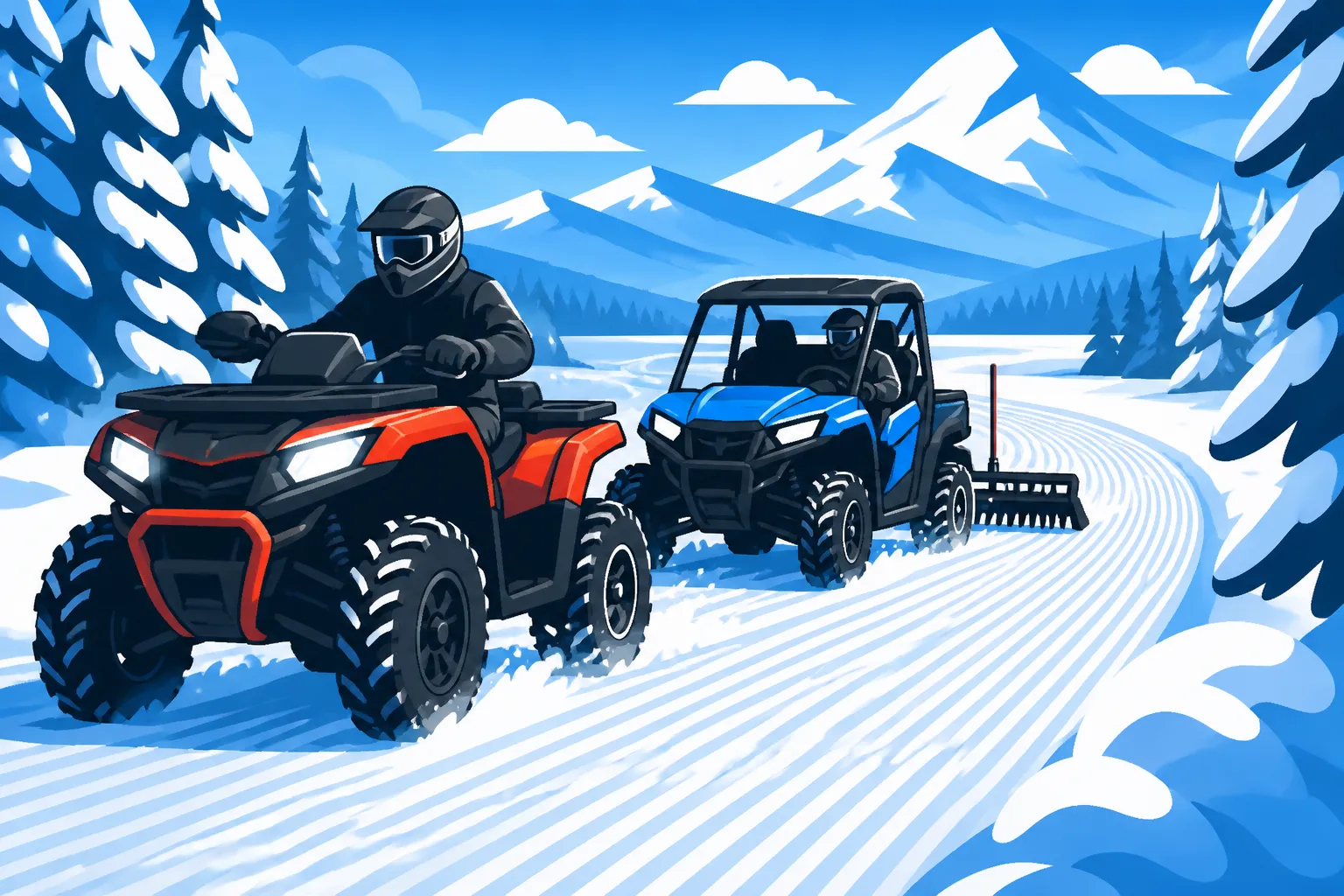
Quebec Trail Grooming in Winter
Winter grooming can make a Quebec trail look ride-ready, but a smooth surface does not automatically mean an ATV or UTV may use it. Grooming schedules, winter access, shared snowmobile traffic, and local closures vary by trail. This guide explains what grooming does, how to check whether a route is open to your machine, and how to plan a safer winter ride.
What winter trail grooming means in Quebec
Grooming maintains a trail, but it does not grant access
Trail grooming is the work of preparing and maintaining a trail surface, often by packing or smoothing snow with specialized equipment. On a winter route, grooming can help create a more consistent corridor for permitted users. It does not, by itself, confirm that ATVs or UTVs are allowed, that the trail is open, or that conditions are suitable for your machine.
That distinction matters because a groomed route may be intended mainly for snowmobiles, or may be shared under specific rules. Some sections may also be closed because of weather, landowner restrictions, trail work, or local decisions. Before setting out, check the current status for the specific route and user type, rather than treating groomer tracks as an invitation to ride.
Quebec clubs help maintain federated trails, but what they maintain and when they do it can vary by area. For context on the local role in trail upkeep, see [Quebec Clubs and What They Maintain]. If a club’s status update is unclear, contact the club or consult the relevant trail information channel before travelling to the trailhead.
Why winter grooming conditions change quickly
A trail’s surface can change significantly after grooming. Fresh snow, wind, warmer daytime temperatures, freezing overnight conditions, and heavy use can all affect traction and ride comfort. A route that looked firm in the morning may have drifted over or become slick later in the day. On narrow corridors, ruts or uneven packed snow can also make handling harder, particularly for heavier machines.
Grooming is not necessarily performed on a fixed schedule. A club may prioritize a section based on conditions, equipment availability, access, or the needs of the trail network. So a recent grooming report is useful, but it is not a guarantee that the whole route remains smooth—or that the groomed segment connects to an open route for ATVs and UTVs.
This is one reason riders should check more than a map. Trail information and club updates can help you understand what is happening on the ground, while a map helps with orientation. [Quebec Trail Conditions Before You Go] offers more on checking conditions before departure.
How to confirm a winter trail is open to your ATV or UTV
Check access for your machine, not just whether a trail is groomed
Start by identifying the exact route and confirming that winter access is permitted for your type of machine. A listing that says “winter trail” or shows groomed tracks may refer to snowmobile access, shared access, or a route with restrictions. If the information does not clearly identify permitted users, do not assume that an ATV or UTV is included.
Shared corridors deserve particular care. Snowmobiles and off-road vehicles may use the same corridor in some areas, but their operating needs differ. A trail can be open to one category of user and closed to another. Review [Quebec Winter Trails Shared With Snowmobiles] and [Quebec Winter Quad Riding on Shared Trails] for related planning considerations, then verify the current status with the local trail authority or club.
It also helps to check the route from end to end. One open segment does not mean every connecting segment is open. A bridge, access road, or short connector may have separate restrictions, and a detour can take you onto land where riding is not permitted. If you cannot confirm a connection, plan a route that avoids relying on it.
Use maps alongside current local information
A map is valuable for planning, but it cannot always tell you whether a trail is open today or whether a particular vehicle may use it. Use an up-to-date trail map to understand your route, then compare it with current club or trail-network notices. The [Quebec Trail Maps and the iQuad App] guide can help you think through mapping tools and route planning.
Some riders also use onX Offroad as a supplementary navigation resource. It can help with route awareness and map-based planning, but do not treat any mapping app as the final authority on current Quebec trail access. Cross-check local notices, signs at the trailhead, and any posted closures. If a map and a current local notice conflict, follow the closure information and seek clarification before riding.
Before leaving, save the route information you may need and make sure you know how to interpret it without relying on a live connection. In remote areas, phone coverage can be limited. An offline map can support navigation, but it does not replace checking conditions and access rules before you lose service.
| What to check | Why it matters | What to do if unclear |
|---|---|---|
| Whether ATVs or UTVs are permitted | Grooming alone does not establish vehicle access | Confirm with the local club or trail authority |
| Current trail status | Conditions and closures can change after grooming | Check recent notices before departure |
| Shared-use rules | Snowmobile traffic may affect how and where you ride | Review signs and local guidance |
| The full route and connections | A short closed segment can interrupt your planned trip | Choose a route with confirmed open connections |
| Navigation and phone coverage | Remote sections may have limited service | Prepare maps and route details in advance |
Preparing your machine and ride for groomed winter trails
Match your plan to snow, traction, and daylight
Winter riding calls for a more conservative plan than a familiar summer loop. Snow can hide ruts, rocks, branches, and uneven ground. Packed sections may feel firm under the tires, while shaded turns or low spots can be icy. Ride at a pace that leaves room to react, increase your following distance, and avoid abrupt steering or braking when traction is uncertain.
Choose a route that suits the least experienced rider in your group and the machines being used. A long, remote loop may be a poor choice if you are unfamiliar with winter conditions or if the group has limited cold-weather experience. Set a turnaround point before leaving, and allow extra time for slower travel, stops, and changing conditions. Do not plan around a hoped-for grooming pass or assume that a machine can easily push through deep snow.
Dress for the possibility of delays, not only for the expected riding time. Cold wind and inactivity can make a breakdown or stuck machine uncomfortable quickly. Bring suitable layers, water, basic tools, and a way to communicate. Tell someone where you are going and when you expect to return, especially if your route passes through areas with limited service.
Respect shared corridors and trail maintenance
Groomed trails are a shared resource, and the people maintaining them are working to keep routes usable. Follow posted signs and club instructions, and avoid riding around a closure or entering an area marked for trail work. A temporary closure may protect the surface, allow equipment to operate safely, or reflect a land-access issue. [Quebec Trail Etiquette Locals Expect] covers practical habits that help riders respect local trail networks.
When you meet a groomer or other trail-maintenance vehicle, give it room and follow any direction from the operator. Do not assume the operator can see you around a bend or through blowing snow. Slow down well in advance, keep to a safe position, and wait until you have clear instructions or a safe opportunity to pass. On narrow routes, patience is safer than trying to squeeze by.
Keep your machine within the authorized corridor. Riding around soft or damaged sections can widen the trail and create extra work for volunteers, while leaving the route can put you on private land or into an unsafe area. If you notice damage, a fallen tree, or a confusing sign, report it through the appropriate club or trail channel rather than trying to make an unofficial bypass.
Closures, thaw periods, and winter trip planning
Treat closures as part of the season
Winter riding does not mean a trail stays open continuously. Clubs and land managers may close routes because of conditions, maintenance, access changes, or other seasonal concerns. Spring thaw is especially important: soft ground can be damaged by vehicle traffic, and closures may be used to protect the trail. Check [Quebec's Spring Thaw Closure] before planning a late-winter or early-spring ride.
Weather can also create short-notice changes. A trail that was rideable during a cold stretch may become unsuitable after a warm spell or rain. Conversely, a route that has been closed may reopen only after local conditions improve and the responsible organization confirms access. Avoid relying on an old social post, a saved map, or a previous trip report as proof that the trail is open now.
If a route is closed, do not ride around a barrier or follow tire tracks that appear to pass through. Tracks do not establish permission, and riding around a closure can damage the trail or create conflict with landowners and clubs. Choose an alternative that is confirmed open, or reschedule.
Build a practical pre-ride check
A short checklist can prevent a frustrating trip to a closed trailhead or an unsuitable route. Before leaving home, confirm access for your vehicle, review recent trail notices, check the weather, and make sure the route has no unverified connectors. Once at the trailhead, read posted signs again: local information may be more specific than what you saw during planning.
It is also sensible to share the route with your group and agree on a turnaround time. If conditions deteriorate, the group should be comfortable shortening the ride rather than pressing on because the route was planned in advance. A flexible plan is especially useful in winter, when snow cover and traction can vary across a relatively short distance.
Use a navigation app such as onX Offroad only as one part of that process. Pair the map with current local trail information and on-the-ground signs, and keep a backup plan if your phone loses signal or battery power. For broader guidance on closures after changing weather, see [Quebec Trail Closures After Heavy Rain].
Disclaimer
This article is for general informational purposes only and does not constitute professional advice. Laws, prices and regulations vary by location and change over time. Consult a qualified professional for guidance on your specific situation.