Quebec Riding in January
January riding in Quebec can be rewarding, but snow, cold, short daylight and seasonal closures make it less predictable than a summer outing. A trail that appears on a map may not be open to ATVs, and a shared corridor can have different rules from one club area to the next. This guide explains how to check access, prepare your machine and plan a safer winter ride.
Find out which Quebec trails are actually open
Treat January access as local, not automatic
Snow on the ground does not mean a trail is open to quad or side-by-side traffic. In some areas, clubs maintain routes shared with snowmobiles; elsewhere, a corridor may be closed to ATVs, temporarily unavailable, or not maintained for winter riding at all. Permission can also vary along a route, especially where trails cross private property or connect different club networks.
Before you plan around a destination such as the Laurentians, Charlevoix or Mauricie, check the status of the specific trails you intend to use. A familiar summer route may be rerouted, closed for winter, or affected by local conditions. Start with the club responsible for that section and look for current notices, closures and any restrictions for ATVs or side-by-sides. The overview in [Quebec Winter Quad Riding on Shared Trails] can help you understand why winter access needs its own check.
A route planner is useful for seeing the broader area, but it cannot give permission to ride a closed trail. onX Offroad can help you review mapped routes and plan how trails connect, which is handy when you are trying to avoid an improvised detour. Compare what you see there with local club information before leaving. If the map and the club notice do not agree, treat the club’s latest access information as the one to follow.
Check conditions and closures close to departure
A trail that was rideable last weekend may be very different after a warm spell, heavy snowfall, freezing rain or a thaw-and-refreeze cycle. Fresh snow can hide ruts, water bars, branches and other uneven ground. A hard crust or icy patch can make a familiar corner unexpectedly slippery. These changes matter on a quad, and they can feel more demanding in a heavier side-by-side.
Check [Quebec Trail Conditions Before You Go] before setting out, then check again on the day of the ride. Also look for [Quebec Trail Closures After Heavy Rain], since milder or wet winter weather can affect trail surfaces and access. A posted closure is not a suggestion to work around: bypassing it may damage the trail, put you on land without permission, or bring you into conflict with another trail user.
Give yourself a backup plan. Choose a second authorized route or a nearby riding area that you can switch to without relying on an unverified connector. If conditions deteriorate or the route is closed, turn around rather than searching for a way through. That can be frustrating when everyone is already dressed and the machines are unloaded, but it is usually a much better outcome than getting stuck or causing damage.
Plan the route around winter realities
Choose a manageable ride, not a summer-distance goal
Cold affects how long people are comfortable riding, and winter tasks take time. Loading, gearing up, dealing with a slow start or clearing snow from a machine can all make the day feel shorter. Plan conservatively, especially if the group includes first-time winter riders or people who have not ridden together before. A shorter loop near a familiar trailhead is often a better first January ride than a long route through unfamiliar terrain.
Check the route’s length, access points, fuel options and places where the group could turn back. Do not assume that a summer fuel stop, restaurant or lodging option will be open or reachable by ATV in winter. In more remote areas, such as parts of Abitibi or the North Shore, services and phone coverage may be limited. Share your planned route and expected return time with someone who is not riding.
Digital maps can make route planning easier, especially when you are comparing possible connections or trying to keep a group on the same corridor. onX Offroad may be useful for reviewing a planned track before the ride, but save the information you need for offline use if your device supports it. Carry a charged phone, and consider a separate navigation device or paper backup. A screen is helpful, but it should not be your only plan in an area with patchy reception or a cold-drained battery. For a Quebec-specific view of trail mapping options, see [Quebec Trail Maps and the iQuad App].
| Planning question | What to check before leaving |
|---|---|
| Is the trail open to my machine? | Confirm with the local club or trail authority, not just a map |
| Is the route suitable for winter? | Look for current condition notices and winter-specific restrictions |
| Can we complete the route comfortably? | Consider daylight, weather, fuel, group experience and turnaround points |
| Can we navigate without cell service? | Save maps offline and bring a backup navigation option |
| Are our documents and pass in order? | Check registration, insurance and any trail-pass requirements |
| What is our exit plan? | Identify safe turnarounds and tell someone your route and return time |
Expect shared trails and different traffic
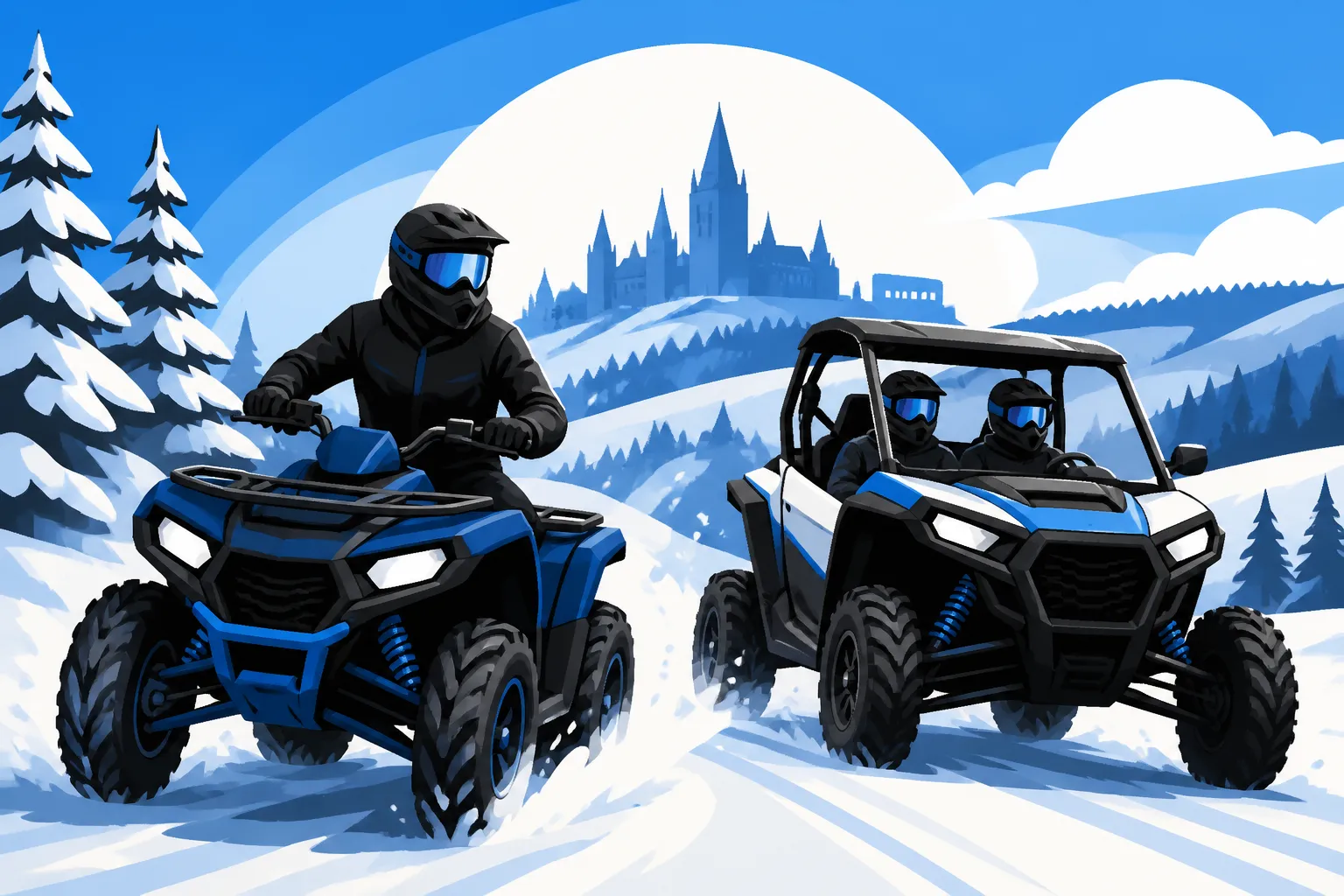
Some winter corridors are shared with snowmobiles, and the experience can be different from riding a quiet summer ATV trail. A snowmobile may approach quickly, and snowbanks or trail bends can limit sightlines. Stay alert, keep to the appropriate side of the trail, reduce speed where visibility is limited, and leave room for other users to pass safely. If a trail is narrow, do not assume there is enough space for two machines to squeeze by.
Follow signs and local instructions, even if you have ridden the same route in another season. Trail etiquette includes slowing near crossings and busy access points, keeping noise down near homes and cottages, and not blocking a trail while the group stops. For more detail on sharing corridors, review [Quebec Winter Trails Shared With Snowmobiles] and [Quebec Trail Etiquette Locals Expect].
Use a navigation app to orient yourself, not to override trail signs. onX Offroad can help you keep track of your intended route, but the safest choice is still to stay on the authorized corridor and follow local guidance. If a connector is blocked or you are unsure whether it permits ATV use, stop and verify rather than following a track into an unmarked area.
Prepare your machine and riding gear
Check the ATV or side-by-side before it gets cold
Cold weather can make an older battery less dependable, thicken fluids and expose small mechanical problems that were easy to ignore in warmer weather. Before the ride, check the battery, tires, brakes, lights, steering and fluid levels. Look for loose wiring or damaged components, and make sure the machine starts and idles reliably. If you use a side-by-side, confirm that its doors, windshield or other fitted parts are secure.
Tire choice and pressure affect how your machine behaves on snow and ice. Use equipment appropriate for your vehicle and riding conditions, and follow the manufacturer’s guidance. Do not assume that a setup used on dry dirt will provide the same grip on a packed, icy or uneven winter trail. Avoid aggressive riding to compensate for poor traction; ease off the throttle and give yourself more room to stop.
Bring basic recovery and repair equipment suited to your route and machine. A tow strap, tools, a tire repair kit and a way to clear snow from the machine can be useful, but only if someone in the group knows how to use them safely. Keep gear secured so it cannot shift or interfere with controls. For a remote ride, think about how you would handle a dead battery, a puncture or a disabled machine without assuming help will arrive quickly.
Dress for time outside the machine
Winter riding gear needs to work when you are moving and when you stop. Wind can make a short pause feel much colder, particularly if clothing has become damp from sweat. Use layers that allow you to adjust your insulation, and protect exposed skin with suitable gloves, boots, headwear and eye protection. Carry an extra dry layer in a protected bag, along with water and food that will remain usable in cold conditions.
A helmet and appropriate eye protection are essential parts of preparation. Check the applicable requirements and make sure your equipment fits comfortably with winter layers. Fogging can affect visibility, so test your visor or goggles before the ride and bring a way to manage moisture. See [Quebec Helmet and Visor Rules] for a closer look at the rules that apply to riding in Quebec.
Plan clothing breaks before anyone becomes uncomfortably cold. Agree that riders can speak up if their fingers are numb, their vision is fogging or they need to warm up. The person who is trying to keep up with a group may be reluctant to ask for a stop, so make regular check-ins part of the plan. A warm-up break is far safer than pushing on while someone is distracted or losing dexterity.
Handle paperwork, safety and changing conditions
Carry the right documents and confirm trail requirements
Before riding, make sure your machine’s registration and required insurance are in order, and check what trail pass or proof is needed for the route. Requirements can depend on where you are riding and which network you are using. Keep required documents accessible, not buried under a pile of winter gear. If you rely on a phone copy, do not make it your only option unless you have confirmed it is accepted for the situation.
A January trip can involve several checks at once: the machine must be properly registered, the rider must meet the applicable rules, and the trail itself must be open to that type of vehicle. Confirm each item separately. [Quebec Trail Pass Proof on the Trail] covers trail-pass evidence, while [Quebec Trail Etiquette Locals Expect] is a useful reminder that being legally equipped is only part of riding responsibly.
Make sure everyone in the group knows the basic plan: who is leading, who is following, where to regroup and what to do if someone loses sight of the group. Keep a reasonable distance between machines, particularly in low visibility, and stop in a safe place rather than around a blind corner. If your group includes riders unfamiliar with the area, agree that nobody will leave the route without telling the others.
Know when to shorten or cancel the ride
Winter plans should have a clear point at which you will turn back. A sudden change in visibility, freezing rain, a closure notice, a mechanical issue or a rider who is getting too cold can all be good reasons. The decision does not need to wait until the group is in trouble. If the trail becomes difficult to read or the machines are struggling for traction, reassess before the next remote section.
Check weather and trail updates before loading up, but stay ready to change plans after you arrive. A trailhead can reveal conditions that were not obvious from home: drifting snow, icy access, a closed gate or a route that has not been maintained. Do not try to force a machine through conditions it cannot handle. A stuck vehicle can turn a manageable ride into a recovery problem, especially when the group is far from a road.
Agree ahead of time that anyone can call for a stop or a turn-around without being teased or pressured. That simple group rule matters. January riding is most enjoyable when everyone feels comfortable speaking up, the trail is confirmed open, and the route leaves enough time to get back before conditions or daylight become a concern.
Disclaimer
This article is for general informational purposes only and does not constitute professional advice. Laws, prices and regulations vary by location and change over time. Consult a qualified professional for guidance on your specific situation.