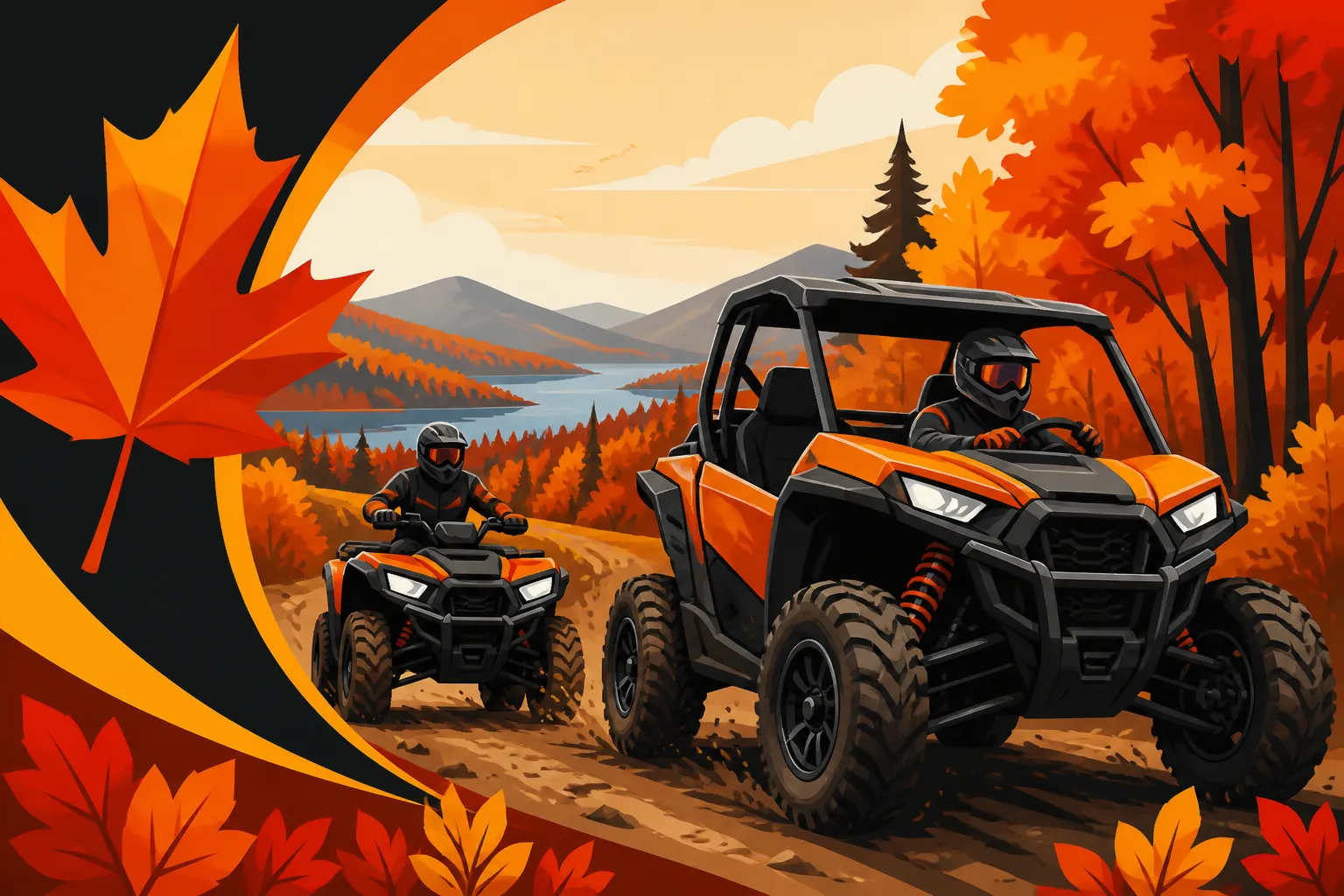
Quebec Riding in October
October riding in Quebec can mean brilliant foliage, quiet trails, and crisp air—but it can also bring sudden rain, muddy stretches, shorter daylight, and hunting-season closures. This guide helps ATV and UTV riders plan a safer fall outing, check whether a route is open, prepare for changing conditions, and avoid the common mistake of assuming every summer trail remains available.
Plan around trail access, not just fall colours
Check whether your route is open
An autumn trail that looks perfect on a map may be closed when you arrive. Quebec trail access is managed locally, and availability can change with weather, landowner permission, maintenance needs, or hunting activity. A route that was open earlier in the season may have a temporary closure or a different access restriction by October.
Before leaving home, check the local club’s latest updates and the federation’s trail information. Look for notices about closures, detours, construction, and access points. The [Quebec Trail Conditions Before You Go] guide is a useful reminder to check current conditions instead of relying on a route saved from a previous ride. If you use onX Offroad to explore or organize possible routes, treat it as a planning aid—not confirmation that a Quebec club trail is open or that you have permission to ride it.
Hunting season deserves particular attention. Dates and restrictions can vary by region, species, and year, so do not assume one area’s rules apply elsewhere. Check the local trail club’s notice before travelling, especially if your route passes through wooded or rural areas. For a closer look at seasonal access, see [Quebec Trail Closures in Hunting Season] and [Quebec Trails Closed for Hunting Season].
Choose a route with realistic October conditions
A scenic route is not automatically a sensible route for a late-season ride. A long loop through remote country may be enjoyable in dry summer weather but stressful in October if rain slows progress, daylight runs short, or an unexpected closure forces a reroute. For a first fall outing, choose a route with clear access points and a practical way to turn back.
Think about where the ride begins and ends, how much time you will spend on the trail, and what options you have if conditions worsen. A shorter circuit near a village or familiar staging area can be a better choice than a complicated route across several regions. When checking a map in onX Offroad, mark likely fuel stops, access roads, and turnaround points, then verify any trail access with the relevant club or official map.
| October factor | What to check before leaving | Why it matters |
|---|---|---|
| Trail status | Club updates, detours, and closures | A familiar route may no longer be available |
| Hunting activity | Local notices and regional restrictions | Access or safe use may change in active areas |
| Weather | Rain, temperature, wind, and forecast changes | Wet ground and cold exposure can affect the ride |
| Daylight | Sunrise, sunset, and your planned return time | Shorter days leave less room for delays |
| Fuel and range | Distance between reliable stops | Remote sections are harder to manage late in the season |
| Machine condition | Tires, lights, battery, and recovery gear | Mud, cold starts, and low light put equipment to work |
Prepare for wet ground, cold air, and shorter days
Expect conditions to change during the ride
October weather can shift quickly. A dry start does not guarantee dry trails, and shaded or wooded sections may feel colder than an open road. Rain can turn soft ground into a slow, messy ride, while overnight frost may leave some surfaces slick early in the day. Conditions can also vary across a single outing, particularly when a route crosses different elevations or open and sheltered terrain.
Check the forecast for the area where you will actually ride, not just the nearest large city. If rain is expected, consider shortening the route or choosing a trail with easy exit options. Avoid treating a wet trail as a challenge to push through: deep mud, standing water, and soft shoulders can hide ruts or damage the trail. The practical guidance in [Quebec Trail Closures After Heavy Rain] is relevant even when a trail has not been formally closed: poor ground conditions are a good reason to reconsider your plan.
Plan for cold even if the forecast seems mild. Wear layers that you can adjust, gloves that still allow you to operate controls, and weather-resistant outerwear. Keep a dry layer in a waterproof bag. A long stop beside a machine can feel much colder than riding, especially if you have become damp from rain or spray.
Make the machine and the group ready for late-season riding
Give your ATV or UTV a careful pre-ride check. Test the lights and brake lights, inspect tires for damage, check fluid levels, and make sure the battery is in good condition. Mud and water can make a marginal machine problem more frustrating, so address unusual noises, loose parts, or warning lights before the trip rather than hoping they will disappear on the trail.
Bring equipment that matches your route and your group’s experience. Useful items may include a first-aid kit, basic tools, a tow strap, a tire repair kit, a flashlight or headlamp, water, snacks, and a charged phone. If you are riding somewhere with unreliable service, tell someone where you are going and when you expect to return. Keep essential items protected from rain and mud, and know how to access them without unpacking everything beside the trail.
Shorter daylight makes time management part of the safety plan. Set a turnaround time, not just a destination. If the group reaches that time before completing the loop, turn back. This can feel disappointing when the foliage is beautiful and the trail is enjoyable, but it is far better than finishing a slow, muddy route in darkness. For route planning, onX Offroad can help you keep potential alternatives organized; still, carry the information you need in a form you can access if your phone battery runs low or service drops.
Ride responsibly around hunting activity and other trail users
Give hunting areas extra consideration
October is a busy outdoor month in Quebec. ATV and UTV riders may share rural landscapes with hunters, hikers, residents, landowners, and other trail users. A marked trail is not a reason to ignore nearby activity. If local notices identify a closure or restriction, follow it. If you encounter signs or barriers, do not ride around them to continue the route.
Keep noise and speed under control near homes, cottages, and areas where people may be working or hunting. Stay on authorized trails rather than cutting across fields, forest roads, or private property. A GPS line or map layer does not grant access rights. If you are unsure whether a route is an authorized trail, check with the local club before riding it.
When planning a ride during hunting season, choose routes with current, clear access information and let everyone in the group know that the plan may change. This is especially useful when riders are coming from different towns and may have different assumptions about local closures. The [Quebec Trail Etiquette Locals Expect] guide offers helpful context for being a considerate guest on shared corridors.
Keep the group visible and predictable
Low light, changing weather, and wet surfaces make it especially important to ride at a pace that allows everyone to react. Leave enough space between machines to see the trail and avoid spraying the rider behind you with mud. On blind corners, narrow sections, or steep descents, slow down and keep to the authorized route.
Before setting off, agree on a simple group plan: who leads, who rides last, where the group will stop, and what everyone should do if they become separated. Do not assume that a rider who falls behind can catch up quickly on a muddy or unfamiliar trail. Use planned regrouping points, and stop somewhere safe if the group becomes spread out.
Check that each rider understands the route and has the required documents and trail access in order. A pass does not make a closed trail rideable, and a route shown in a mapping app does not replace local signage. The [Quebec Trail Passes Cover Every Club] guide can help clarify the role of trail passes, while [Quebec Trail Maps and the iQuad App] provides another useful reference for navigating Quebec’s trail network. If you also use onX Offroad, compare its route information with local club updates before departure rather than relying on a single map source.
Build a practical October ride plan
Match the outing to your group
A successful October ride does not need to cover a huge distance. If you are riding with beginners, children, or anyone unfamiliar with the area, choose a shorter route with straightforward navigation and places to stop. More experienced riders may be comfortable with a longer outing, but they should still account for wet ground, reduced daylight, and the possibility of detours.
Ask each person about their comfort level before the ride begins. Some riders are happy to navigate slippery terrain; others may find it tiring or intimidating. A good group plan leaves room for the least experienced rider to travel safely without feeling pressured to keep up. If conditions deteriorate, adjusting the route is a sensible decision, not a failure to complete the plan.
A simple itinerary helps everyone stay on the same page:
- Confirm the trail is open and check local notices.
- Choose a route that fits the group, weather, and daylight.
- Share the planned route and return time with someone at home.
- Check each machine, pack weather-appropriate gear, and confirm fuel.
- Agree on a turnaround time and regrouping points.
- Recheck conditions before entering the trail and be willing to change plans.
Decide when to turn around or cancel
Some signs call for a shorter ride or an early return: worsening rain, heavy mud, poor visibility, a machine problem, an unexpectedly slow pace, or a trail closure. A group should also stop if someone is cold, wet, or uncomfortable. October rides can be memorable without being long, and there is no benefit in pressing ahead just because the original route looked manageable at home.
Cancel or choose another activity if you cannot confirm that the trail is open, if weather conditions make the route unsafe, or if you do not have the equipment needed for the planned terrain. A last-minute change can be frustrating, especially after loading machines and driving to a trailhead. But a closed trail or deteriorating route is not an invitation to improvise across private land or take an unverified shortcut.
Before your next seasonal ride, review [Quebec Riding in January] for a useful contrast with winter trail planning, and [Quebec Trail Closures After Heavy Rain] for a reminder that conditions can matter as much as the calendar. October riding is at its best when the route is confirmed, the group is prepared, and everyone is willing to turn a planned loop into a shorter, safer outing when the day calls for it.
Disclaimer
This article is for general informational purposes only and does not constitute professional advice. Laws, prices and regulations vary by location and change over time. Consult a qualified professional for guidance on your specific situation.