Quebec Clubs and What They Maintain
A Quebec ATV ride can look simple on a map, then turn into a maze of closed gates, soft spring ground, missing signs, or trails crossing land you do not own. Local clubs do much of the work that makes a federated route rideable, but their role is easy to misunderstand. This guide explains what Quebec clubs maintain, how that work affects your ride, and how to help protect access.
What Quebec ATV clubs actually do
Clubs maintain trails, not the land beneath them
A trail club’s job is generally to maintain and manage authorized riding corridors, not to own every parcel beneath them. A route may cross private farmland, forest, Crown land, or a purpose-built connection between two areas. The club’s ability to keep that route open depends on permission and on riders respecting the conditions attached to access.
That distinction matters when you see a trail sign beside a field near Saint-Hyacinthe, a wooded corridor in the Laurentians, or a remote route in Abitibi. The club may have built or repaired a bridge, posted signs, and arranged for riders to pass, but the underlying land can still belong to someone else. A route shown on a map is not permission to wander off it.
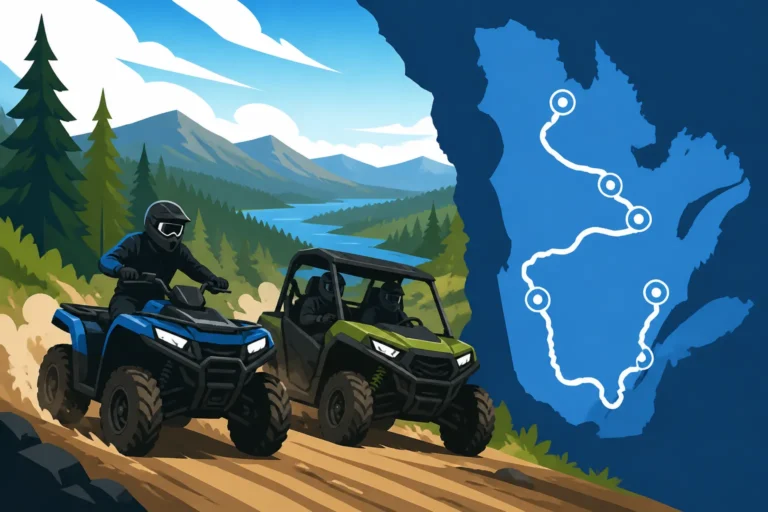
Club-maintained routes are commonly part of the broader federated trail network. The Fédération Québécoise des Clubs Quads, often shortened to FQCQ, connects clubs and helps administer the network and its trail-pass system. Individual clubs handle much of the local, hands-on work. For a broader look at the scale of the network, see [Quebec's 25,000 Kilometres of Federated Trail].
Each club works within its own territory and resources
There is no single maintenance crew responsible for every kilometre of ATV trail in Quebec. Local clubs focus on their own routes, equipment, volunteers, land-access agreements, and operating constraints. A club serving an area around Québec City may face a very different workload from one maintaining a remote route near Chibougamau or along a regional circuit in the Outaouais.
The practical result is that maintenance can vary from one section to the next. One corridor may have recently refreshed signs and a firm surface, while another may be temporarily closed after heavy rain or awaiting a bridge repair. That does not necessarily mean one club is careless and another is diligent. Terrain, weather, landowner conditions, volunteer availability, and the club’s equipment all affect what can be done and when.
If a route crosses several club territories, expect the condition and signage to change as you travel. Plan with current trail information rather than assuming that a familiar corridor remains open end to end. [Quebec's 100 Plus Member Clubs] provides useful context for why responsibility is distributed across local organizations instead of resting with one central trail crew.
The physical work clubs perform on trails
Surface, drainage, and erosion work
A great deal of trail maintenance is unglamorous: clearing water away from the riding surface, smoothing ruts, reinforcing soft spots, and addressing erosion before it turns into a hazard. In hilly areas such as the Laurentians or Charlevoix, water can run down a trail and cut channels into the surface. In flatter regions, wet ground can hold water and become deeply rutted under repeated traffic.
Clubs may use equipment or hand tools to manage drainage, depending on the location and the scale of the problem. A small ditch or culvert can help water move off the trail instead of pooling in the wheel tracks. A badly placed or blocked drainage feature, on the other hand, can send water onto a neighbouring property or cause further damage. The right repair depends on the ground and the route, not simply on filling in a rut.
Riders often notice surface work only when it has not been done recently. A muddy section can feel like an invitation to spin the tires, but that usually makes the damage worse. If you encounter a fragile or deeply rutted stretch, slow down, follow the marked route, and avoid creating a new bypass. A short detour through the brush can widen into a lasting scar that the club then has to address.
Bridges, culverts, gates, and other structures
A trail can depend on structures that are easy to take for granted: a bridge over a stream, a culvert beneath the trail, a gate that marks a property boundary, or a barrier that prevents riders from entering a closed section. Clubs may inspect, repair, replace, or report problems with these features, depending on their authority and resources.
A damaged bridge is not just an inconvenience. It may be unsafe for a machine, a rider, or a person walking nearby. Do not assume that a narrow crossing is sound because another ATV has already gone over it. If a structure looks unstable, has shifted, or is marked closed, turn back and report what you saw through the club’s preferred channel. Do not move a closure sign to get through.
Gates also deserve care. They may protect livestock, keep unauthorized vehicles out, or mark a condition negotiated with a landowner. If the route instructions tell you to close a gate behind you, do so. If a gate is locked or the trail is blocked, do not force it open or ride around the barrier. Access agreements can be lost when riders treat a landowner’s boundary as an obstacle rather than a condition of trail use.
Signs, maps, and information riders rely on
Markers help you stay on the authorized route
Trail signs and markers make it possible to follow a corridor through unfamiliar terrain, intersections, and communities. A club may install or maintain directional signs, warnings, route markers, and notices about hazards or closures. In a wooded area, a missing marker can leave a rider unsure whether to continue, turn, or retrace the route.
That uncertainty is a good reason to stop and check your location rather than guess. Continuing down an unmarked road may take you onto a private driveway, a municipal road where ATV access is not authorized, or an unofficial path. If signs are missing or damaged, note the nearest intersection or landmark and report it later. Removing or relocating a sign yourself can make the problem harder to diagnose.
Signage is not decoration; it communicates where riding is allowed and what conditions apply. Follow temporary signs even if an app or printed map shows the trail continuing. A digital route may not reflect a recent closure, a landowner request, or a storm-related hazard. Maps are useful planning tools, but the posted instructions on the ground still matter.
Trail condition updates can change your day
Clubs and federated trail resources may share information about closures, maintenance, and conditions. That information is especially important during spring thaw, after heavy rain, during hunting periods, and when a structure or access agreement changes. A route that was open on your last visit may not be suitable or available today.
Before leaving home, check the trail information for the specific region and sections you intend to ride. If your loop crosses multiple club areas, check each relevant update rather than relying on one general map. This is particularly helpful for long rides through the Laurentides, Mauricie, or Chaudière-Appalaches, where a closure on one connector can change the whole day’s plan. For a practical pre-ride checklist, use [Quebec Trail Conditions Before You Go].
A navigation app such as onX Offroad can help you understand your position, plan a route, and keep track of your ride, especially where mobile coverage is limited. Treat it as a navigation aid rather than proof that every line displayed is an authorized ATV trail. Compare your plan with official trail information, obey local signs, and avoid using a mapped road or track simply because it appears on a screen.
| Club responsibility | What a rider may notice | What the rider should do |
|---|---|---|
| Trail surface and drainage | Ruts, soft ground, standing water, or a repaired section | Slow down and avoid widening the trail |
| Bridges and culverts | A crossing, barrier, or temporary closure | Do not cross a damaged or closed structure |
| Signs and route markers | Directional arrows, warnings, or detours | Follow posted instructions and report missing signs |
| Land-access coordination | Gates, private property, or restricted sections | Stay on the authorized corridor and respect conditions |
| Trail information | Updates about closures or changing conditions | Check before departure and adjust the route |
| Grooming or seasonal preparation | A smoother or more clearly defined route | Ride considerately and leave room for other users |
Land access and the relationships behind a trail
Permission is a key part of keeping a route open
A club-maintained corridor may exist because a landowner has agreed to let riders cross a specific part of a property under specific conditions. That arrangement can be more delicate than it appears. A rider who leaves the trail, damages a field, ignores a gate, or rides during a prohibited period can create a problem for the club and the landowner alike.
Imagine a route crossing a working property outside a small town in Centre-du-Québec. The trail may be available only along a marked edge, not across the whole field. If a rider cuts across the crop to avoid mud, the damage is visible, costly, and likely to affect whether the route remains available. The club cannot guarantee access if riders do not respect the boundaries and timing agreed upon with the property owner.
For that reason, a trail is best understood as a permission-based corridor, not an open invitation to explore the surrounding land. Stay on the marked route, keep noise under control near homes, and avoid stopping in a way that blocks a gate or driveway. [Quebec Trails That Cross Private Land] explains why access and rider behaviour are closely connected.
Closures protect access as well as the trail surface
A closure may be posted because the trail is too soft, a bridge needs attention, a landowner has withdrawn permission, or conditions make the route unsafe. It can be frustrating to reach a planned route and find a barrier, especially after a long drive with a trailer. But going around a closure can put future access at risk and create hazards for other riders.
Spring thaw is a common example. Snowmelt and saturated soil can make even a familiar trail vulnerable to deep ruts and erosion. Clubs may close sections to protect the surface while it dries. Respect the closure rather than treating it as a suggestion. A short delay in riding is generally less damaging than forcing heavy traffic through ground that cannot support it. See [Quebec's Spring Thaw Closure] for more on why seasonal restrictions matter.
Closures can also affect only one segment of a route, but that does not mean it is safe to improvise a bypass. Use an authorized alternative if one is provided, or choose a different ride. Do not cross private land, follow a farm lane, or create a new trail to reconnect with the route. If the posted information is unclear, contact the club or consult the official regional trail information before setting out again.
How clubs organize maintenance and respond to problems
Volunteers and local knowledge keep the network moving
Many club tasks rely on members and volunteers who know the local terrain. They may help clear branches, inspect signs, report washouts, prepare trail sections, or support organized work days. Local knowledge matters because a problem that looks minor on a map may be a recurring hazard after rain, or a route that seems easy to reroute may depend on a particular land-access agreement.
Volunteer work is often practical rather than glamorous. A crew might spend a day clearing storm debris, repairing a small section of trail, or checking a route before a busy riding period. These efforts can save riders from arriving at an unexpected dead end, but they do not mean every trail can be inspected continuously. Conditions can change between club visits, especially after storms or during periods of heavy use.
If you want to help, look for a club’s volunteer activities and ask what is useful. Showing up with the right equipment, following safety instructions, and taking direction from the crew lead is more helpful than making an unapproved repair. [Quebec Club Volunteer Days] offers a starting point for understanding how riders can support local trail work.
Reporting damage gives clubs information they may not have
Clubs cannot fix a problem they do not know about. Riders can help by reporting hazards such as a washout, a damaged sign, a fallen tree blocking a corridor, a broken gate, or a suspicious new bypass. A clear report helps the club decide whether the issue needs urgent attention, a closure notice, or a later repair.
Include the location as precisely as possible. Mention a nearby intersection, trail marker, bridge, village, or recognizable landmark. If you use a GPS app, a saved location can be helpful, but include a plain-language description too. A message saying “a tree is down somewhere after the river” may be difficult to act on; “on the marked corridor east of the bridge, before the junction signed for the village” is more useful.
Do not put yourself at risk to gather details. If a bridge looks unsafe or a tree blocks a narrow trail, turn around rather than attempting a repair with a machine or chainsaw. Report the issue through the club’s preferred contact route when you are safely stopped. For more guidance on making a useful report, see [Reporting Trail Damage to a Club].
Trail passes, clubs, and what riders help support
A trail pass is not the same as a club work order
Riders sometimes assume that buying a trail pass means every part of a route will be groomed, dry, and open whenever they arrive. That is not how trail maintenance works. A pass supports access to the federated network and its administration, but trail conditions remain affected by weather, land access, local resources, and maintenance schedules.
A pass also does not override a closure or give permission to ride outside the marked network. It is one part of riding legally and responsibly, alongside registration, insurance, required equipment, and compliance with local rules. If you are planning a trip across several regions, confirm that your pass and other required documents are in order before setting off. [Quebec Trail Passes Cover Every Club] explains the network-wide role of the pass.
The exact work funded and organized by a club can differ. Some tasks may be handled by volunteers, while others may require equipment, contracted work, or coordination with landowners and local authorities. It is more accurate to think of the pass as supporting access to the organized trail system than as a promise that a particular trail will be maintained to a specific surface standard every day.
Club membership connects riders with local stewardship
Club participation can give riders a closer connection to the area where they ride. Depending on the organization, members may receive local updates, learn about volunteer opportunities, or have a way to raise concerns about a corridor. The club is also a place to ask practical questions about a local route, provided you check current information before relying on an answer for a particular ride.
Membership is not a substitute for a trail pass or for following access rules. Nor does joining a club mean that a rider can decide where signs go, open a closed route, or make a new connection across private property. Trail planning requires coordination with the people responsible for access and maintenance.
If you ride the same region regularly, supporting its club can help sustain local knowledge and communication. That support may be especially valuable in areas where one damaged bridge or lost land-access agreement can interrupt a longer circuit. A club’s work is easier to see when something is closed; it is just as important when a route remains open because someone has maintained the relationship and the corridor.
Planning rides with club-maintained trails in mind
Build a route with realistic alternatives
A reliable ride plan includes more than a start point and a destination. Check the route status, confirm which club areas you will cross, and identify a reasonable alternative if a connector is closed. A loop that depends on one narrow crossing can become a much longer day if that section is unavailable.
For example, a group leaving from a trailhead near Saint-Hippolyte may plan a ride that connects several local corridors. Before departure, check for closures and consider where the group can turn back without blocking traffic or trespassing. If a route heads into a remote area, plan for limited cell coverage and agree on where to regroup if someone gets separated.
A navigation app such as onX Offroad can be useful for recording your route and checking your position. Download or save what you need before you lose reception, and carry a charged phone or other navigation backup. Still, do not let a GPS line overrule signage or current club information. If a route shown in an app conflicts with a closure sign, follow the closure.
Ride in a way that makes maintenance easier
Riding responsibly reduces the amount of avoidable repair work clubs must handle. Keep to the trail, avoid spinning tires in soft ground, and do not widen a muddy section by creating a new line around it. On a narrow corridor, leave space for other riders and slow down near homes, farm access points, and trail workers.
Be especially considerate when passing a maintenance crew. Follow their directions, reduce speed, and wait if they are working around equipment or a blocked section. A work zone may involve tools, vehicles, unstable ground, or people who cannot hear an approaching ATV clearly. Patience helps keep both the crew and the trail safe.
Good trail etiquette also supports landowner relationships. Close gates when instructed, pack out litter, avoid unnecessary noise, and do not ride around a barrier. For more on the everyday habits that help protect access, read [Quebec Trail Etiquette Locals Expect]. A considerate rider is not just protecting one afternoon’s ride; they are helping preserve the route for the next season.
Disclaimer
This article is for general informational purposes only and does not constitute professional advice. Laws, prices and regulations vary by location and change over time. Consult a qualified professional for guidance on your specific situation.