Common Quebec Paperwork Mistakes
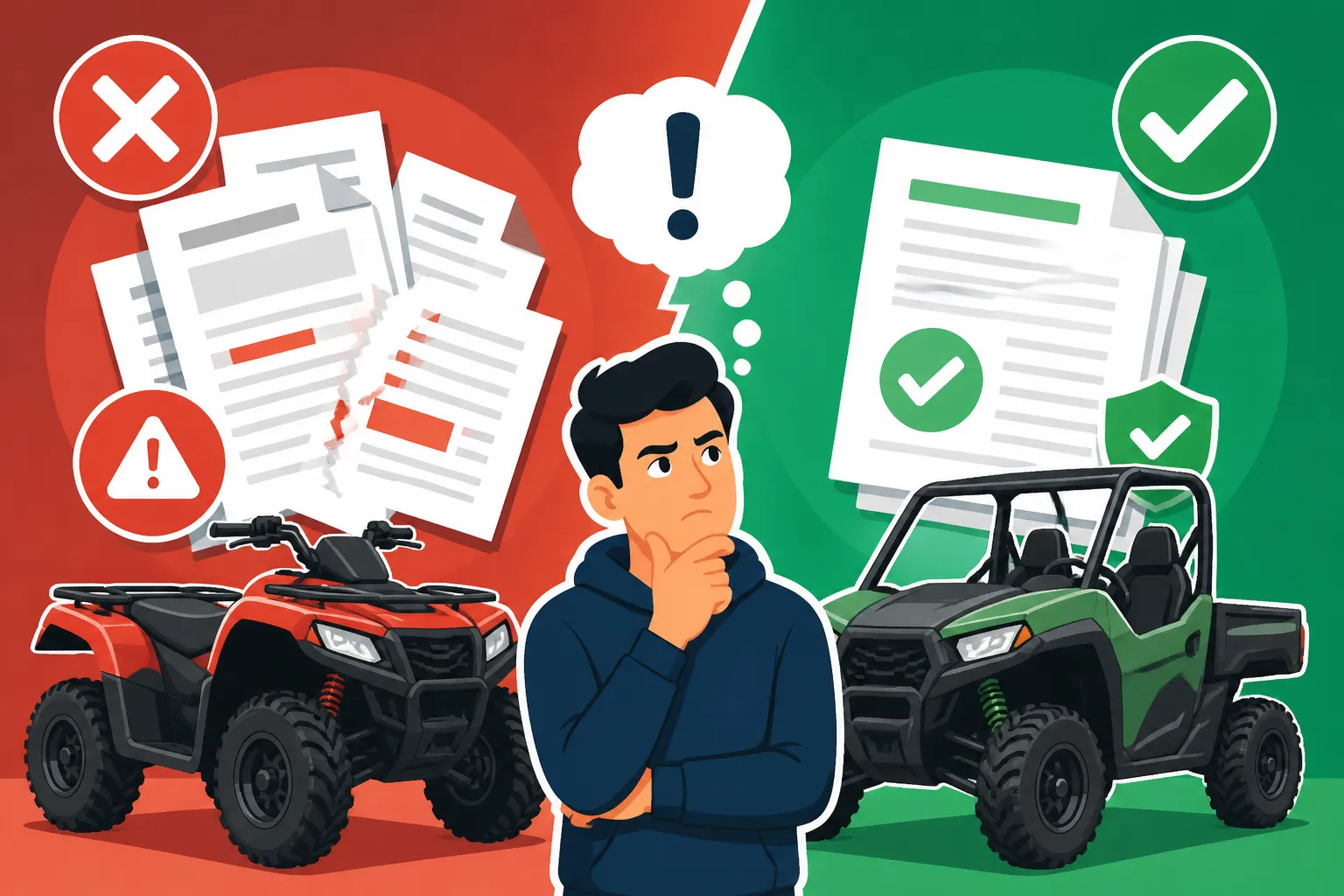
Oh, the joy of getting a new-to-you ATV or UTV, whether it's a shiny new ride from a dealer or a fantastic find from a neighbour! But then comes the moment of truth: dealing with the SAAQ paperwork. It's often where the excitement hits a bureaucratic brick wall. So many folks, myself included, have walked into that SAAQ office, brimming with anticipation, only to be met with a polite, "Monsieur/Madame, il manque un document," or "Ce n'est pas rempli correctement." It's incredibly frustrating, and it can turn a simple registration into a multi-trip headache. This guide is here to walk you through the most common paperwork mistakes Quebec ATV and UTV owners make, so you can breeze through the process and get out on the trails faster.
The Frustration of Misplaced or Incomplete Documents
It's a scene as old as time: you gather what you think is everything, head to the SAAQ, and then discover you're missing that one crucial piece. The SAAQ, as the province's registrar and insurer for off-highway vehicles, has a very specific checklist, and they really don't budge on it. This isn't about being difficult; it's about ensuring legal ownership, proper identification, and compliance with the [Quebec's Off-Highway Vehicle Act and Your Papers]. Missing one link in the chain can send you right back home.
Missing a Key Piece of Identification
One of the most frequent culprits is simply not having all the necessary personal identification with you. You'd think your driver's licence would be enough, right? For most things, it is. But when you're registering a vehicle, especially if you're a new resident or if there's any discrepancy, the SAAQ clerks might ask for more. This could include a second piece of photo ID, or sometimes, proof of your Quebec address. Imagine getting to the counter, waiting in line, only to realize you left your utility bill at home. It's not a fun detour. Always bring your valid Quebec driver's licence, another piece of government-issued ID (like a health card or passport), and a recent document showing your current address, just to be safe. It saves so much time and prevents that sinking feeling of a wasted trip. For newcomers, it's particularly important to be prepared; check out [Quebec ATV Registration for Newcomers] for a detailed list.
The Elusive Bill of Sale
This is probably the number one headache for private sales. You find that perfect used quad, shake hands, exchange cash, and the seller scribbles something on a piece of paper. Or worse, maybe it's just a verbal agreement. Then you go to the SAAQ, present your "proof of purchase," and they shake their heads. A proper bill of sale isn't just a receipt; it's a legal document that formally transfers ownership. It needs specific details: the full names and addresses of both the buyer and seller, the complete vehicle identification number (VIN) of the ATV or UTV, the make, model, year, the purchase price, and the date of the sale. Most importantly, it needs both buyer and seller signatures.
Without a clear, complete bill of sale, the SAAQ can, and often will, refuse the registration. They need to establish a clear chain of ownership. If you're buying from a friend or family member, it might feel informal, but don't skip this step! It protects both parties and ensures a smooth transfer. If you're wondering what needs to be on it, take a look at [Paperwork Two Individuals Sign on a Private Sale]. And if you're drafting one yourself, using a template from a reputable service like LawDepot can make a world of difference. It ensures all the legal jargon and necessary fields are included, preventing any "oops" moments at the SAAQ counter.
Navigating the Nuances of Vehicle Information
Beyond just your personal details, the information about your actual ATV or UTV is critical. These machines have unique identifiers for a reason, and any mismatch between what's on your paperwork and what the SAAQ database expects can cause a significant holdup. It's all about precision, and off-road vehicles can sometimes have their information less readily available than a car or truck, making it easy to overlook details.
Incorrect Machine Details on the Paperwork
The VIN (Vehicle Identification Number) is the unique fingerprint of your machine. It's usually stamped on the frame in a specific location, often under a fender or near the engine. Make sure the VIN on your bill of sale, and any previous registration documents you might have, matches the VIN on the machine itself exactly. Even a single digit or letter error can halt the process. The SAAQ uses this number to track the vehicle's history and ensure it's not stolen or tied to other issues.
Beyond the VIN, double-check the make, model, and year. Sometimes, people might refer to a machine by its common name rather than its official manufacturer's model designation. For example, calling it a "Raptor" instead of "Yamaha YFM660R Raptor." These small details matter. If the previous owner's registration certificate has incorrect details, it's often best to address that with them before you attempt the transfer, as it could become your problem. If you’re dealing with a machine where the serial number is hard to find or even seems to be missing, that’s a whole other can of worms, which we discuss in [Quebec Registration When the Serial Is Gone].
Overlooking Previous Owner Information or Liens
When buying privately, it’s imperative to verify that the person selling you the ATV or UTV is actually the legal owner. This might seem obvious, but sometimes people try to sell machines that aren't legally theirs, or they might not have fully transferred ownership themselves from a previous sale. Always ask to see their current SAAQ registration certificate. The name on that certificate should match the seller's identification. If there are two names on the registration, both parties generally need to sign the bill of sale.
A more insidious problem is an outstanding lien. This means the previous owner used the ATV or UTV as collateral for a loan, and the financial institution still has a legal claim on the machine. The SAAQ will check for liens when you try to register. If there's a lien, you won't be able to register it until the lien is cleared. This can leave you without your money and without a registered machine, so it's a crucial check to perform before you hand over any cash. Learning [What a Lienholder on File Means for a Buyer] is vital before making a purchase. A well-drafted bill of sale, perhaps created using LawDepot, can include clauses confirming that the seller guarantees the vehicle is free of liens, offering you some legal recourse if issues arise.
Common Errors in the Registration Process Itself
Even with all your documents in order, the way you approach the registration, or misconceptions about when and why you need to register, can lead to mistakes. Quebec has specific rules for off-highway vehicles, and they aren't always intuitive, especially if you're new to the quad scene or coming from another province.
The "Private Land Only" Misconception
Many new ATV owners mistakenly believe that if they only ride their machine on their own property, or on private land belonging to friends or family, they don't need to register it with the SAAQ. This is a persistent myth that can lead to big fines. The truth is, under Quebec law, if your ATV or UTV is operated anywhere other than on land you own, it generally needs to be registered and have a valid VHR (Véhicule Hors Route) plate. Even on your own land, if there's any chance you'll ever take it off-property—even just to cross a road to get to another piece of private land—it absolutely needs to be registered.
Furthermore, if you plan to ride on the vast network of federated trails maintained by the FQCQ clubs, registration with the SAAQ and a valid trail pass are both mandatory. The VHR plate is your ticket to legal trail riding. Don't fall into the trap of thinking "private land equals no rules." It's best to err on the side of caution and register your machine. You can read more about this in [Quebec Machines Used Only on Private Land] and [Do You Need to Register an ATV in Quebec?].
Forgetting About Sales Tax on Private Sales
Here's a common and often infuriating surprise for buyers: even when you buy an ATV or UTV privately in Quebec, you're still on the hook for the Quebec Sales Tax (QST). Many people assume that sales tax only applies to purchases from dealers. Not so! The SAAQ acts as the collector for QST on private vehicle sales. When you go to register, they will calculate the QST based on the higher of either the declared purchase price on your bill of sale or their estimated value of the machine.
This can be a significant chunk of change that many buyers don't budget for, leading to an unwelcome surprise at the SAAQ counter. Always factor QST into your total cost, even for a private sale. If you're unsure about the estimated value, you can often check online resources or compare similar machines for sale. For more details on this often-overlooked cost, check out [Quebec Tax on a Private ATV Sale]. Ensuring your bill of sale clearly states the agreed-upon price is important here; using a template from a service like LawDepot can help provide a professional and clear document that leaves no room for ambiguity regarding the sale price.
Missing the Annual Renewal Deadline
Just like with your car, ATV and UTV registrations in Quebec aren't a one-and-done deal. They need to be renewed annually. The SAAQ typically sends out renewal notices well in advance to your registered address. However, if you've moved and haven't updated your address with the SAAQ, that notice might never reach you.
Riding an ATV or UTV with an expired registration is against the law and can result in fines. It also means you're technically riding without the mandatory liability insurance that comes with your SAAQ registration, which is a serious risk. Always keep your address current with the SAAQ and make a note of your renewal date. You can usually renew online, which is a convenient way to avoid that dreaded expired sticker. To understand the renewal process better, take a look at [Quebec ATV Registration Renewal Each Year] and [Why VHR Registration Has to Be Renewed Yearly].
Understanding Financial and Legal Obligations
Beyond just the registration, there are critical financial and legal requirements that Quebec ATV owners must meet. These aren't optional extras; they're fundamental to riding legally and responsibly in the province. Overlooking them can lead to significant penalties and serious financial exposure.
Underestimating the Importance of Liability Insurance
This is a big one. Many folks are used to buying vehicle insurance from a private provider. But in Quebec, the SAAQ is unique: it acts as both the registrar and the mandatory minimum liability insurer for off-highway vehicles. When you register your ATV or UTV, you are automatically purchasing a basic liability insurance policy that covers you for a minimum of $1 million. This coverage protects you if you're found responsible for damage to property or injury to another person while operating your off-road machine.
There's no opting out of this basic SAAQ liability insurance. If your registration is expired or incomplete, you are effectively riding without this crucial coverage. Imagine causing an accident on the trail, and then realizing you're personally on the hook for potentially millions of dollars in damages. It's a terrifying thought. Always ensure your registration is current and valid. We've written more about this in [Quebec's Liability Insurance Rule] and [The $1 Million Liability Floor Every Owner Carries]. Some riders choose to buy additional, private insurance for collision, theft, or higher liability limits, but the SAAQ's component is non-negotiable for legal operation.
Incomplete or Incorrect Signatures
It seems so basic, doesn't it? Just sign on the dotted line. But a missing or incorrectly executed signature on key documents can invalidate them. This is especially true for the bill of sale. If there are two owners, both generally need to sign. If the seller is a business, the authorized representative needs to sign and often include their title. What if the seller is out of town, or unable to be present? Sometimes, a power of attorney is used, but this document itself needs to be legally sound and properly executed.
The SAAQ clerks are trained to look for these details. A signature that doesn't match the ID, or a missing signature where one is required, can lead to the rejection of your registration application. It might seem like a minor detail, but it's a legal formality that ensures all parties agree to the terms of the transaction. For crucial legal documents like a bill of sale or even a simple letter of authorization, leveraging a service like LawDepot can provide legally sound templates that ensure all necessary signature lines are present and accounted for, reducing the chances of a technicality derailing your registration.
Specific Scenarios and How to Avoid Pitfalls
Sometimes, the paperwork challenges come from unique circumstances that aren't straightforward sales. Whether it's a gift, an out-of-province machine, or navigating the differences between dealer and private purchases, each scenario has its own potential pitfalls.
The Gifted Machine — Still Needs Paperwork
"Oh, my dad just gave me his old quad for my birthday!" That's wonderful! But even a gift isn't exempt from paperwork. You'll still need a "bill of sale" document, even if the purchase price is declared as $0 (or "donated"). This document legally transfers ownership from the donor to the recipient. The SAAQ still needs this proof to update the owner on file.
And here's another potential surprise: even for a gift, the SAAQ might still assess QST. If the declared value is $0, they can determine the machine's "fair market value" and charge QST based on that. So, while the initial transaction has no cost, there could still be a tax implication at registration. Always prepare a formal document for a gifted machine, clearly stating it's a gift, and be ready for potential tax assessments. More on this can be found in [Quebec Tax on a Gifted Machine].
Out-of-Province Purchases and Imports
Bringing an ATV or UTV into Quebec from another province or, more complexly, from the United States, adds several layers of paperwork. If you bought it in Ontario, for instance, you'll need the original registration and bill of sale from Ontario. The SAAQ will then process the transfer and issue a Quebec VHR plate.
If you're importing from the United States, it gets considerably more complicated. You'll need to navigate customs requirements, pay federal duties and taxes, and ensure the machine meets Canadian import standards before you can even think about SAAQ registration. This often involves specific customs forms and proof that the vehicle has been modified (if necessary) to comply with Canadian regulations. Many owners underestimate the complexity and cost of these steps, leading to machines sitting unregistered in their driveways. For a deep dive into this, consult [Quebec Registration for an Imported Machine] and [Importing a Quad Into Quebec From the United States]. Having properly prepared documents for the purchase from the outset, possibly with the help of LawDepot templates, can make the customs process smoother.
Dealer Purchases vs. Private Sales
The paperwork process differs significantly depending on whether you're buying from a licensed dealer or a private individual. When you buy from a dealer, they typically handle the heavy lifting of the SAAQ registration. They'll submit all the necessary forms, collect the QST (and GST), and ensure the vehicle is properly registered in your name before you pick it up. This convenience is one of the benefits of buying new or certified pre-owned. You'll still need to provide your ID and sign some forms, but the dealer acts as an intermediary with the SAAQ. You can typically just drive away, with the dealer ensuring you have all the necessary documentation like your temporary registration. Learn about this process in [Quebec SAAQ Steps After a Dealer Purchase].
However, if you're buying privately, the entire burden of paperwork, from the bill of sale to the SAAQ visit, falls squarely on you and the seller. This is where most of the mistakes we've discussed tend to occur. It requires careful attention to detail from both parties. While a dealer's fees might seem high, they often cover the administrative headache that comes with registration. Always weigh the pros and cons, and remember that [Buying From a Neighbour Instead of a Dealer] means you're in charge of all the little details.
Table: Common Quebec ATV/UTV Paperwork Mistakes and Solutions
| Mistake Category | Common Issue | Impact | Solution |
|---|---|---|---|
| Identification | Missing secondary ID or proof of address | SAAQ will refuse to process, requiring another visit. | Always bring driver's licence, another photo ID, and recent proof of address. |
| Proof of Ownership | Incomplete or informal bill of sale | Registration rejected, difficulty proving ownership. | Use a formal bill of sale with all details (VIN, names, price, date, signatures). LawDepot offers reliable templates. |
| Vehicle Information | VIN or machine details don't match | Delays, investigation, or refusal of registration. | Double-check VIN on machine against all documents. Verify make, model, year accurately. |
| Legal Status | Unknown liens on the machine | Cannot register until lien cleared; risk of losing machine/money. | Always check for liens before purchase. Confirm seller is the legal owner. |
| Registration Logic | Belief that "private land only" avoids registration | Fines for unregistered operation, no liability insurance. | All ATVs/UTVs operated off-road (even private land not your own) generally require SAAQ registration. |
| Financial Obligations | Forgetting QST on private sales | Unexpected cost at SAAQ, potentially delaying registration. | Factor QST into your budget for private sales. SAAQ collects it based on declared or estimated value. |
| Process Management | Missing annual renewal deadline | Fines, riding uninsured, potential loss of trail access. | Update SAAQ address if you move. Note renewal date and renew online or in person. |
| Signature Errors | Missing or incorrect signatures on documents | Documents deemed invalid, requiring re-submission. | Ensure all required parties sign legibly and completely. Use LawDepot templates for clear signature fields. |
| Special Scenarios | Gifted machine without transfer paperwork | Difficulty transferring ownership, potential QST. | Prepare a formal "bill of gift" document, even if value is $0. |
| Special Scenarios | Out-of-province/US import without proper steps | Customs issues, delays, inability to register in Quebec. | Research federal import rules/customs requirements before buying. Have all original paperwork. |
Disclaimer
This article is for general informational purposes only and does not constitute professional advice. Laws, prices and regulations vary by location and change over time. Consult a qualified professional for guidance on your specific situation.