Provincial and Federal Tax Together
One of the most common head-scratchers when buying an ATV or UTV in Quebec is figuring out the sales tax situation. It's not always as straightforward as you might hope, especially with both provincial and federal taxes at play, and depending on whether you're buying from a dealer or a private seller. This guide is here to untangle that knot for you, breaking down how GST and QST apply to your off-highway vehicle purchase in Quebec, so you know exactly what to expect.
Understanding Quebec's Dual Tax System for ATVs and UTVs
When you buy almost anything in Quebec, you’re dealing with two layers of sales tax: the federal Goods and Services Tax (GST) and the provincial Quebec Sales Tax (QST). It's a system that can definitely feel a bit confusing, particularly when you’re making a big purchase like an ATV or UTV. Many folks assume all taxes are handled the same way, but the reality is a little more nuanced, especially depending on where and how you buy your machine.
GST: The Goods and Services Tax
The Goods and Services Tax, or GST, is a federal tax that applies across Canada. It's a single, harmonized rate that you’ll encounter on most goods and services you purchase. For off-highway vehicles, whether it's a brand-new quad from a showroom floor or accessories you’re adding later, GST is almost always going to be part of the equation.
When you're looking at the price tag on a new ATV or UTV, remember that the federal government considers these machines "goods" subject to GST. This tax is collected by businesses, like dealerships, who then remit it to the Canada Revenue Agency. It's a pretty consistent application, meaning the rate doesn't change based on the province, even if the provincial tax does. You might see it itemized separately on an invoice, or sometimes it's simply bundled into the overall "tax" line if the retailer uses a combined approach for display purposes, but it's always there.
QST: The Quebec Sales Tax
In addition to the federal GST, Quebec has its own provincial sales tax, the QST (Quebec Sales Tax). Unlike GST, which is uniform across the country, QST is specific to Quebec and has its own rate and rules. What often throws people off is that QST is generally calculated on the price including the GST. So, you're essentially paying a tax on a tax, which can certainly make the final cost of your ATV or UTV feel a bit higher than you might have initially anticipated.
The QST is collected by the provincial government, specifically Revenu Québec. When you buy from a dealer, they'll collect both GST and QST from you. But as we'll explore, if you're buying privately, the QST collection process is quite different and is typically handled by the Société de l'assurance automobile du Québec (SAAQ) when you go to register your new machine. This dual system, with QST often calculated on the GST-inclusive price, is a key element of the Quebec sales tax landscape that every ATV and UTV buyer needs to understand to avoid any surprises down the road.
How Taxes Apply to Dealer Purchases in Quebec
Buying your ATV or UTV from a licensed dealer in Quebec is usually the most straightforward way to handle the tax situation. Dealers are well-versed in the sales tax requirements and are set up to collect both the federal and provincial taxes directly from you at the point of sale. This means you won't have any unexpected tax bills popping up later when you go to register your machine with the SAAQ, which can be a huge relief for many buyers.
Transparent Tax Collection at the Dealership
When you purchase an ATV or UTV from a dealer, they act as the collection agent for both the GST and the QST. This means they'll add the applicable federal and provincial sales taxes to the negotiated price of your machine. It's all done in one transaction, so you get a clear, total price that includes all taxes. This simplified approach is one of the big advantages of buying new or used from a dealership; they handle the heavy lifting of calculating and remitting the taxes, which means less paperwork and fewer headaches for you.
This transparency extends to any additional services or accessories you purchase with your machine. If you're adding a winch, a new set of tires, or even opting for extended warranty coverage, the sales taxes will be applied to these items as well. The dealer's responsibility is to ensure that all taxable components of your purchase are properly accounted for, so you receive a final bill that reflects the complete cost, inclusive of both the federal and provincial charges. It really streamlines the process, allowing you to focus on the excitement of your new ride rather than worrying about tax compliance.
What to Expect on Your Bill of Sale
Your bill of sale from a Quebec dealer should clearly itemize the sales taxes. You'll typically see the base price of the ATV or UTV, followed by separate lines for the GST and the QST, along with their respective amounts. This detailed breakdown ensures you can see exactly what you're paying for in terms of taxes, preventing any ambiguity. The QST, as mentioned earlier, will often be calculated on the price that already includes the GST, so don't be surprised if the QST figure looks a bit higher than a simple percentage of the pre-tax price.
This official document serves as your proof that all applicable sales taxes have been paid at the time of purchase. When you head to the SAAQ to complete your registration, having a dealer's bill of sale with the taxes clearly itemized means the SAAQ won't assess or collect any additional QST on the purchase value. This is a critical distinction from private sales, where the SAAQ takes on the role of QST collector. Always keep your bill of sale safe, as it’s an important record for your ownership and tax history. It's the final piece of [Quebec Dealer Paperwork at Delivery] that confirms your payment and rights.
Navigating Taxes on Private Sales in Quebec
Buying an ATV or UTV from a private seller in Quebec can often seem like a great way to save a bit of money, and in some aspects, it can be. However, when it comes to taxes, private sales introduce a different set of rules, particularly around the Quebec Sales Tax (QST). Many buyers get caught off guard, assuming that if they buy from an individual, they avoid all sales taxes. That's simply not the case in Quebec, and understanding the nuances here is crucial to avoiding an unpleasant surprise when you go to register your machine.
GST Implications for Private Sales
Here's a piece of good news for private buyers: in most cases, the federal Goods and Services Tax (GST) generally does not apply to private sales between individuals. Why? Because individuals are typically not registered to collect GST. When you buy an ATV or UTV from another private owner, neither you nor the seller is a GST registrant in the eyes of the Canada Revenue Agency for that transaction.
This means you won't pay GST on the sale price when you hand over your money to a private seller. This is a significant difference compared to purchasing from a dealership, where GST is always collected upfront. So, if you're solely focused on the federal component of the sales tax, a private sale might seem appealing. However, it's vital not to confuse this with an exemption from all sales taxes, because the provincial side of things is a whole different ball game. Don't assume that no GST means no taxes at all – that's a common misconception that can lead to headaches down the road.
QST: The Tax You Still Pay to the SAAQ on Private Sales
This is the big one, and it's where many private buyers get surprised. While GST typically doesn't apply to private sales, the Quebec Sales Tax (QST) absolutely does. The key difference is who collects it. In a private sale between individuals, the seller does not collect QST from you. Instead, the Société de l'assurance automobile du Québec (SAAQ), which is responsible for registering all off-highway vehicles, steps in to collect the QST when you go to transfer the registration into your name.
The SAAQ won't just take your word for the sale price, either. They will assess the QST based on the higher of two values: either the actual sale price you declare on your bill of sale or the SAAQ's estimated wholesale value of the machine. This rule is in place to prevent people from declaring a ridiculously low sale price just to avoid paying QST. So, if you manage to snag a fantastic deal privately, say for $5,000, but the SAAQ's internal valuation for that specific make, model, and year is $7,000, you'll be paying QST on the $7,000 figure. This can be a real source of frustration, as what you thought was a great bargain can end up costing more than expected once the QST is applied. Always be prepared for this valuation process when you’re doing a [Quebec Registration Transfer After a Sale]. You'll need to have a clear [Paperwork Two Individuals Sign on a Private Sale] to present. Understanding [Quebec Tax on a Private ATV Sale] is fundamental.
Out-of-Province and Imported Machines: A Different Tax Landscape
The tax situation can become even more intricate when you're bringing an ATV or UTV into Quebec from another Canadian province or, even more so, from outside of Canada. Each scenario has its own set of rules for how federal and provincial taxes apply, and it’s important to understand these distinctions to avoid any unexpected costs or delays when you’re ready to hit the trails. The SAAQ is your main point of contact for registration, and they'll be key in collecting any outstanding provincial taxes.
Bringing a Machine from Another Canadian Province
If you've purchased an ATV or UTV in another Canadian province and are bringing it into Quebec, the tax implications can be a bit different from a local purchase. The good news is that you typically won't pay the federal GST (or the HST, if you bought it in an HST-participating province) twice. If you've already paid the federal component of the sales tax in the province of purchase, you generally won't be required to pay it again when you register the machine in Quebec. You'll need proof of this prior payment, usually found on your original bill of sale.
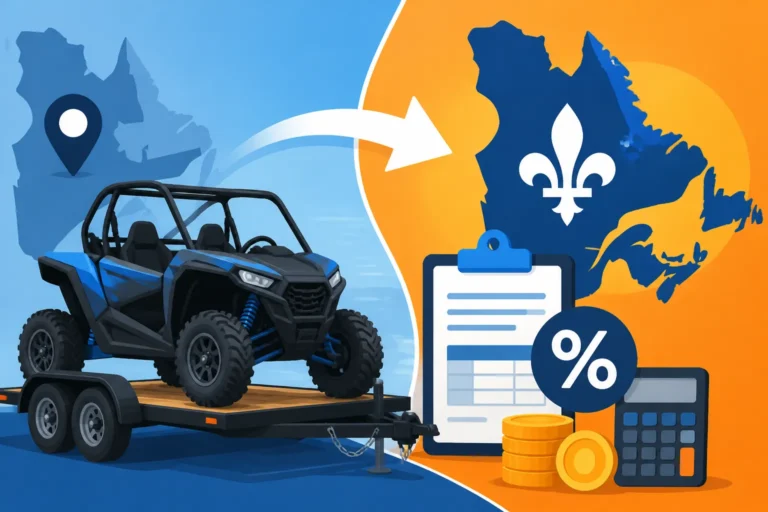
However, the Quebec Sales Tax (QST) is another matter entirely. Quebec's provincial tax rules mean that if QST wasn't collected at the time of purchase in the other province, it will be assessed and collected by the SAAQ when you register your machine here. Just like with private sales within Quebec, the SAAQ will calculate the QST based on the higher of your declared purchase price or their estimated wholesale value. This is a common point of confusion for new Quebec residents, who might have paid tax in their previous province but still owe the QST to Quebec. For details on how to register your machine once you arrive, check out [Quebec Registration for an Imported Machine].
Importing from the United States or Internationally
Bringing an ATV or UTV into Quebec from the United States or any other international location involves a multi-stage tax process. The first step involves federal customs. When you cross the border, you will typically pay any applicable federal duties and the federal Goods and Services Tax (GST) to the Canada Border Services Agency (CBSA). This is a non-negotiable step for importing vehicles and is distinct from provincial taxes. You'll need to have all your [Customs Paperwork at the Border] in order, including proof of ownership and valuation, to ensure a smooth process.
Once your machine has cleared customs and you've paid the federal charges, the next step involves registering it with the SAAQ in Quebec. At this point, the Quebec Sales Tax (QST) will be assessed and collected by the SAAQ. Again, the SAAQ will base this QST calculation on the higher of your declared purchase price (which should be reflected on your customs documentation) or their internal estimated value for the machine. So, you're essentially paying federal taxes and duties at the border, and then the provincial QST when you register in Quebec. It's a two-tiered process that requires careful attention to documentation at each stage. Understanding [Federal Import Requirements for a Quebec ATV] is crucial before you even start the process.
Record Keeping and Potential Pitfalls
Navigating the combined provincial and federal taxes for your ATV or UTV in Quebec requires diligent record keeping and an awareness of potential snags. Whether you're buying from a dealer or a private seller, having your paperwork in order is not just a good idea—it's essential for a smooth registration process and for avoiding unexpected costs. A little preparation can save you a lot of grief down the road.
Importance of a Clear Bill of Sale
A well-detailed bill of sale is your best friend when it comes to ATV and UTV purchases, especially for tax purposes. For dealer purchases, it proves that all GST and QST were collected upfront. For private sales, a clear bill of sale is crucial for the SAAQ to correctly assess the QST. It should include:
- Seller's and Buyer's Information: Full names, addresses, and contact details.
- Vehicle Details: Make, model, year, VIN/serial number, and odometer reading.
- Sale Price: The agreed-upon price in Canadian dollars.
- Date of Sale: The exact date the transaction occurred.
- Signatures: Both seller and buyer should sign and date the document.
A detailed bill of sale helps the SAAQ determine the taxable value for QST on private sales. Without it, or with an unclear one, the SAAQ might lean more heavily on their estimated value, which could be higher than what you actually paid. There are many templates available online to help you draft a proper bill of sale. For instance, services like LawDepot can provide customizable templates that ensure all necessary fields are included, giving you peace of mind. Proper documentation is a critical part of [Quebec Registration and Proof of Ownership]. Also, make sure you understand [Quebec Sales Tax on an ATV Purchase] completely.
Avoiding Surprises at the SAAQ
The biggest surprise for many private ATV and UTV buyers in Quebec comes at the SAAQ counter. As mentioned, the SAAQ will collect QST based on the higher of the declared sale price on your bill of sale or their internal estimated market value for the machine. This means if you managed to buy an older machine for a steal, but the SAAQ's valuation is significantly higher, you'll be paying QST on that higher valuation.
To avoid this particular pitfall, it’s always a good idea to do a bit of research beforehand. You can check online classifieds or valuation guides to get a general sense of what similar machines are selling for. While you can't officially get an SAAQ valuation beforehand, having a realistic expectation can prepare you for the QST cost. If the declared sale price on your bill of sale is indeed reasonable and reflective of market value for a private sale, the SAAQ is more likely to accept it. But always be ready for them to use their own data. This process is part of [Sales Tax at the Time of Registration] and it’s why your [Quebec SAAQ Forms for a Private Sale] need to be precise.
Here’s a quick overview of how taxes generally apply in different purchase scenarios for an ATV or UTV in Quebec:
| Purchase Scenario | Federal GST (Goods & Services Tax) | Provincial QST (Quebec Sales Tax) | Notes |
|---|---|---|---|
| New from Quebec Dealer | Collected by dealer at sale | Collected by dealer at sale | Simplest process; both taxes itemized on bill of sale. |
| Used from Quebec Dealer | Collected by dealer at sale | Collected by dealer at sale | Same as new; dealer handles all tax collection. |
| Used from Quebec Private Seller | Generally NOT applicable | Collected by SAAQ at registration | SAAQ assesses QST on higher of declared price or estimated value. |
| From another Canadian Province | If paid, generally NOT again | Collected by SAAQ at registration | You need proof of GST/HST payment. QST always assessed by SAAQ. |
| Imported from USA/Int'l | Collected by CBSA at border | Collected by SAAQ at registration | Duties and GST paid at customs. QST assessed by SAAQ on entry. |
Disclaimer
This article is for general informational purposes only and does not constitute professional advice. Laws, prices and regulations vary by location and change over time. Consult a qualified professional for guidance on your specific situation.