Fines for Riding During the Thaw
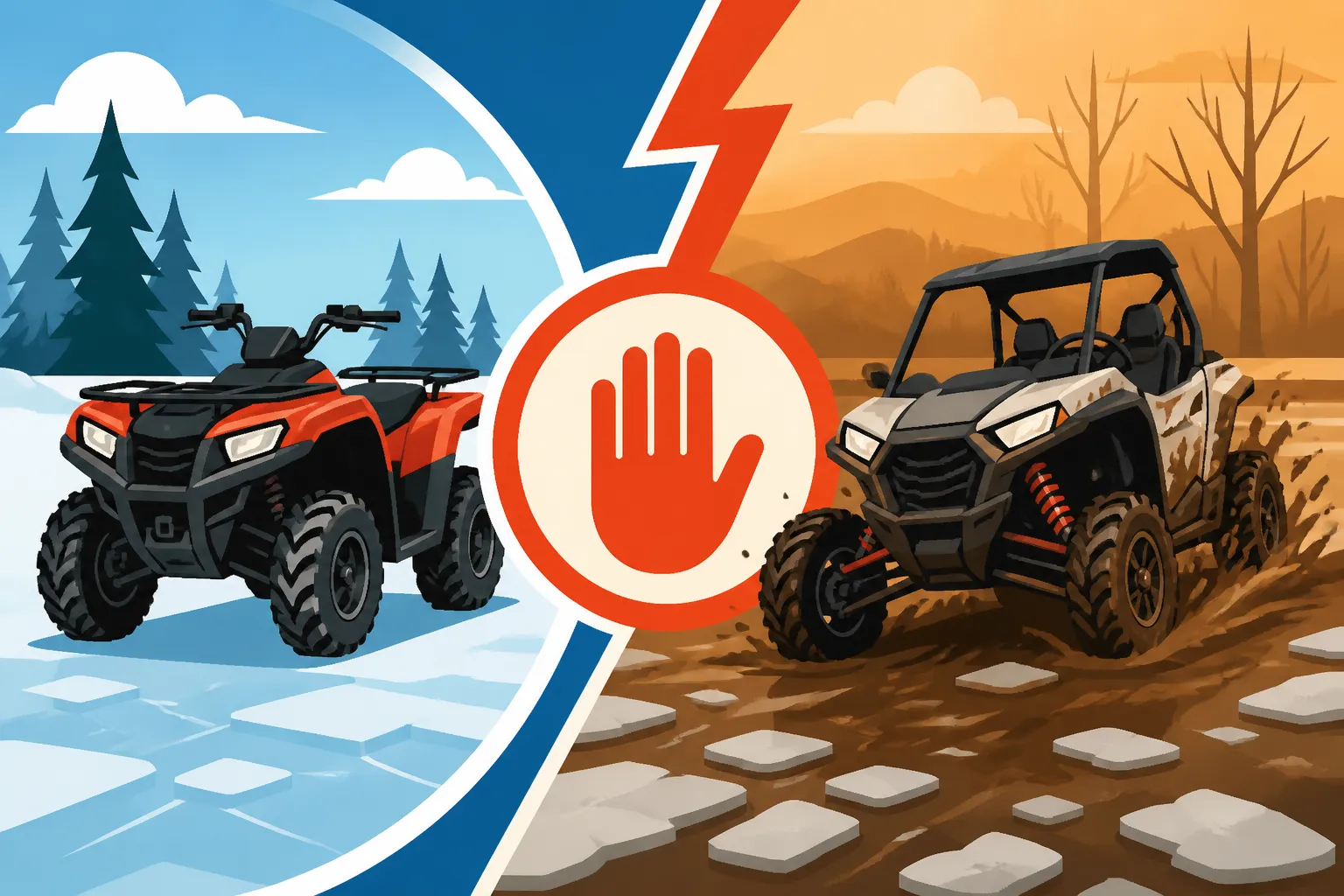
A spring thaw closure can turn a familiar quad route into a no-go zone, even when the machine is registered and the rider has a trail pass. The tricky part is knowing which fine actually applies: a thaw-specific amount is not identified in the rules summarized here. The practical answer is to confirm the closure, stay off closed trails and distinguish that issue from other violations with stated fines.
Is there a specific fine for riding during the thaw?
The rules summarized here do not identify a separate dollar amount that applies simply because a rider is on a trail during the spring thaw. That does not make a closed trail fair game. It means you should not assume a fine quoted for another violation is automatically the penalty for riding during a thaw closure.
According to the Gouvernement du Québec, operating an off-road vehicle outside the permitted hours of 6 a.m. to midnight carries a minimum fine of $250. The Gouvernement du Québec also sets a minimum fine of $250 for riding off-track in a restricted zone. Those are stated penalties for those specific violations, not a confirmed thaw-only fine.
That distinction matters. A trail can be closed because conditions make it unsuitable for riding, and a rider may also break another rule while on a closed route. But the existence of a fine for riding after permitted hours or off-track in a restricted zone does not, by itself, show that the same amount applies to every spring-thaw case. Check the current notice for the trail and ask the relevant club or authority about the rule and penalty that apply to that closure.
For the closure itself, start with Quebec’s Spring Thaw Closure and Quebec Thaw Dates by Club. Spring conditions and reopening information may vary by trail or club, so an old map, a past ride, or an open-looking trail entrance is not a reliable substitute for checking the current status. Quebec Trail Conditions Before You Go explains what to check before setting out.
A trail pass is not permission to ignore a closure. As the title Why a Trail Pass Cannot Override a Closure makes clear, access depends on the trail being open, not only on having a valid pass. If the information is unclear, postpone the ride until you can confirm that the specific route is open.
How to check a trail before you ride
Thaw conditions are local and can change. A route that is open in one area may be closed elsewhere, and a trail’s status can change after you made your plans. Build the check into your trip preparation rather than relying on what was true last weekend.
- Identify the exact trail or route. A broad regional plan may include several club trails. Note the route you intend to use and any connecting segments, so you can check the status of the entire ride.
- Check the interactive trail information. The Gouvernement du Québec says trail conditions can be consulted through the Fédération québécoise des clubs quads interactive map. Use the available trail information to check the planned route, and look for a closure or other restriction before leaving.
- Confirm uncertain information with the club. If the map and trail signage appear to conflict, or the status is unclear, contact the relevant club before riding. A route should not be treated as open just because a closure notice is hard to find.
- Check again close to departure. Conditions and closures can change after an initial plan. Recheck shortly before the ride, especially if you will travel to a distant trailhead.
- Follow signs and closure instructions on site. A pass or a saved map does not cancel a posted closure. If a sign or barrier indicates that the trail is closed, do not ride around it or continue onto the closed section.
Keep your trip flexible. Choose an alternate route only after confirming that it is open too; detouring onto an unapproved route or riding off the trail can create a separate problem. If no suitable open route is confirmed, wait for the closure to lift.
What can lead to a separate fine?
A thaw closure is only one part of riding legally. The Gouvernement du Québec says owners, operators and passengers can face fines for non-compliance. The rules also depend on where you ride and what kind of machine you operate, so having the right paperwork does not excuse unsafe or prohibited use.
| Issue | What the Gouvernement du Québec says | Practical takeaway |
|---|---|---|
| Riding outside permitted hours | Off-road vehicles may use roads and trails from 6 a.m. to midnight; violating the allowed hours carries a minimum fine of $250. | Plan your start and return so you are not on the trail outside permitted hours. |
| Riding off-track in a restricted zone | The minimum fine is $250. | Stay on the authorized trail and do not use an informal bypass around a closure. |
| Operating without a helmet | The minimum fine is $350. | Drivers and passengers must wear a helmet with a visor, or safety goggles if the helmet has no visor. |
| Riding illegally on a public road | The minimum fine is $350. | Do not use a road as an improvised detour; check whether the route is authorized. |
| Driving on private property without permission | The minimum fine is $350. | Get permission from the owner or tenant before entering private property. |
| Consuming alcohol or drugs before driving | The minimum fine is $450. | Do not operate an off-road vehicle after consuming alcohol or drugs. |
| Driving while impaired | Police officers can impose an immediate licence suspension and a $300 fine for an impaired-driving offence involving drugs or alcohol. | Do not drive impaired, even for a short distance. |
According to the Gouvernement du Québec, the minimum fine for riding outside permitted hours is $250, and the minimum fine for riding off-track in a restricted zone is also $250. The Gouvernement du Québec lists separate minimums for other conduct, such as riding without a helmet, driving illegally on a public road, or entering private property without permission. Do not treat one fine as a general price for ignoring a closure.
The simple way to reduce risk is to avoid turning a closure into another violation. Do not go around a barrier, cut across land without permission, or carry on riding after the allowed hours. If you are unsure whether a connecting road or trail is authorized, stop and verify it before using it.
What patrols may ask for and what to carry
The Gouvernement du Québec says peace officers and trail wardens patrol snowmobile and ATV trails. A trail warden appointed by a local club patrols within a defined territory; a warden appointed by an association of clubs can patrol a larger area. Club-appointed trail wardens may stop an off-road vehicle to inspect it and check its equipment.
A patrol may ask you to show identification with proof of age, a driver’s licence, vehicle registration, proof of insurance or a valid trail access permit. Keeping required documents accessible can make a stop more straightforward, but showing them does not turn a closed trail into an open one. A valid permit is not a substitute for checking the route’s current status.
Before leaving, make sure your machine and the people riding with you meet the applicable requirements. For example, the Gouvernement du Québec says drivers aged 16 or 17 need a driver’s licence and training certificate from a recognized federation to drive an off-road vehicle on a trail, road, public land or municipal private land. The Gouvernement du Québec also says a utility task vehicle driver must be at least 18 and hold a valid driver’s licence. Check the rules for your vehicle and riding situation rather than assuming every quad and side-by-side has identical requirements.
Equipment matters as well. According to the Gouvernement du Québec, drivers and passengers must wear a helmet with a visor, or safety goggles if there is no visor. Drivers must wear footwear that allows them to control the pedals easily, and the vehicle’s front white headlight and red taillights must be on while it is being operated. These requirements apply independently of the thaw question.
Before departure, make a short check of the route, the closure status, your documents and your machine. If the trail is closed, choose a confirmed open route or postpone the ride. If you have already encountered a closure and are unsure whether a particular rule or fine applies, get clarification from the relevant club or authority instead of relying on a general fine amount.
Sources
- Gouvernement du Québec — Lieux pour circuler en véhicule hors route | Gouvernement du Québec (checked November 3, 2026)
- Gouvernement du Québec — Off-highway vehicle trail patrol | Gouvernement du Québec (checked November 3, 2026)
- Gouvernement du Québec — Rules for off-road vehicles | Gouvernement du Québec (checked November 3, 2026)
- Gouvernement du Québec — Off-road vehicle riding areas | Gouvernement du Québec (checked November 3, 2026)
- Gouvernement du Québec — Mandatory equipment for off-road vehicles | Gouvernement du Québec (checked November 3, 2026)
- Gouvernement du Québec — Safety tips for off-road vehicles | Gouvernement du Québec (checked November 3, 2026)
Disclaimer
This article is for general informational purposes only and does not constitute professional advice. Laws, prices and regulations vary by location and change over time. Consult a qualified professional for guidance on your specific situation.