Quebec Wildlife Reserve Rules
Planning an ATV or side-by-side ride through a Quebec wildlife reserve can be confusing: a route may appear on a map without being open to recreational riding, and a trail pass does not automatically grant access. The safest approach is to confirm the reserve’s rules, your route and any required authorization with its manager before setting out. Here is what to check.
Wildlife reserve access is not automatic
A wildlife reserve is a managed territory, not simply an open riding area. Reserves support activities such as hunting, fishing and wildlife conservation, and access may be controlled to protect habitat, manage visitors or coordinate activities. The rules can vary by reserve, season, road and purpose of travel.
That means there is no single answer to “Can I ride an ATV in a Quebec wildlife reserve?” A route might allow motorized travel for a specific purpose, be restricted to certain users, or be closed during part of the year. A road shown on a map is not, by itself, proof that recreational ATV use is permitted.
The first step is to identify who manages the reserve and contact that manager directly. Some reserves are managed by Sépaq, while others may have a different manager. Ask about the exact entrance, road or trail you intend to use—not just the reserve in general. If your route crosses several parcels or connects to a federated trail, confirm each part separately.
A few distinctions help prevent common misunderstandings:
- A wildlife reserve is not the same as a provincial park. Do not assume that rules for one type of territory apply to the other. For machine use in parks, see Quebec Park Rules for Machines.
- A wildlife reserve is not the same as a pourvoirie. A hunting or fishing outfitter may control its own access, lodging or roads. Permission from one operator does not necessarily cover neighbouring land. See Quebec Pourvoirie Access Rules.
- A public road, private road and club trail can have different access conditions. A road that is physically passable may still be restricted to authorized users.
- A trail pass is not a general land-access permit. The pass applies to the federated trail network under its terms; it does not grant permission to ride any road inside a reserve. For how the pass and network relate, see Quebec Trail Passes Cover Every Club.
- A machine’s registration and insurance do not establish permission to enter. They are separate requirements from land access.
When you call, give the manager enough detail to provide a useful answer: the planned date, machine type, entrance, destination, route name or map reference, and whether you are riding for recreation, travelling to a cabin, or accessing a hunting or fishing activity. Ask whether you need a reservation, access permit, gate code, pass, or other authorization, and whether the rules change during hunting season or other closures.
If you cannot get a clear answer about a particular route, do not treat silence as permission. Choose a confirmed route or postpone the ride until you can verify access.
Check authorization, closures and route conditions
Before riding, establish which sections of the planned route are open and what kind of access is allowed. A route can be permitted for one use but not another. For example, access associated with a booked activity may not mean that every visitor can use the same road for a recreational loop. Ask whether the authorization covers your vehicle, the full route, the date and each person in your group.
A useful way to prepare is to check the route in layers:
- Contact the reserve manager. Confirm that recreational ATV or side-by-side travel is allowed on the specific route and identify any authorization or conditions.
- Check for temporary restrictions. Ask about seasonal closures, hunting-related controls, construction, fire risk, poor road conditions and other restrictions. A road that is normally open may be closed temporarily.
- Confirm what kind of road or trail it is. Find out whether it is a federated trail, a reserve road, a forestry road, or a route on private land. Different rules and permissions may apply.
- Check the connecting sections. A route may leave the reserve, cross private property or join a club corridor. Confirm permission and trail status for those portions too.
- Save the details. Keep the manager’s contact information, authorization confirmation, route information and any instructions accessible during the ride.
| What you need to verify | Why it matters | Who to ask |
|---|---|---|
| Permission for the exact route | General access information may not cover every road or trail | Reserve manager |
| Dates and hours of access | Seasonal or temporary restrictions can change the plan | Reserve manager or relevant trail operator |
| Required permit, booking or gate procedure | Some access may require advance authorization or specific entry instructions | Reserve manager |
| Trail-pass requirement | Federated trails have their own access conditions | Relevant club or trail organization |
| Private-land permission | A connector may cross land outside the reserve | Landowner or authorized operator |
| Road and trail condition | A legal route may still be unsafe or impassable | Reserve manager and local trail sources |
Do not rely on an old social media post, a friend’s previous trip or a downloaded map as confirmation that access is open now. Maps can help with navigation, but they may not show temporary closures, current authorization requirements or changes in land access. The Quebec Trail Conditions Before You Go checklist can help with trail planning, but reserve access still needs to be verified with the reserve manager.
A Quebec trail pass and reserve authorization solve different problems. A pass may be required to use a federated trail, while permission from the reserve may be needed for another road or access point. In some cases, a route could involve both. Check the rules for every segment rather than assuming that one document covers the entire ride.
The same principle applies to provincial vehicle requirements. Before riding on a public road or an authorized trail, make sure your machine and paperwork meet the applicable requirements. Quebec ATV Road Rules Under the LVHR explains the broader rules for off-highway vehicles; reserve access does not cancel those requirements.
Bring the right documents and follow riding rules
Once access is confirmed, prepare for the ride as though you may need to show that you and your machine are eligible to be there. The exact documents depend on the route, activity and applicable rules, so ask the reserve manager what it expects visitors to carry.
As a practical baseline, have the machine’s registration information and proof of insurance available, along with any reserve authorization, booking confirmation or trail pass that applies. If the route includes a federated trail, check what proof patrols may ask to see. Details on vehicle papers are covered in Quebec Registration Paperwork Checklist, and insurance requirements are discussed in Quebec’s Liability Insurance Rule.
Carry documents in a way that keeps them protected from rain and easy to retrieve. A phone photo can be useful as a backup, but do not assume it replaces an original or otherwise acceptable proof unless the relevant authority confirms that it does. Remote areas may also have limited cellular service, so save confirmations offline and tell someone your route and expected return time.
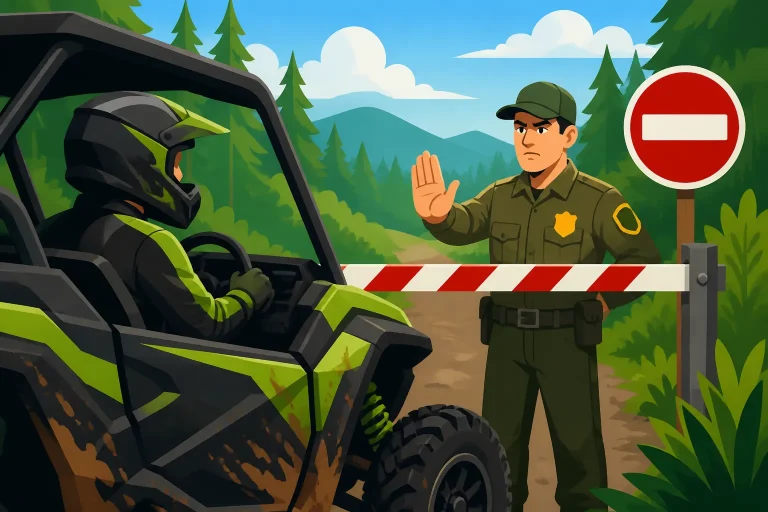
Follow posted signs and any instructions given by reserve staff. Do not bypass a gate, move a barrier, or continue past a closure sign because the road appears usable. A closed route may be protecting wildlife, preventing damage or managing another activity. If you encounter a new closure or a route that seems unsafe, turn back and contact the manager rather than creating your own detour.
Stay on the route you were authorized to use. Riding into an adjacent road, onto a field or through an unmarked opening can take you onto land with different rules. For general land-access principles, Quebec Private Land Permission explains why a visible track or a route used by others should not be treated as consent.
Other good practices matter on reserve roads, even where a specific rule is not posted:
- Keep speed appropriate to the surface, visibility and presence of other users.
- Yield carefully and give people on foot, cyclists and other vehicles room.
- Avoid disturbing wildlife or approaching animals for a closer look.
- Do not ride through wet or soft ground when it could cause damage or leave deep ruts.
- Pack out waste and secure any equipment that could fall from the machine.
- Avoid creating excessive noise near cabins, camps or wildlife areas.
- Do not assume that a road is open to every vehicle simply because your ATV can travel on it.
If you are riding as part of a hunting or fishing trip, clarify how vehicle access relates to the activity. A booking for fishing or a hunting permit should not be assumed to authorize unrestricted ATV travel around the reserve. Ask where you may drive, where machines must be parked and whether access changes during the activity.
A practical checklist before departure
Reserve trips are easier when access questions are settled before the machine is loaded. Use this checklist for each outing, especially if the route is unfamiliar or the trip is close to a seasonal transition.
- Identify the reserve and its manager.
- Ask whether the specific route is open to recreational ATVs or side-by-sides on your travel date.
- Confirm whether you need advance authorization, a booking, a permit or an entry procedure.
- Ask whether restrictions apply to your machine type, group size, time of day or purpose of travel.
- Check whether a trail pass is also required for any federated trail section.
- Verify permission for connecting roads outside the reserve.
- Ask about closures, road conditions and temporary hazards.
- Carry registration, insurance proof and all required access documents.
- Save the route and contact details for offline use.
- Tell someone where you are going and when you expect to return.
| Situation | What to do |
|---|---|
| A trail map shows a route inside a reserve | Confirm access with the reserve manager; a map alone does not establish permission |
| A club trail appears to enter the reserve | Check trail status with the club and confirm any additional reserve conditions |
| You have a trail pass | Verify whether the route is actually part of the federated network and whether separate reserve authorization is required |
| You are visiting for hunting or fishing | Ask whether vehicle access is included and which roads or parking areas are permitted |
| You see a gate or closure sign | Stop and follow the restriction; contact the manager for an approved alternative |
| Your route crosses private land | Obtain permission for that segment rather than relying on access elsewhere |
If plans change while you are on the road, do not improvise a route through a restricted area. Turn around, use an authorized alternative, or contact the manager for guidance. That may add time, but it is safer than risking a trespass issue, damaging a road or interfering with reserve operations.
The core rule is straightforward: verify permission for the specific route, on the specific date, with the organization responsible for that land. A trail pass, registration, insurance policy or previous visitor’s experience may be relevant, but none should be treated as a substitute for current access confirmation.
Disclaimer
This article is for general informational purposes only and does not constitute professional advice. Laws, prices and regulations vary by location and change over time. Consult a qualified professional for guidance on your specific situation.