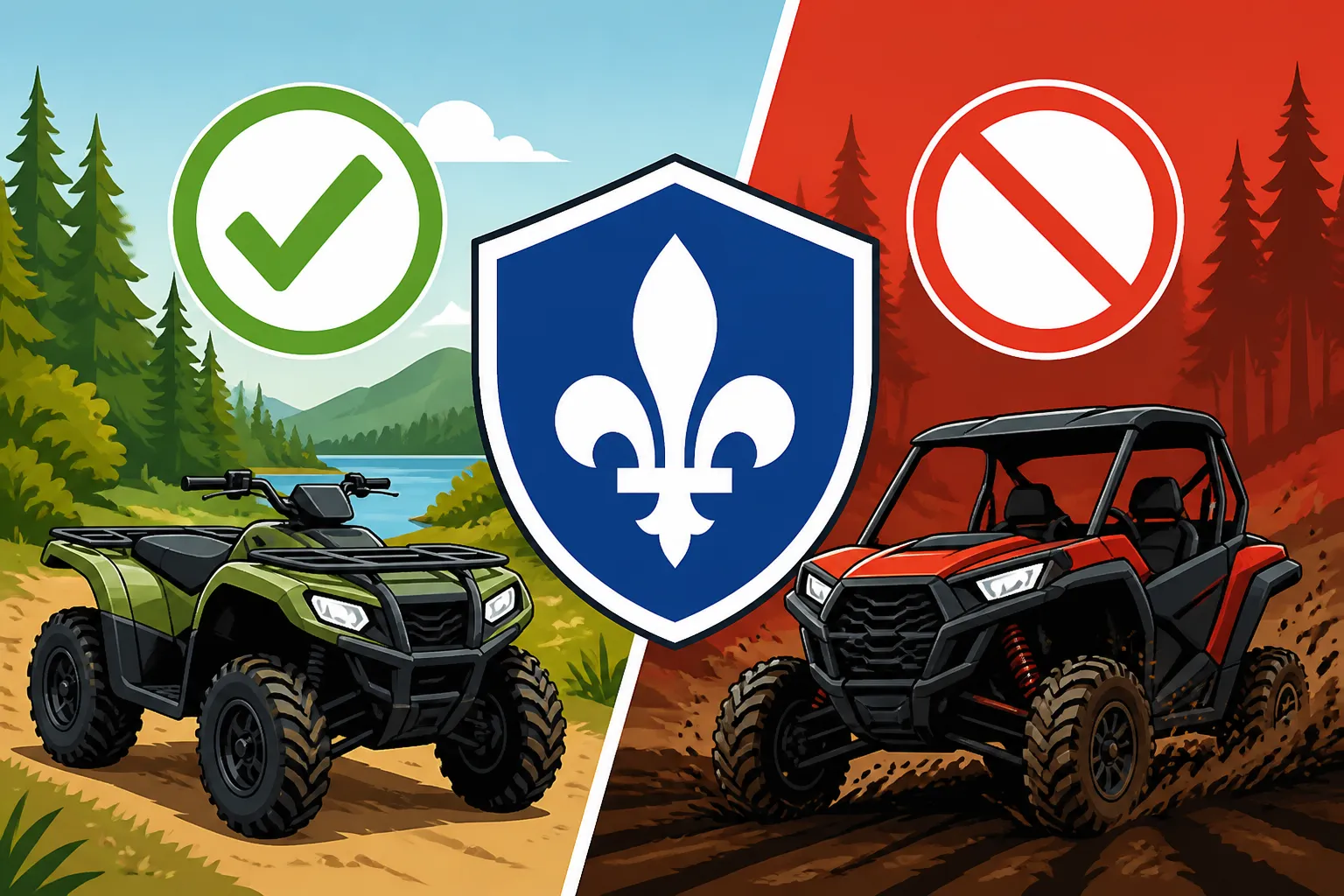
Quebec Park Rules for Machines
Planning an ATV or UTV ride in Quebec can get confusing when a trail approaches a park boundary. A registration plate, insurance policy or trail pass does not automatically authorize entry. The key is to identify who manages the land, which routes are expressly open to machines and what extra conditions apply before you ride.
Start by identifying what kind of park you mean
“Park” can refer to several different kinds of land in Quebec, and the rules are not interchangeable. A provincial park, a federal national park, a municipal park, a wildlife reserve and a private campground may each have a different manager, purpose and set of access rules.
For ATV and UTV riders, the safest starting assumption is that recreational machine use is not allowed inside a park unless the park authority clearly permits it. A trail visible on a map, an open gate or a route used by other vehicles is not enough to establish permission. Ask the manager or check the park’s current rules and route information.
Quebec national parks
Quebec’s national parks are protected areas with rules focused on conservation and visitor safety. They are not the same thing as a general-purpose ATV trail network. A machine may be allowed on an ordinary road or designated access route where the park permits it, but that does not mean riders can use park hiking trails, service roads or unmarked tracks for recreational riding.
Some routes may serve park operations, maintenance or authorized users. Their existence does not make them public ATV routes. If you cannot confirm that a particular route is open to your machine and your type of use, do not ride it until the park manager confirms.
The distinction between a road and a recreational trail matters. A road leading to a visitor facility may be open to ordinary motor vehicles, while off-road machines may still be restricted. Likewise, a trail corridor could be open to hikers, cyclists or another permitted use but closed to ATVs and UTVs. Check the rules for the specific park, not just the general map legend.
For more on how protected park land differs from other riding areas, see Quebec Provincial Parks and Machines.
Federal, municipal and regional parks
Federal parks, municipal parks and regional parks are governed by their own authorities. Do not assume a rule that applies in one park applies in another, even if the land looks similar or lies beside the same trail corridor.
A local park may have a road or access lane that is open to some vehicles but not recreational ATVs. A regional authority might have its own restrictions, seasonal closures or permit requirements. In a federal park, use the park authority’s rules rather than assuming Quebec’s trail access rules are sufficient.
If a park contains or borders an authorized ATV corridor, confirm exactly where the corridor runs and whether it crosses park land. A route that reaches a park entrance may end there. A trail map can help with planning, but the park authority’s current access information is the better source for deciding whether you may ride through.
Wildlife reserves, outfitters and nearby public land
A wildlife reserve, outfitter property or other managed territory is not automatically a park, and it is not automatically open to machines. Access can depend on the land manager, the purpose of your visit, the route and any reservation or permit conditions. Rules may differ from those in a provincial or municipal park.
For land designated as a wildlife reserve, check the rules for that specific reserve before entering with a machine. The same applies to an outfitter’s property: booking accommodation or a service does not necessarily include permission to ride every road or trail on the property. See Quebec Wildlife Reserve Rules and Quebec Pourvoirie Access Rules for those separate situations.
Crown land also has its own access considerations. It is not a blanket guarantee that every road or trail is open to an ATV, or that a nearby park’s restrictions stop at a clearly marked line on the ground. Confirm the land status and route permissions before you leave an established corridor. Quebec Crown Land Riding Rules explains why public ownership alone does not settle the question.
| Where you plan to ride | What to confirm before entering |
|---|---|
| Quebec national park | Whether the park specifically permits your machine on the exact route |
| Federal park | The federal park’s current vehicle and route rules |
| Municipal or regional park | The local authority’s restrictions, hours and permitted routes |
| Wildlife reserve | The reserve’s access conditions and any required authorization |
| Outfitter property | The owner’s permission and which routes your booking covers |
| Crown land near a park | Land status, route access and any closure or restriction |
| Federated ATV trail | That the trail is open and that your pass and required documents are in order |
What permission does and does not cover
Park access is only one part of a lawful ride. A rider may need to satisfy several separate requirements, and meeting one does not replace the others. Registration, insurance, a trail pass, the rider’s licence or certificate, and permission to use a particular parcel of land address different issues.
A trail pass does not open a park
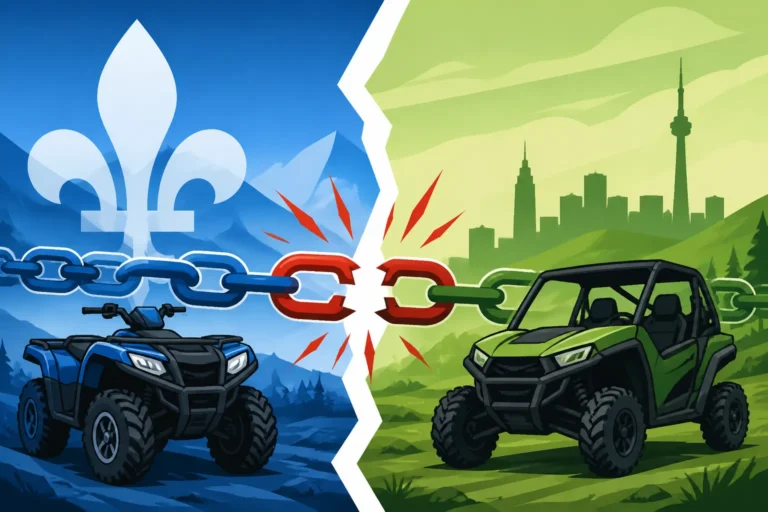
An FQCQ trail pass relates to access to the federated trail network under its applicable conditions. It is not a general permit to ride on any land that touches, crosses or appears near that network. A pass cannot override a park closure, a landowner’s restriction or a route that is not authorized for ATV use. See Why a Trail Pass Cannot Override a Closure.
This distinction is easy to miss when a club trail runs close to a park boundary. The authorized corridor may pass beside the park without entering it, or it may connect to a trailhead where riding must stop. Follow signs and posted closures; do not treat a coloured line on a map as permission to leave the marked route.
The same principle applies if your pass is valid for the season or you have ridden the area before. Conditions can change because of conservation needs, maintenance, weather, landowner decisions or a temporary closure. Check the route before each trip rather than relying on a previous visit.
Registration and insurance are not land-use permission
Registration identifies the machine for the purposes of Quebec’s applicable vehicle rules. Liability insurance addresses financial responsibility if the machine causes injury or damage. Neither document grants permission to enter a park or private property.
Review Quebec ATV Registration With the SAAQ and Quebec’s Liability Insurance Rule if you need to confirm the paperwork requirements for your machine. Then check the park’s access rules separately. If you are unsure what papers to carry while riding, Carrying Papers on a Long Ride can help you plan.
Do not assume a registration plate means a machine is allowed on every public road, park road or off-road route. Quebec’s rules for road use are a separate issue from the park manager’s rules. If your route depends on riding along or crossing a road, check Quebec ATV Road Rules Under the LVHR as well as the park’s instructions.
A reservation or entrance payment is not necessarily an ATV permit
A campsite reservation, park entry arrangement, cabin booking or event registration may cover only the service named in the booking. It does not necessarily grant permission to ride an ATV or UTV within the park.
Before booking, ask the manager directly:
- Are ATVs or UTVs permitted inside the park?
- Which exact roads or routes may they use?
- Are those routes open to recreational riders, or only to authorized service vehicles?
- Does permission apply to the whole route or only to a specific access point?
- Are there seasonal hours, temporary closures or noise restrictions?
- Is advance approval needed, and what proof must the rider carry?
If the answer is unclear, ask for the route or permission details in writing. A clear description can prevent a misunderstanding at a gate or on a trail.
How to plan a ride near a Quebec park
A little checking before departure can prevent a long detour, a denied entry or a ticket. Use this process whenever your route touches a park boundary or crosses land with a different manager.
- Name the land manager. Identify whether the area is a Quebec national park, federal park, municipal or regional park, wildlife reserve, private property or Crown land. If a map does not make the boundary clear, ask the relevant authority.
- Find the current access rules. Use the park or land manager’s official information for vehicle access, permitted routes, hours and closures. Old maps, archived posts and route tracks shared by other riders may not reflect current conditions.
- Confirm the exact route. Ask whether the machine is allowed on the particular road or trail you intend to use. “The park allows vehicles” is too general if the permission applies only to ordinary cars, staff vehicles or a designated access road.
- Check both sides of the boundary. A route may be open on the trail network but closed once it enters park land. It may also be permitted within a managed area but not on the connecting public road. Confirm each segment.
- Check your separate riding requirements. Make sure registration, insurance, pass, licence or training requirements are satisfied for your ride. These obligations do not replace landowner or park permission.
- Look for current closures and signs. Recheck shortly before departure. Follow signs at the site, even if an older map or route file shows access.
- Have a legal alternate route. If a gate is closed or permission cannot be confirmed, turn back or use a route known to be open. Do not make a new trail through forest, wetlands or another restricted area.
Signs and boundaries deserve attention
A marked boundary can be easy to miss when the route is wooded or the park entrance is not beside a main road. Watch for signs identifying a park, a closed trail, a restricted access road or a change in land manager. If the signs and map appear to conflict, stop and resolve the uncertainty rather than continuing on the assumption that the route is open.
Do not ride around a barrier, move a sign or follow tracks through an unmarked opening to get around a closure. A track made by another rider is not proof of legal access. It may be an unauthorized route, a service track or a route that has since closed.
Stay on the route you have confirmed. Cutting a corner or following a side track can take you into sensitive habitat or land where your permission does not apply. That can create environmental damage as well as access problems.
When plans change during the ride
A closure can appear after you have started. Treat it as a route change, not as a challenge to get past. Turn around where it is safe, use your planned alternative or contact the park manager for clarification. Do not continue simply because your group has already ridden part of the route.
If you encounter an unexpected closure or unclear boundary, note the location and report the issue to the relevant manager or trail club. Do not assume that a nearby club volunteer can authorize access to park property unless that authority has been clearly delegated.
For rides that use a federated trail near protected land, check trail conditions as well as park restrictions. A trail pass does not guarantee that every section is open on the day you ride. Planning around a closure is part of staying on authorized routes, not a reason to find an informal detour.
Disclaimer
This article is for general informational purposes only and does not constitute professional advice. Laws, prices and regulations vary by location and change over time. Consult a qualified professional for guidance on your specific situation.