Quebec Fishing Trip Access by Quad
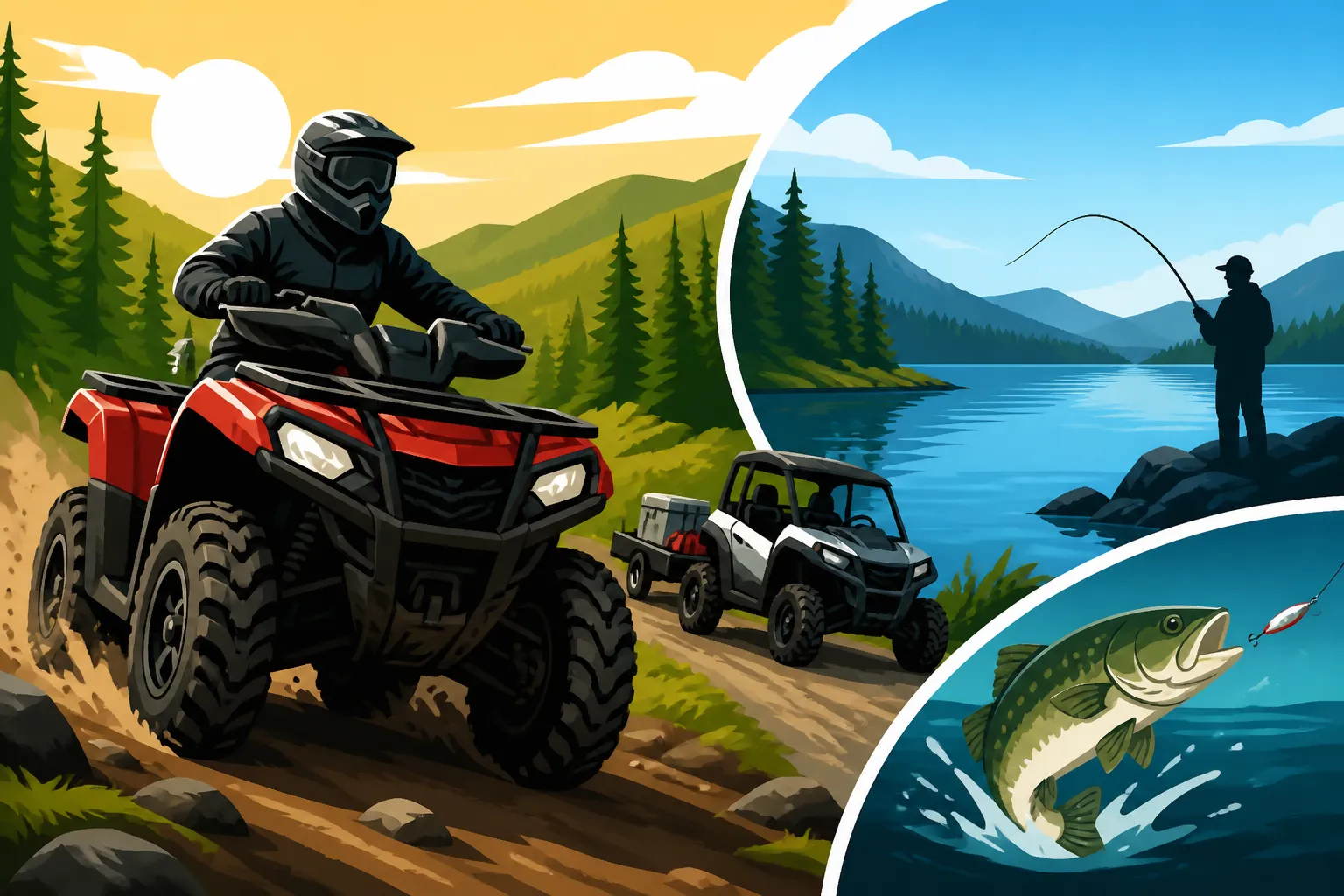
A quad can get you closer to a Quebec fishing spot, but it does not give you automatic permission to ride every road, trail or shoreline on the way. The key is to check three separate things: whether you may ride the route, whether you may access the land, and what fishing rules apply at your destination. Here’s how to plan without treating one permit as a substitute for another.
Separate the ride, the land access and the fishing rules
A fishing trip by quad usually involves several permissions that are easy to confuse. Your fishing licence concerns the act of fishing. Your vehicle registration and insurance concern the machine. A trail pass may be needed for a federated trail. None of those, by itself, grants permission to cross private property or ride into a protected area.
Before leaving, think of the trip as a route with separate sections: the road or trail you ride, the property or territory you enter, and the water where you fish. Each may have its own rules.
| What you need to check | What it covers | What it does not automatically allow |
|---|---|---|
| Vehicle registration and insurance | Operating the quad under the applicable vehicle rules | Access to private property or restricted land |
| Trail pass | Use of the federated trail network when a pass is required | Riding on every ATV track, forestry road or shoreline |
| Landowner permission or access authorization | Entering or crossing land where permission is needed | Fishing without the required licence or local authorization |
| Fishing licence and applicable fishing rules | Fishing in the relevant zone and following its conditions | Driving a quad to the water |
| Site-specific access rules | Entry to a park, wildlife reserve, outfitter territory or managed site | A right to use routes outside that site |
The practical distinction is simple: permission to fish is not permission to ride there, and permission to ride a trail is not permission to leave it. A trail may pass near a lake without providing a legal route to the shore. A fishing destination may be open to anglers while its access road is closed to recreational vehicles.
Keep your vehicle documents current and carry the paperwork required for your ride. If you are using the federated network, confirm whether you need a pass and what proof patrols may ask to see. Quebec Registration Before Your First Ride and Quebec Registration and Trail Pass Together explain why vehicle registration and trail access are separate checks. If you are unsure which trail-pass rules apply to your trip, Quebec Crown Land Riding Rules is also a useful starting point.
Fishing rules are a separate check. Confirm that you have the right licence for the fishing you intend to do, and check the current rules for the species, water body and fishing period. Conditions can vary by zone and location. A general fishing licence should not be treated as a guarantee that every lake, river or managed territory is open under the same conditions.
Identify who controls the route and the destination
The first route-planning question is not simply, “Is there a road?” It is, “Who controls this road, trail or piece of land, and are quads permitted here?” A visible track may be a private access road, a work road, an informal route or a trail with seasonal restrictions. Its appearance alone does not establish that recreational riding is allowed.
Federated trails
If your route uses a federated ATV trail, check that the trail is open and that your pass is valid for the planned ride. Trail status can change because of seasonal closures, maintenance, weather, landowner decisions or other conditions. A pass does not override a posted closure, and it does not authorize you to leave the marked route to reach a nearby fishing spot.
Use current trail information shortly before the trip, not only an old map or a route someone saved months ago. If the trail ends before the water, do not assume that the last stretch across a field, logging road or wooded track is included. Quebec Trail Conditions Before You Go and Quebec Passes Cover Every Federated Club can help you understand what a pass does and why checking the active route matters.
Private property
A fishing destination may be reached by crossing private land, even if the land looks remote or the route has no gate. Get permission from the landowner before riding across it. Permission to walk in or fish from a particular spot may not include permission to bring a quad, cross the property, park near the water or use a private road.
Be specific when asking. Explain where you want to enter, what route you plan to use, whether you will park or unload, and whether anyone else is coming with you. If permission is limited to a particular date or route, follow those limits. Do not treat a neighbour’s permission as permission from every landowner along the way.
If a gate is closed, a sign prohibits access, or the owner withdraws permission, choose another route. Do not bypass a barrier or ride around it to reach the fishing spot. Quebec Private Land Permission covers the access question in more detail, while Quebec Trespass Rules for Riders is relevant when a route crosses property you do not control.
Crown land and managed territory
Public ownership does not mean every road or terrain is open to quad riding. Access can be limited by land-use rules, closures, resource work, fire conditions or the status of a particular route. You may be able to reach an area on foot or by another method while quad access remains restricted.
Check the specific territory and route, rather than relying on a general assumption that Crown land is open. Pay particular attention to signs, gates, seasonal notices and local information. If the route continues onto private land or a managed territory, check the rules for that portion separately.
Parks, wildlife reserves and outfitters’ territories can have their own access conditions. A place that allows fishing may still restrict motorized access, require you to use a designated entrance or prohibit quads beyond a parking area. Ask the site operator or managing authority what is allowed before unloading your machine. Quebec Park Rules for Machines, Quebec Wildlife Reserve Rules and Quebec Pourvoirie Access Rules are useful references for these different settings.
Road connections
Some trips require a short stretch on a public road to connect trails or reach an access point. Do not assume that an ordinary road is open to quads just because it is quiet or connects two off-road routes. Road access depends on the applicable rules, signage and local authorization. Check the exact segment and any municipal conditions before including it in your plan.
A route that appears continuous on a map may cross a road where quad travel is restricted, or it may pass through a municipality with different local rules. Quebec ATV Road Rules Under the LVHR and Quebec By-Laws Beyond 1 Kilometre explain why the road segment needs its own check.
Plan the final approach without riding onto the fishing spot
The last part of the trip is often where an otherwise careful plan goes wrong. A rider reaches the lake, sees a short path to the shore and assumes that getting closer is harmless. But a trail pass, landowner permission or fishing licence does not automatically allow riding across wetlands, beaches, banks or sensitive vegetation.
Choose a legal place to park or secure the quad before you reach the water. Keep the machine on a permitted route and walk the remaining distance where necessary. Avoid riding through shallow water, along a shoreline or over soft ground unless the route is specifically designated for that use. Wet areas can be vulnerable to damage, and a route that looks firm in dry weather may not stay that way.
The same care applies to unloading a quad from a trailer. A wide shoulder or open area beside a road is not necessarily a public parking area. Check whether parking is allowed and whether the trailer can be left without blocking a gate, road, trail or emergency access. If you are meeting friends, agree on one lawful staging point rather than having several vehicles stop at different spots.
Before the trip, confirm these details:
- Mark the route in sections. Note where you will use public roads, federated trails, private access roads and any managed territory.
- Check the current status of each section. Look for closures, seasonal limits, local restrictions and signs at the route itself.
- Ask for permission where needed. Get clear approval for both crossing and parking, not just for fishing.
- Confirm site rules. Contact the park, reserve, outfitter or other manager if the fishing destination is within a managed area.
- Check fishing requirements. Verify the licence and current location-specific rules before you pack.
- Plan an alternative. Have another legal access point in mind if a gate is closed, permission is unavailable or a trail is restricted.
If you’re carrying permits, registration papers or a written note from a landowner, keep them protected from rain and mud. A small waterproof document pouch from an outdoor retailer such as Amazon can keep papers together, but it does not replace having the correct authorization or following the route rules. A phone photo may be useful as a backup, but do not assume it will count wherever original or specific proof is required. Carrying Papers on a Long Ride and Does a Phone Photo Count as Proof on Trail? address document handling and proof more directly.
Build a safer fishing-trip checklist
A quad makes remote fishing access more manageable, but it also brings practical risks that are easy to underestimate. A long route may involve limited cell coverage, changing weather, a closed trail or a detour that adds distance. Plan for the ride home as carefully as the ride out.
Tell someone where you intend to ride and when you expect to return. Carry enough water, suitable clothing and basic first-aid supplies. Check fuel range against the whole route, including any detour, rather than estimating only the distance to the lake. In a remote area, a machine problem can turn a short fishing outing into a long wait.
If you are carrying fishing gear, secure it so it cannot interfere with steering, visibility, controls or safe passenger space. Rods, tackle boxes and coolers can shift over rough ground. Do not exceed the machine’s seating or cargo capacity, and make sure every passenger is allowed under the applicable rules. Quebec Rules for Passengers on a Quad and Seat Belts and Factory Capacity can help you check passenger and capacity questions.
Plan around weather and trail conditions. Heavy rain can make a route slippery or increase the risk of damage, while seasonal closures may apply even if the destination remains open to fishing. Check for updates before departure and again if the trip involves a long drive to the trailhead. If conditions deteriorate, turn back rather than trying to push through a closed, flooded or unsafe section.
A simple final check can prevent most access problems:
- The quad is registered and insured as required.
- The route is open to the machine you are riding.
- Any required trail pass is valid, and its proof is available.
- Permission has been confirmed for private land and private access roads.
- The destination’s manager allows quad access and parking.
- Fishing requirements have been checked for the intended water and activity.
- The final approach does not depend on riding across a shoreline or restricted terrain.
- You have a return plan, enough fuel and a backup access option.
When a route is unclear, stop and verify before riding farther. A map line, tire tracks or another vehicle’s presence is not reliable proof that access is allowed. Contact the landowner, trail club, site manager or relevant authority for the section in question. It is usually easier to change the plan before unloading or reaching a remote trail junction than to resolve an access dispute on the spot.
Disclaimer
This article is for general informational purposes only and does not constitute professional advice. Laws, prices and regulations vary by location and change over time. Consult a qualified professional for guidance on your specific situation.