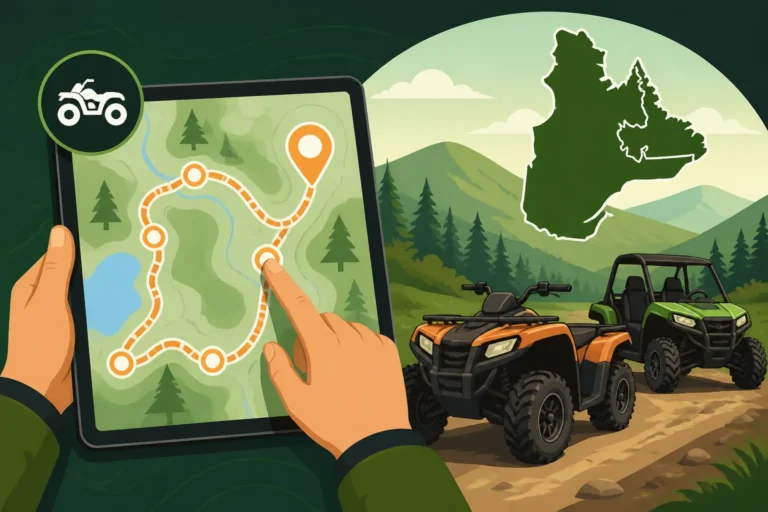
Quebec Trails That Reach a Pourvoirie
A ride that appears to end at a fishing lodge or outfitter can be more complicated than it looks: the route may cross a closed trail, private land, or a section that requires separate permission. This guide explains how to plan a Quebec ATV or UTV trip to a pourvoirie, check access before leaving, and use the lodge as a practical base without assuming every nearby trail is open.
What it means for a trail to reach a pourvoirie
A pourvoirie is a destination, not automatically a trail pass
A pourvoirie is an outfitter that may offer lodging, meals, fishing, hunting, guided activities, or access to outdoor territory. Some are convenient places to stay during an ATV trip; others may be reachable from a nearby trail network, but not by a signed route that runs right to the door. The word “near” matters. A lodge can be close on a map while the legal route requires a substantial detour.
There is another important distinction: being able to ride to a pourvoirie does not necessarily mean you may ride around its property. The final approach might use a federated ATV trail, an authorized road, a private access road, or a route managed by the outfitter. Each can have different rules. Ask the operator which route is permitted and whether riders may leave the marked corridor to reach the entrance.
Think of the destination as one part of the plan, not proof that access is allowed. A booking confirmation for a cabin or fishing package does not, by itself, authorize ATV travel across land you do not have permission to use. For a closer look at what to confirm with the operator, see [Quebec Pourvoirie Access Rules] and [Using an Outfitter as Your Trail Base].
Why some outfitters work better as riding bases
A pourvoirie can make a useful riding base when it has a clear connection to a maintained trail network, a suitable place to park or store machines, and staff who understand local riding access. It can also simplify a multi-day trip: riders may leave luggage at the lodge, travel a loop during the day, and return without moving a truck and trailer between trailheads.
That convenience is not universal. Some outfitters focus on water access, hunting territory, or activities that have little connection to ATV trails. Others may welcome riders only by prior arrangement, have limited parking, or require guests to use a particular access road. Before booking, ask whether the property is accustomed to ATV guests and what the ride actually looks like from the trail to the lodging.
A good fit depends on your group. A couple planning a relaxed day ride may value meals and a secure place to leave gear. A group with several machines may need trailer space, a place to wash muddy equipment, and clear instructions about where to unload. If the lodge is only a stop on a longer route, confirm that it can accommodate your arrival time and overnight needs rather than assuming it operates like a roadside hotel.
Read “trail access” carefully
When a listing or package says “trail access,” clarify what that phrase means. It might describe a trailhead nearby, a route that begins on the property, permission to use a private connector, or simply the outfitter’s location within riding country. Those are different arrangements, and the distinction can determine whether your planned route is legal and practical.
Ask direct questions before paying a deposit. Which trail or road should riders use? Is the access open to guests only? Does the route require a separate pass or permission? Are there seasonal closures, local restrictions, or times when the road is unavailable? If the operator says the trail is “right there,” ask for the name of the route or a map reference so you can compare it with official trail information.
Do not treat a line on a commercial map as permission to ride. Mapping apps can help you understand distance and terrain, but they may not show temporary closures, landowner restrictions, or local access conditions. [Quebec Trails That Cross Private Land] and [Staying on a Federated Corridor] are useful reminders that the visible route and the permitted route are not always identical.
How to plan a legal and realistic route
Start with the trail network and confirm the final approach
Plan from the nearest reliable trail connection outward. First identify a maintained or authorized route that gets you into the right region. Then confirm the last stretch to the pourvoirie directly with the operator. That final section is where riders are most likely to encounter a private road, a gate, a local by-law, or a route that is open to guests only.
For example, a group travelling through Lanaudière or Mauricie might find a lodge that looks close to a marked corridor. The map may suggest a short connector, but the connector could be an access road used by the property, not a public ATV trail. The operator can tell you whether guests may ride it, whether you need to arrive by truck, and where machines should be parked.
Use more than one source when building your route. Start with the relevant club or federation trail information, check the route in a mapping tool, and ask the outfitter about local conditions. The [Quebec Trail Maps and the iQuad App] can help with route planning, while onX Offroad can be useful as a supplementary tool for reviewing terrain and route context. Neither should replace local confirmation about permission, closures, or trail status.
Check passes, registration, and insurance separately
A route to a pourvoirie does not remove the usual requirements for riding on a Quebec federated trail. Before departure, confirm that each machine has the required registration and insurance, and that each rider has the necessary documents and trail access. Requirements can depend on where and how you ride, so do not assume that a booking package includes everything needed for the entire journey.
Ask the outfitter specifically whether any trail pass is included, and which portion of the route it applies to. A lodging or guided-tour package may include access to a private network or a particular activity without covering your use of the broader federated trail system. If the trip crosses several club areas, check that your pass and documents are valid for the route you intend to ride.
Paperwork is easy to overlook when the focus is on packing and departure times. Keep the machine’s registration and proof of insurance accessible, and make sure riders can show the required pass or certificate if asked. For a practical overview, review [Quebec Trail Passes Cover Every Club] and [Quebec Insurance Proof on the Trail]. Confirm specific requirements before your trip, particularly if you are visiting from outside Quebec.
Build in time for closures and route changes
Trail status can change because of weather, maintenance, landowner decisions, hunting-season arrangements, or seasonal thaw conditions. A route that was open when you booked may not be open on your travel day. This is especially frustrating when the lodging is prepaid and the group has planned its whole trip around reaching the destination by machine.
Check the route shortly before departure and again on the day of the ride if conditions are uncertain. Ask the local club or outfitter whether any sections are closed, whether a detour is available, and whether the alternative remains suitable for your machine. A detour that works for a compact ATV may not be comfortable for a large side-by-side with a trailer or a group carrying extra luggage.
Leave enough daylight and fuel margin for a change of plan. If you are travelling in a remote area, do not make the last available fuel stop or the final marked trail junction a casual decision. [Quebec Trail Conditions Before You Go] and [Quebec's Spring Thaw Closure] can help frame the kinds of status checks riders should make before setting out.
| Planning question | Why it matters | What to confirm |
|---|---|---|
| Is the route a federated trail, road, or private connector? | The access rules may differ by section. | Route name, permission, and any required pass |
| Does the trail reach the property entrance? | A nearby trail may still leave a road gap. | The legal final approach and parking location |
| Is the route open on your travel dates? | Closures and conditions can change. | Current status, detours, and seasonal restrictions |
| Can the property accommodate your machines? | Parking and unloading can be limited. | Trailer space, storage, and arrival arrangements |
| Are passes or services included in the booking? | A package may cover only part of the trip. | What is included and what riders must arrange |
Make the pourvoirie stop work for your group
Ask practical questions before reserving
A few specific questions can prevent a frustrating arrival. Ask whether the property accepts guests arriving by ATV, where machines can be parked overnight, and whether trailers can be left on site. If you are bringing a group, give the operator an honest count of machines and people rather than asking vaguely about “some parking.”
Also ask what riders should bring and what the property provides. Lodging may include meals but not fuel, meals may need advance booking, and a room or cabin may not have space for wet riding gear. If your route arrives late in the day, confirm check-in arrangements and whether the property can still receive you. The details matter more when you are travelling far from a town with backup lodging.
If your party plans to ride from the lodge each day, ask whether there is a recommended loop that starts and ends at the property. A local suggestion can help you avoid a route that looks short on a screen but involves a difficult surface, a long road section, or a closed connector. For more trip-planning context, see [Quebec Trails With Lodging Along the Way] and [Pourvoirie Packages That Come With Trail Access].
Match the trip to the machine and the riders
A route can be legal and still be a poor fit for your group. Consider the machine’s width, ground clearance, range, and passenger capacity. A narrow trail may be uncomfortable for a large side-by-side, while a rough or remote segment may be tiring for newer riders. If the group includes beginners, ask about the easiest approach and whether a guided ride is available.
Think about what you will carry. A day ride from a lodge is different from moving between accommodations with clothing, food, tools, and overnight gear on the machine. Keep luggage secure and avoid blocking lights, mirrors, or controls. If you are unsure whether a particular route is suitable, ask the local outfitter or club rather than relying on a route line alone.
Plan for the least experienced person in the group. A fast-moving ride can stretch the group out, especially where trail surfaces change or turns are easy to miss. Agree on a lead and sweep rider, regroup at junctions, and decide in advance what to do if someone has a mechanical issue or loses phone coverage. These small choices make the ride to the lodge feel less stressful and keep the destination from becoming a deadline everyone is racing toward.
Respect the property and the surrounding community
Arriving at a pourvoirie is not the end of your responsibility as a rider. Follow the operator’s instructions about parking, unloading, washing machines, noise, and where you may travel on the property. Stay on the authorized route instead of exploring side roads or nearby tracks simply because they look rideable.
Quiet, considerate behaviour matters around cabins, cottages, and rural homes. Reduce speed where appropriate, avoid unnecessary revving, and do not assume that a private driveway is a shortcut. Land access depends on permission, and careless riding can affect whether an outfitter or landowner welcomes ATV visitors in the future.
Before leaving, confirm the route back to the trail network and any changes since your arrival. A staff member may know that a section has become muddy, a gate has been closed, or a local detour is now preferred. Thank the people who provide current information; their local knowledge can be more valuable than a perfect-looking digital route.
A simple pre-ride checklist
- Confirm the pourvoirie accepts ATV or UTV arrivals and ask for its approved approach.
- Identify the trail or road used for each part of the route, including the final connection.
- Check current trail status, closures, and any seasonal restrictions.
- Confirm registration, insurance, passes, and rider documents for the route.
- Ask about parking, trailer space, overnight machine storage, and arrival arrangements.
- Carry enough fuel, water, basic tools, and warm or rain-ready clothing for a delay.
- Save the route details offline and share the plan with someone who is not riding.
- Follow property instructions and stay on trails or roads where you have permission.
A pourvoirie can be a memorable stop on a Quebec ATV trip, particularly when the route, lodging, and local access are planned together. The key is to verify the last mile as carefully as the main trail: a confirmed approach, current trail information, and clear permission turn a promising map idea into a ride you can enjoy with confidence.
Disclaimer
This article is for general informational purposes only and does not constitute professional advice. Laws, prices and regulations vary by location and change over time. Consult a qualified professional for guidance on your specific situation.