Registering a Quad Ridden Only on Family Land
It's a common assumption that if your quad, side-by-side, or other off-highway vehicle never leaves your family's private land, you don't really need to bother with registration in Quebec. This thinking often comes from a place of wanting to keep things simple and avoid unnecessary paperwork, especially when you're just riding in your own backyard. However, the reality under Quebec's laws is often quite different, and misunderstanding these rules can lead to some significant headaches and financial penalties down the road. This guide aims to clear up that confusion, explaining when and why your private-land machine likely does need to be registered, and what steps you need to take to stay on the right side of the law.
The Myth of the "Private Land Exemption" in Quebec
Many quad owners in Quebec operate under the impression that using their machine exclusively on private property, like a sprawling farm, a vast cottage lot, or even just extensive family land, grants them an automatic exemption from the provincial registration requirements. It's a very understandable thought process: "If I'm not on public trails, I'm not bothering anyone, so why would the government need to know about my machine?" This belief, while common, doesn't quite align with the intricacies of Quebec's Off-Highway Vehicle Act (LVHR) and the mandates of the Société de l'assurance automobile du Québec (SAAQ).
What the SAAQ Says About Off-Highway Vehicles
The SAAQ, which acts as both the registrar and insurer for off-highway vehicles in Quebec, has a pretty broad definition of what constitutes a "véhicule hors route" (VHR) or off-highway vehicle. Essentially, if it's a motorized recreational vehicle designed for off-road use, it generally falls under their purview. This definition isn't limited by where you primarily intend to ride it, but rather by the nature of the machine itself. Whether you plan to tear up federated trails across the province or simply putter around your 50-acre woodlot, the machine fundamentally remains an off-highway vehicle in the eyes of the law.
The primary purpose of SAAQ registration isn't just about collecting fees; it's deeply intertwined with public safety and, crucially, liability insurance. When you register your quad, you're not just getting a plate; you're also automatically receiving mandatory liability coverage. This coverage is designed to protect you financially in case your machine causes injury or property damage to others, regardless of where that incident occurs. So, even if you're on your own land, an unforeseen accident could still have far-reaching implications, making that underlying registration and insurance incredibly important.
Why Owners Get Confused
The confusion often stems from mixing up riding rules with registration requirements. It's true that many of Quebec's detailed rules about speed limits, helmet use, and age restrictions often apply most directly to public trails and roads open to off-highway vehicles. For example, [Quebec ATV Road Rules Under the LVHR] primarily dictate how you can operate on public infrastructure. People tend to think, "If I'm exempt from those rules because I'm on private land, then I must be exempt from all the rules, including registration." This isn't the case. The act of registering a VHR and ensuring it carries the mandatory minimum liability insurance is a foundational requirement, separate from the operational rules that dictate how and where you can ride it once registered.
Another source of confusion might be comparing quads to other equipment that does stay on private land, like a lawn tractor or a small backhoe. These pieces of equipment generally aren't considered recreational off-highway vehicles and don't require SAAQ registration. However, a quad, even if used for chores, still retains its classification as a VHR due to its design and common recreational use. It's a subtle but critical distinction that often trips up even seasoned landowners.
Quebec's Off-Highway Vehicle Act and Private Land
Quebec's Off-Highway Vehicle Act, often referred to by its French acronym LVHR (Loi sur les véhicules hors route), outlines the rules for all off-highway vehicles in the province. It's a comprehensive piece of legislation that addresses everything from where you can ride to what equipment your machine needs. And critically, it doesn't generally carve out a blanket exception for machines used solely on private land when it comes to the fundamental requirement of registration.
When Registration Is Required
Simply put, if your vehicle fits the SAAQ's definition of an off-highway vehicle – which most quads, side-by-sides, and other UTVs do – it generally must be registered. This includes securing a VHR plate and maintaining the associated mandatory liability insurance. The law is designed to ensure that any potential damages or injuries caused by these machines are covered, providing a safety net for everyone involved, including the operator and any third parties.
Consider a scenario: you’re riding your quad on your own expansive property. Perhaps a friend or family member is visiting, and through no fault of your own, they trip and fall in front of your slowly moving quad, sustaining an injury. Or maybe you accidentally veer off your own property onto a neighbour's field, causing damage to their crops or fences. In these situations, the mandatory liability insurance that comes with your SAAQ registration would be your first line of defense against potentially massive financial claims. Without registration, that crucial safety net is gone, leaving you personally exposed. This is why [Quebec's VHR Vehicle Class] is so important, as it dictates these requirements. The law doesn't differentiate between whether these incidents happen on a federated trail or your backyard; if your machine is involved, the requirement for insurance coverage remains paramount.
Exceptions and Nuances for Farm or Business Use
While the general rule is that all off-highway vehicles must be registered, Quebec law does offer a few very specific and limited exceptions. These are not broad exemptions for "private land use" but rather narrow provisions for machines used strictly for certain types of work, and they come with their own set of conditions.
For example, a machine used exclusively for farming operations on agricultural land might be exempt from registration if it never leaves that land and is used strictly for agricultural purposes. This isn't about recreational riding or even using it to get from the house to the barn if there's any public road involved. It's about a machine that's essentially a tool for farming, like a small tractor, and confined to the farm property. Similarly, there are very specific conditions for machines used by trappers or in certain forestry operations. However, these are highly nuanced exceptions, and the burden of proof to demonstrate that your machine strictly qualifies for such an exemption would fall squarely on you. If there's any recreational use, or if the machine ever crosses a public road (even briefly, to get to another part of the farm), the exemption typically vanishes. It’s always best to err on the side of caution and assume registration is required unless you've thoroughly verified your specific circumstances with the SAAQ. We have articles like [Quebec Registration for a Farm Machine] and [Quebec Registration for a Trapper's Machine] that go into more detail on these specific use cases.
The Risks of Riding Unregistered on Family Land
It's easy to think that if you're out of sight, you're out of mind. But even on your own property, operating an unregistered off-highway vehicle carries significant legal and financial risks that are far more serious than the minor inconvenience or cost of registration. Ignoring these requirements can turn a simple day of riding into a devastating nightmare.
Penalties and Fines for Non-Compliance
Quebec takes the registration of off-highway vehicles seriously. If you're caught operating an unregistered quad, even on your own land (for instance, if a patrol officer is called for another reason or happens to be on adjacent public land and observes you), you could face substantial fines. These penalties are designed to be a deterrent, making it clear that compliance is expected. We've discussed these at length in [Quebec Penalties for Riding Unregistered].
Beyond monetary fines, there's also the very real possibility that your machine could be seized. Imagine a provincial officer or local police impounding your quad right off your property, leaving you without your machine and facing additional costs for impoundment and storage before you can even begin to sort out the fines. It's a costly, time-consuming, and incredibly frustrating experience that can be entirely avoided by simply registering your machine. Even if you argue that it never leaves your property, the simple act of operating an unregistered VHR can be enough for a citation and subsequent action.
Insurance Implications and Liability Nightmares
This is arguably the most critical and often overlooked risk associated with not registering your quad for private land use. As mentioned, SAAQ registration automatically includes a mandatory minimum of liability insurance – specifically, [The $1 Million Liability Floor Every Owner Carries]. This insurance is not optional; it's a fundamental part of operating a VHR in Quebec.
Consider these hypothetical, but very realistic, scenarios:
- Scenario 1: The Visiting Child. Your niece is visiting your cottage. She's playing in the yard, and you're moving your unregistered quad slowly to park it. Distracted for a moment, you accidentally back over her foot, causing a serious injury. Without SAAQ registration, you have no liability insurance. Your niece's parents sue you for medical expenses, pain and suffering, and lost future income. You are now personally responsible for potentially millions of dollars in damages, which could lead to the loss of your family home, savings, and future financial stability.
- Scenario 2: Property Damage Gone Wrong. You're trying to clear a fallen tree on your property with your unregistered quad. You misjudge the angle, and the tree rolls, damaging your neighbour's shed or fence. Your neighbour files a claim for the repairs. Again, without the SAAQ's mandatory liability insurance, you're on the hook for all repair costs out of pocket.
- Scenario 3: An Unforeseen Accident. You lend your unregistered quad to a friend to help them move some firewood on your land. They accidentally crash into another parked vehicle on your property, or hit a family member who is also on foot, causing serious injury. Because the machine was unregistered, any private insurance policy you might have obtained (if you even could without SAAQ registration) could be voided, and the SAAQ's mandatory coverage wouldn't apply. This leaves you, the owner, fully exposed to the legal and financial fallout.
In all these cases, the SAAQ's liability insurance acts as a shield, covering third-party damages and injuries up to the set minimum. Without it, you are completely vulnerable. The minimal annual cost of registration pales in comparison to the financial ruin that could result from a single, uninsured incident.
Steps to Register Your Family Land Quad (Even If It Stays Put)
The good news is that registering your quad, even if it's destined to stay on your family land, is a straightforward process. It's a small investment of time and money that offers immense peace of mind and legal protection.
Gathering Your Documentation
Before you head to an SAAQ service outlet, you'll want to gather all the necessary documents. Being prepared will make the process much smoother and prevent you from having to make multiple trips. We covered this in detail in [Quebec Registration Paperwork Checklist], but here's a quick rundown:
- Proof of Identity: A valid driver's license or another government-issued photo ID.
- Proof of Address: A utility bill, lease agreement, or other official document showing your current Quebec address.
- Proof of Ownership: This is critical.
- For a New Machine (Dealer Purchase): The Statement of Transaction form provided by the dealer.
- For a Used Machine (Private Sale): A complete bill of sale signed by both the buyer and seller. This document should clearly state the buyer's and seller's names and addresses, the machine's make, model, year, vehicle identification number (VIN), and the purchase price. Using a template from a reputable source like LawDepot can ensure all necessary fields are included and properly documented. Even for transfers within a family, a bill of sale or gift declaration is important to establish clear ownership for the SAAQ. Without a proper bill of sale, [Quebec ATV Registration Without a Bill of Sale] can become a much more complicated process.
- Payment for Fees: Be ready to pay the registration fees. [Quebec ATV Registration Costs Explained] will give you a good overview of what to expect, though exact figures are best confirmed directly with the SAAQ or their website.
Having these documents neatly organized will streamline your visit to the SAAQ.
The SAAQ Registration Process
Once you have your documents in hand, the next step is to visit an SAAQ service outlet. You can find these offices in most major towns and cities across Quebec.
- Visit an SAAQ Service Outlet: Head to the counter with your documentation. You might want to consider going during off-peak hours to avoid long wait times, though some locations offer appointment booking.
- Present Your Documents: A clerk will review your identity, address, and proof of ownership. They'll input your machine's details into their system.
- Pay the Registration Fees: You'll pay the applicable registration fees, which include the cost of your VHR plate and the mandatory liability insurance. The SAAQ accepts various payment methods, but it's always wise to confirm this beforehand.
- Receive Your Registration Certificate and Plate: Once everything is processed, you'll be issued a registration certificate (which you should always carry with you when operating the machine) and your VHR plate. Make sure to affix the plate securely in a visible location on your quad, as described in [Quebec Plate Placement on a Quad].
The process is generally quick and efficient, assuming you have all your papers in order. The SAAQ clerks are usually quite helpful if you have any questions during your visit.
Understanding Your Ongoing Responsibilities
Registering your quad isn't a one-and-done deal. There are ongoing responsibilities that come with it to ensure you remain compliant with Quebec law.
- Annual Renewals: Just like with a car, your VHR registration needs to be renewed annually. The SAAQ will typically send you a renewal notice in the mail. You can often renew online, at certain financial institutions, or in person at an SAAQ outlet. For more details on this, check out [Quebec ATV Registration Renewal Each Year]. It's crucial not to let your registration lapse, as riding with an expired registration is just as bad as riding unregistered.
- Keeping Information Up-to-Date: If you move, change your name, or sell the machine, you need to inform the SAAQ. This ensures your registration certificate always reflects accurate information and that you receive important notices, like your annual renewal reminder.
- Maintaining Mandatory Liability Insurance: The liability insurance is tied to your registration. As long as your registration is active, you maintain that crucial coverage. However, if you let your registration expire or cancel it, you lose that mandatory insurance, leaving you exposed. It's a common misconception that you can buy separate liability insurance without SAAQ registration for a VHR; in Quebec, the SAAQ is the primary insurer for the minimum liability, and private insurers typically offer additional coverage beyond that baseline, not a replacement for it.
By following these steps and understanding your ongoing responsibilities, you can enjoy your quad on your family land with the full confidence that you are legally protected and compliant with Quebec law. Even when dealing with private sales or transfers, a clear LawDepot bill of sale can prevent future headaches with the SAAQ.
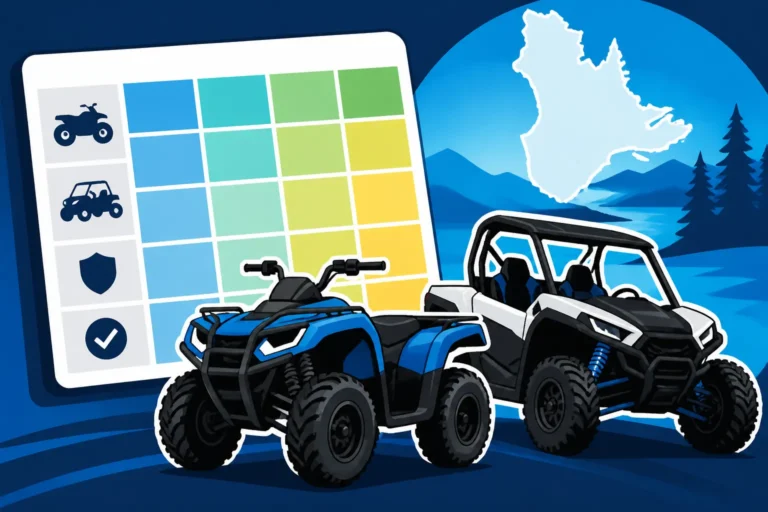
| Feature | Registered Quad on Private Land | Unregistered Quad on Private Land |
|---|---|---|
| Legality | Fully compliant | Illegal |
| SAAQ Plate | Required, issued | Not present |
| Mandatory Liability Insurance | Included ($1 Million minimum) | NONE (full personal liability) |
| Risk of Fines | Low/None | High (potential for substantial fines) |
| Risk of Seizure | Low/None | High |
| Peace of Mind | High | Low (constant worry of consequences) |
| Cost | Annual registration fee | Potentially catastrophic financial loss |
Disclaimer
This article is for general informational purposes only and does not constitute professional advice. Laws, prices and regulations vary by location and change over time. Consult a qualified professional for guidance on your specific situation.