What a Patrol Can Ask to See
It's a moment many of us have faced or worried about: you're out enjoying a beautiful day on the trails, maybe exploring some forest roads in Quebec, and suddenly, a trail patrol or police officer is signaling you to pull over. Your heart jumps, you wonder if you missed a sign, or if something is wrong with your machine. This guide is here to demystify that experience, outlining exactly what a patrol can legally ask to see from you and your off-highway vehicle (OHV) in Quebec, helping you be fully prepared and ride with confidence.
The Non-Negotiables: Essential Documents and Proof
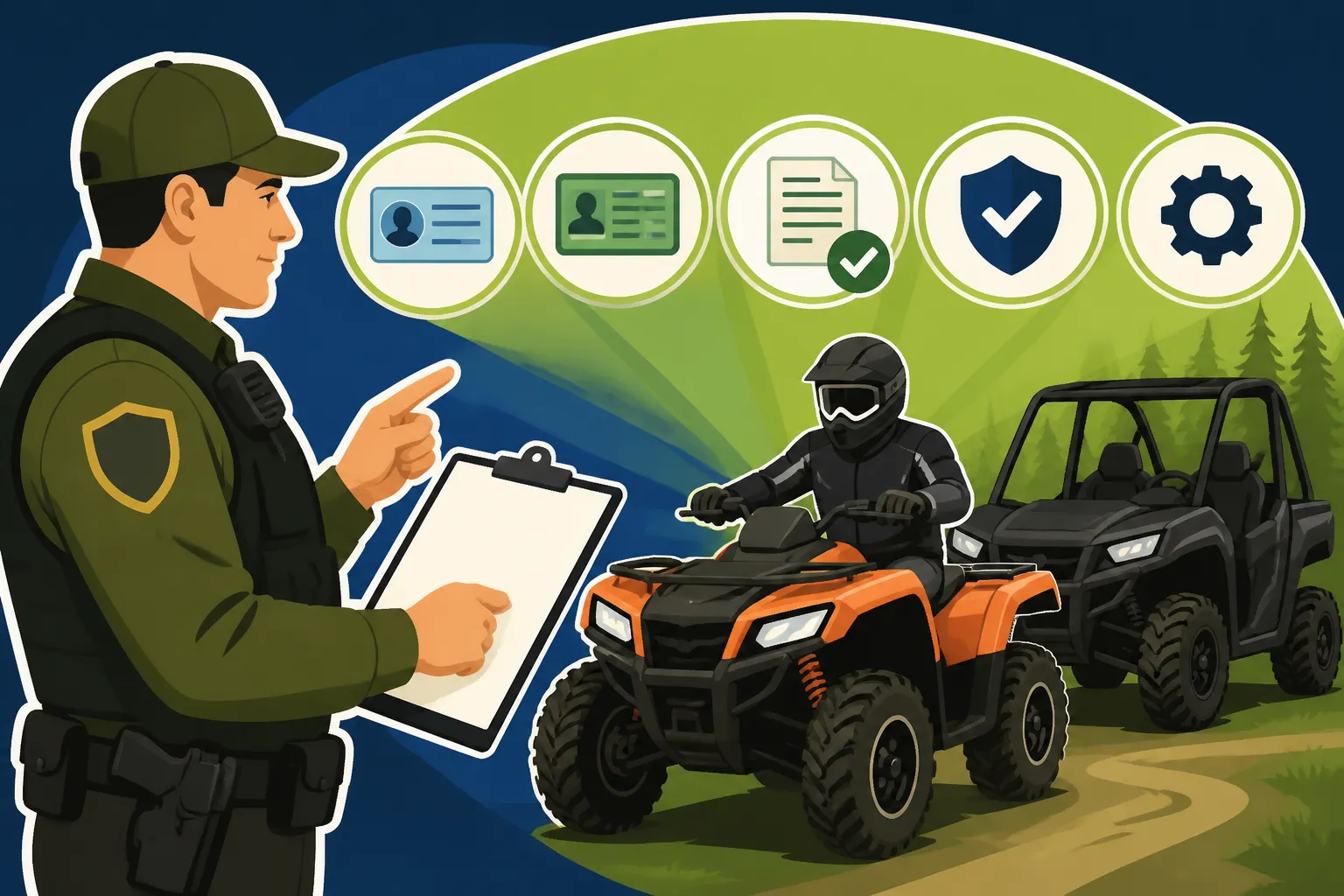
When you're stopped by a patrol, whether it's an FQCQ warden, a Sûreté du Québec officer, or a municipal police force, their primary concern is ensuring you're operating your machine legally and safely. This means they're going to ask for the foundational documents that prove you have the right to be on the trail and are adequately protected. Having these readily accessible and in order is your first line of defense against potential headaches or fines.
Your Valid Driver's Licence
First and foremost, a patrol officer will always ask for your driver's licence. In Quebec, it’s a non-negotiable requirement for operating an ATV (or VTT, as they're often called here) or a side-by-side on trails, public land, or any authorized routes. The law is quite clear: you need a valid driver's licence for any motorized vehicle. This isn't just about proving who you are; it's about demonstrating you have the legal privilege to operate a motor vehicle.
For ATVs, you generally need at least a Class 5 (passenger vehicle) licence, though a Class 6 (motorcycle) also works. However, there are age restrictions that tie into this. Riders must be at least 16 years old to operate an ATV on trails, and 18 years old for a side-by-side. If you're 16 or 17, there are additional rules, including a mandatory [Quebec FQCQ Training Certificates for Teens] which you might also be asked to produce. The patrol wants to ensure you meet these age and licensing criteria. It's not enough to just be old enough; you need the plastic card in your wallet. Always carry your physical licence, not just a photo on your phone, as that might not be accepted as official proof. This is a common point of confusion for many riders, and patrols will be vigilant in checking it. For more details on this, you can check out [Do You Need a Licence for an ATV in Quebec?].
Proof of Registration and Insurance
Next on the list, and equally critical, is proof that your machine is properly registered and insured. In Quebec, the SAAQ (Société de l'assurance automobile du Québec) handles the registration of off-highway vehicles, classifying them as VHR (Vehicules hors route). This means your ATV or side-by-side must have a valid VHR licence plate affixed to it, and you must carry the registration certificate with you. The registration certificate is your official document showing the SAAQ has recorded your machine and that its annual fees have been paid.
Along with registration, the SAAQ also ensures you have the mandatory minimum liability insurance. Since September 2021, the minimum liability insurance required in Quebec for off-highway vehicles is $1 million. This coverage is typically included when you pay your annual SAAQ registration fees. However, some riders opt for additional private insurance coverage beyond this basic SAAQ offering. If you have separate private insurance, it's a good idea to carry that policy's certificate as well, even though the SAAQ registration generally covers the mandatory minimum. A patrol will primarily be looking for the SAAQ registration certificate as proof of both registration and the baseline liability insurance. Keep these documents in a waterproof bag on your machine – getting them soggy or lost while on the trail is a real pain. Learn more about [Quebec ATV Registration With the SAAQ] and [Quebec's Liability Insurance Rule].
Your FQCQ Trail Pass
If you're riding on any of Quebec's extensive network of federated trails, which are maintained by ATV clubs under the Fédération québécoise des clubs de VTT (FQCQ), your valid trail pass is absolutely essential. These trails are private property managed by the clubs, and your pass is your permission to ride on them. Patrols from local clubs, as well as police, actively check for valid passes. Riding on a federated trail without one is trespassing and can lead to significant fines.
When you purchase an FQCQ trail pass, you receive a sticker that must be visibly affixed to your machine, typically on a front fender, so it can be easily seen by patrols. In addition to the sticker, you should also have proof of purchase, such as the confirmation email or a printed receipt, especially if you've just bought the pass and are waiting for the sticker to arrive. Patrols will check the validity of the sticker and may ask for your name to cross-reference with their system. They want to see that the pass is current for the season you're riding in, whether it's an annual pass (valid from November 1 to October 31) or a summer pass (May 1 to October 31), or even a daily or three-day pass. Don't risk riding without it; the fines for doing so can quickly make your fun day on the trails very expensive. You can find more information about [Quebec's Annual FQCQ Trail Pass] and what happens if you're caught without one in [Quebec Fines for Riding Without a Trail Pass].
Beyond the Paperwork: Your Machine and Gear
Beyond checking your personal documents, a patrol officer is also looking at the machine itself and your personal safety gear. Quebec's Off-Highway Vehicle Act (LVHR) has specific requirements designed to ensure the safety of riders and other trail users, as well as to minimize environmental impact. These checks are crucial for ensuring everyone can enjoy the trails responsibly.
Mandatory Equipment Checks
Your ATV or side-by-side isn't just about horsepower; it's about being properly equipped for the trail. A patrol can and will inspect your machine for certain mandatory items. This includes ensuring you have functional headlights and taillights, which are essential not just for night riding but also for visibility in dusty or low-light conditions. Your brake lights must also be operational.
Mirrors are another key component. Quebec law requires your OHV to have at least one rearview mirror, properly adjusted to allow you to see behind you. Don't underestimate this; it's a safety feature that prevents accidents when you're on busy trails. Moreover, patrols will often check your exhaust system. Aftermarket modifications that make your machine excessively loud are generally not allowed and can lead to fines. Quebec has noise regulations to protect residents near trails and maintain a peaceful environment for all. Make sure your muffler is in good condition and designed for your machine. They may also check for proper tire inflation, ensuring your tires are suitable for the terrain and not overly worn. All these details, from functioning lights to appropriate mufflers, contribute to a safe and respectful riding environment. For specific requirements, you might want to read [Quebec Lighting Requirements at Night] and [Quebec Mirror Requirements on a Quad].
Helmet and Safety Gear Compliance
Your helmet is arguably the single most important piece of safety gear, and Quebec law takes it very seriously. A patrol will absolutely check that you and any passengers are wearing an approved helmet. In Quebec, this means a helmet that meets recognized safety standards (like DOT, Snell, ECE, or similar) and is properly fastened. It’s not enough to just have it on your head; the chin strap must be secured.
Furthermore, helmets must be equipped with a visor, or you must wear goggles to protect your eyes. This rule is in place to prevent debris, insects, or branches from impairing your vision while riding. There are very few exceptions to the helmet rule, and they are typically specific to situations like trappers operating at very low speeds (under 30 km/h) with frequent stops. For the vast majority of recreational riders, a helmet with eye protection is mandatory. If you’re riding a side-by-side that has a factory-installed windshield, the visor/goggle requirement may be relaxed, but it’s always safest to wear eye protection. Ensure your helmet is in good condition, without major cracks or damage, as a patrol could deem a damaged helmet insufficient. To understand all the nuances, refer to [Quebec Helmet and Visor Rules].
Age and Capacity Rules
Patrols are also keenly aware of the rules concerning rider age and machine capacity, especially when minors are involved or if you have passengers. As mentioned, the minimum age to operate an ATV on trails is 16, and 18 for a side-by-side. If a patrol encounters a younger rider, they will want to know if they are riding on private land with parental supervision and authorization, which has different rules than federated trails.
When it comes to passengers, your machine must be designed by the manufacturer to carry more than one person. This means having a factory-installed seat for a passenger, not just a makeshift cushion or cargo box. Riding two-up on a single-seat ATV is illegal and dangerous. For side-by-sides, patrols will verify that all passengers are within the machine's factory-rated capacity and are using seat belts if equipped. These rules are in place to prevent injuries and ensure the machine is being used as intended by its design. A patrol can issue fines for exceeding capacity or carrying passengers improperly. Delve deeper into [Quebec Passenger Rules on an ATV] for more details.
Specific Scenarios: Additional Proof a Patrol Might Request
While the core documents and equipment checks cover most situations, there are specific scenarios where a patrol might ask for additional proof or documentation. These are often related to ownership, special use cases, or unique circumstances that require a bit more context.
Confirming Ownership of Your Machine
In some instances, a patrol might ask for proof of ownership beyond just your registration certificate. This typically happens if there's a question about the machine's origin, if the registration seems out of date, or if the machine appears to have been recently acquired. Having a bill of sale or other proof of purchase is incredibly helpful here. This document establishes a clear chain of ownership, proving that you are the rightful owner of the ATV or side-by-side.
This is especially critical if you bought your machine through a private sale. Without a clear bill of sale, proving ownership can become complicated, potentially leading to delays or even suspicion if the machine's history is unclear. If you're buying or selling privately, having a robust bill of sale is paramount. You can find reliable templates to ensure all bases are covered through services like LawDepot, making sure you have all the necessary legal documentation in order. For inherited machines, a will or a notarized letter from the estate can serve as proof. Similarly, if you've recently imported a machine, customs documents might be requested. In these trickier situations, clear documentation of ownership transfer is vital. Services like LawDepot offer templates for affidavits of ownership or bills of sale that can help create a paper trail even when the original is missing. It’s always a good practice to keep a copy of your bill of sale with your other important documents. To learn more, check out [Quebec Registration and Proof of Ownership].
Special Cases: Youth Riders, Farm, or Trapping Use
Quebec's OHV Act recognizes that some situations require different rules and, therefore, different documentation. For youth riders (specifically those aged 16-17), a patrol might ask for proof of their mandatory FQCQ safety training certificate. As mentioned, this is a requirement for them to ride on federated trails. Additionally, if a younger rider (under 16) is encountered, a patrol will be checking to see if they are on private land and if there is a [Quebec Parental Authorization Forms] present, ideally in writing, along with adult supervision. Parents of young riders, especially those 16-17, often worry about having proper written consent. Using a service like LawDepot can provide clear, legally sound templates for parental authorization forms, giving you peace of mind.
For those using ATVs or side-by-sides for specific occupational purposes, such as farming or trapping, there are certain exemptions to the OHV Act. However, these exemptions are not blanket passes; they often come with their own set of requirements. For example, a farmer using a quad on their own land, or traveling a short distance on a public road between fields, might be exempt from certain registration or helmet rules under very specific conditions. A trapper operating a machine at low speed in a designated trapping territory might have an exception to the helmet rule. In these cases, a patrol might ask for proof of your occupation (e.g., a trapping license, farm registration) to verify that you qualify for the exemption. Having these documents on hand is crucial. Having your legal ducks in a row for your quad isn't just about registration; it’s about having clear documentation for any scenario. Platforms like LawDepot can be a great resource for structuring documents like gift deeds or comprehensive bills of sale. Further details on these specific exemptions can be found in [Quebec Registration for a Farm Machine] or articles related to trapping activities.
Summary of What a Patrol May Request
To make it easier to visualize, here's a quick rundown of what you should typically be ready to present when stopped by a patrol in Quebec:
| Category | Primary Document(s) | Secondary/Situational Document(s) | Patrol Focus |
|---|---|---|---|
| Rider ID | Driver's Licence (Class 5 or 6) | FQCQ Training Certificate (for 16-17 year olds) | Age verification, legal driving privilege |
| Machine ID | SAAQ Registration Certificate | Bill of Sale, Proof of Ownership (if questions arise) | Legal registration, proof of rightful possession |
| Insurance | SAAQ Registration (covers mandatory liability) | Private insurance certificate (if additional coverage) | Mandatory $1M liability coverage |
| Trail Access | FQCQ Trail Pass (sticker on machine + proof of purchase) | Permission to ride on federated trails | |
| Safety Gear | Approved Helmet with Visor/Goggles | (Proof of specific exemption if applicable, e.g., trapper at low speed) | Head and eye protection for all riders/passengers |
| Machine Equip. | Functional Head/Tail/Brake lights, Mirror, Muffler | Roadworthiness, noise compliance | |
| Special Use | (N/A for general recreation) | Parental Authorization (for minors), Trapping License, Farm ID | Verification of specific legal exemptions |
Preparing for a ride isn't just about checking your fuel and tire pressure; it's also about making sure your paperwork is as ready as your machine. By understanding what a patrol can ask to see, you can enjoy Quebec's beautiful trails with peace of mind, knowing you're fully compliant with the law.
Disclaimer
This article is for general informational purposes only and does not constitute professional advice. Laws, prices and regulations vary by location and change over time. Consult a qualified professional for guidance on your specific situation.