Quebec Passes and the Thaw Period
Quebec Passes and the Thaw Period
A Quebec trail pass does not mean every federated trail is open whenever you want to ride. During spring thaw, clubs may close routes to protect soft, waterlogged ground, and the timing can differ from one area to another. Here’s how to plan around closures, check trail status and avoid assuming that a valid pass overrides a closed trail.
What the spring thaw means for ATV riders
Spring thaw is the period when melting snow and saturated ground make many trails especially vulnerable to damage. A surface that seems firm at first can soften quickly under an ATV or side-by-side. Tires can rut the trail, push mud into drainage areas and damage the base beneath the visible surface. The impact can last beyond the thaw itself, increasing repair work for local clubs and delaying reopening.
For riders, the practical result is that access can be restricted while the ground recovers. A trail may close even if the weather looks pleasant, the snow has disappeared, or nearby roads are dry. Conditions can vary with elevation, shade, soil, drainage and recent rain, so one part of a region may be ready for riding while another remains too soft.
This is not simply a question of whether a machine can physically get through. A quad may cross a muddy section without getting stuck and still cause damage. Avoiding a trail during a closure protects the route, supports the clubs that maintain it and reduces the chance of being stopped or cited.
A trail pass and an open trail serve different purposes:
- The pass is a requirement for riding on the federated trail network.
- The closure status determines whether a particular trail is available to ride at that time.
- A pass does not give permission to use a closed trail, bypass a barrier or take an unofficial detour.
That distinction matters because annual and seasonal passes may cover a period that includes the spring thaw. The pass may remain valid, but a section of trail can still be closed. For a broader overview of pass validity and access, see Quebec Trail Pass Start Date and Quebec Passes Cover Every Federated Club.
Closures are not necessarily the same across Quebec. Local clubs manage trails in their areas and may make decisions based on local conditions. The exact dates and routes can change from one season to another, and a closure may affect only part of a network. Check Quebec’s Spring Thaw Closure for the general issue, then confirm the status of the particular route you plan to ride.
Why a valid pass cannot override a closure
It is easy to read a pass as a season-long permission slip: buy it, put the sticker on the machine and go riding. In practice, the pass is only one part of trail access. Riders must still follow closures, signs, barriers and other applicable rules.
The pass is not a guarantee that trails will be open every day of its validity period. Clubs may close routes temporarily for thaw conditions, heavy rain, maintenance, damage, hunting activity or other local reasons. A closure may also be imposed after a route was shown as open earlier in the day. Conditions and notices can change.
A helpful way to think about it is:
| Situation | What the pass does | What the rider must do |
|---|---|---|
| Trail is open and the pass is valid | Meets the trail-pass requirement for the network | Follow posted rules and carry proof as required |
| Trail is closed for thaw | Does not create an exception to the closure | Stay off that trail until it reopens |
| One route is closed but another is open | Does not make the closed route usable | Confirm the alternate route is open and permitted |
| A closure notice is unclear | Does not settle the trail’s status | Check with the responsible club or official trail-status channel |
| A pass was bought before a closure | Does not guarantee access or a refund | Review the applicable pass policy and current information |
A closure can be shown with signs, barriers, notices or other local communications. Do not treat the absence of a physical gate as proof that the trail is open. A barrier can be missing, moved or difficult to see; the responsible club’s current status information is more useful than guessing from the trailhead.
The same goes for a route that appears passable. Do not ride around a barrier, through a rope or past a closure sign to reach an open-looking stretch. A closure may cover the trail beyond the first visible section, and bypassing a blocked point can damage nearby land or create an unsafe route.
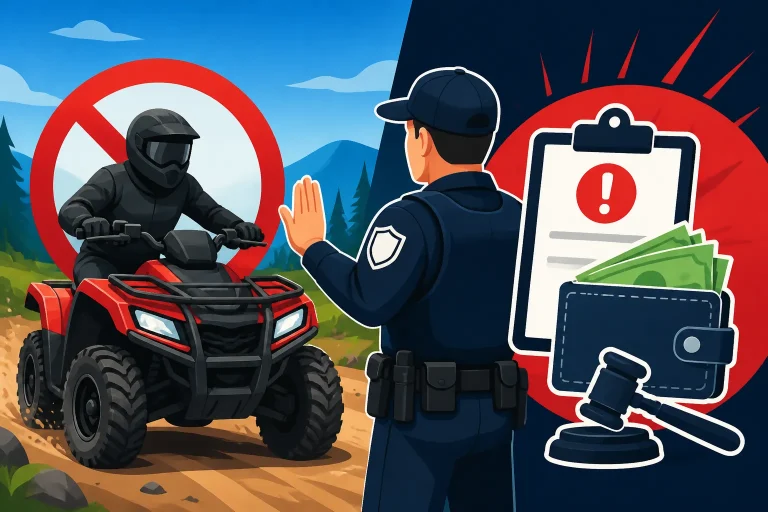
There may be financial or legal consequences for riding where access is closed or otherwise prohibited. The specific outcome can depend on the circumstances and the rules that apply. Rather than relying on a remembered fine or a post from another season, check current official information if you need to understand a particular penalty. The most straightforward way to avoid trouble is to respect the closure and choose an open route.
It is also worth separating trail access from machine registration and insurance. A valid registration, liability coverage and trail pass do not cancel a trail closure. Each addresses a different requirement. Riders unsure what documents or proof they need can review Quebec Pass Proof on the Trail and Quebec’s Liability Insurance Rule.
How to check thaw dates and trail status
There is no reliable province-wide calendar date that tells every rider when spring thaw closures begin or end. The local ground can remain soft for different lengths of time depending on weather and trail conditions. Some clubs may close routes earlier than others, and a route can reopen in stages rather than all at once.
Use current information for the specific location you intend to ride, rather than assuming that a nearby town or another club has the same schedule. A practical check includes the following:
- Identify the club or trail area responsible for your route. A regional route may cross more than one club’s territory. If it does, the status of each section matters.
- Check the latest trail-status notice before leaving. Look for closures, temporary restrictions and reopening updates, not only general seasonal information.
- Confirm the status again on the day of the ride. Weather, rain or changing ground conditions can affect access after you first planned the trip.
- Read signs and barriers at the trailhead. Local notices can provide important information that a map or older screenshot does not show.
- Ask the club if the information is unclear. If a route’s status is ambiguous, do not infer that it is open. Contact the responsible organization or choose a clearly open option.
- Keep a legal alternative in mind. If your intended trail is closed, use only another route confirmed as open and permitted for your machine.
The map is a planning aid, not always a real-time guarantee. A line shown on a map may represent a route in the network without confirming that it is currently accessible. A trail app or downloaded map can also retain outdated information if it has not been refreshed. Use maps together with current notices and on-site signs. Quebec Trail Conditions Before You Go has more on checking conditions before setting out.
For a ride that crosses several areas, do not stop checking after the first section. A route can start on an open trail and lead toward a closed segment. Verify the entire intended route, including connectors and the return leg. If a closure blocks the route, do not use private property, an unmarked path or a road as a substitute unless access is specifically authorized.
It helps to plan a ride with flexibility. Choose a shorter loop or a different trailhead as a backup, and make sure each alternative is open before using it. During thaw season, the best plan may be to delay the ride rather than attempt to salvage a trip through closed or uncertain terrain.
Pass purchases, closures and trip planning
Riders sometimes buy a pass before the spring closure period and then find that the local network is closed for longer than expected. That can be frustrating, particularly if a planned trip or holiday depends on riding. But the pass and the condition of the trails are separate: a pass can remain valid while closures prevent access to some or all of the routes you hoped to use.
Before purchasing, consider the timing and purpose of your riding. If most of your planned use falls in a period when thaw closures are possible, check the expected season information from the relevant clubs and review the pass terms. Do not assume that every route will open on a particular date simply because it did so in another year.
If you already have a pass, use the time to prepare rather than treating the closure as an invitation to seek unofficial access. You can:
- Check whether another nearby network is open and confirm the route status with that area’s club.
- Postpone the ride until the specific trails reopen.
- Use the off-season to inspect the machine, replace worn parts and plan a route for later.
- Keep current trail-status links or contact information handy for the places you ride.
- Review the pass policy if you are wondering whether a closure affects eligibility for a refund.
Refund eligibility is a separate question from whether the trail is open. Do not assume that a closure automatically qualifies for a refund, or that buying a pass means no refund can ever be considered. The terms can depend on the pass type and the applicable policy. Check Quebec Trail Pass Refund Policy for the relevant considerations and confirm current terms with the pass provider before making a decision.
A pass bought online or earlier in the season should not be treated as proof that a particular trail is open. Likewise, a confirmation receipt or sticker does not replace current status information. For a smoother trip, make sure the pass proof is available, but also check the route before loading the machine and again before entering the trail.
If you are travelling from outside the area, build extra time into the plan. A long drive to a closed trailhead is disappointing, but riding a closed trail can create a larger problem for the club and the rider. A quick status check before departure is more useful than relying on an old itinerary or a friend’s report from a previous week.
For multi-day rides, recheck conditions each morning. A route that was open on the first day may close after rain or a change in ground conditions. Do not assume that a lodging reservation, tour plan or trail pass secures access to the trail network. Any commercial operator or event organizer should be able to clarify its own plans, but riders should still follow closure information and local signs.
What to do if a trail is closed
If you encounter a closure, stop before the blocked section and follow the posted direction. Do not move, cut or go around a barrier. If the notice gives a detour, use it only if it is clearly authorized and confirmed open for your machine. A detour on a map, a worn track in the woods or a path used by another rider is not automatically an approved route.
If there is no clear detour, turn back and choose a route that is confirmed open. Avoid crossing private land or taking a road simply because it appears to connect two trail sections. Access rights and road rules are separate from trail-pass access. If a route requires road travel, check that the connection is authorized and comply with applicable rules.
When the closure is not clear, a cautious response protects both the rider and the trail:
- Stop in a safe place where you do not block other trail users.
- Read the sign or closure notice carefully.
- Check the responsible club’s current information.
- Contact the club or relevant information channel if the status remains uncertain.
- Do not continue until you have confirmation that the route is open and permitted.
If you see fresh damage, a washed-out section or a barrier that appears to have been disturbed, avoid the area and report the issue to the local club when practical. Do not attempt repairs unless you have authorization and the proper equipment. A well-intended repair can make drainage or trail damage worse.
Be considerate of other riders who may be turning around as well. Keep machines under control, avoid blocking narrow access points and communicate calmly. The closure is not a personal decision against one rider; it is a way to protect a shared route and keep it usable when the ground can support traffic again.
Reopening is not always an all-at-once event. A club may open some routes and keep others closed, depending on their condition. Follow the latest notice rather than interpreting one reopening announcement as permission to ride the entire network.
Frequently Asked Questions
Does a valid Quebec trail pass let me ride during the spring thaw?
No. A valid pass does not override a closure. You must stay off routes that are closed, even if your pass remains valid.
Are all Quebec trails closed for the same period?
No. Thaw conditions and closure timing can vary by area and club. Check current information for each part of your planned route.
Can I ride a closed trail if there is no barrier?
Do not assume it is open. A missing or unclear barrier does not replace current status information. Confirm with the responsible club or choose a route clearly marked as open.
Can I get a refund if thaw closures disrupt my plans?
Do not assume that a closure automatically qualifies for a refund. Check the terms for your pass and confirm the current policy with the provider.
Disclaimer
This article is for general informational purposes only and does not constitute professional advice. Laws, prices and regulations vary by location and change over time. Consult a qualified professional for guidance on your specific situation.